 Indietro
Membrane Structure and Function: Study Notes for General Biology
Guida di studio - Note intelligenti
 Appunti personalizzati basati sui tuoi materiali, ampliati con definizioni chiave, esempi e contesto.
Chapter 7: Membrane Structure and Function
Introduction to Cellular Membranes
The plasma membrane is a fundamental structure in all cells, acting as a boundary and regulating the movement of substances. The "fluid mosaic model" describes the membrane as a dynamic combination of lipids and proteins, with both components contributing to its function and flexibility.
Plasma membrane: The outer boundary of the cell, separating internal and external environments.
Fluid mosaic: Refers to the flexible, shifting arrangement of lipids and proteins.
Amphipathic molecules: Phospholipids have both hydrophilic (water-loving) heads and hydrophobic (water-fearing) tails.
Selective permeability: The membrane allows certain substances to pass while blocking others.
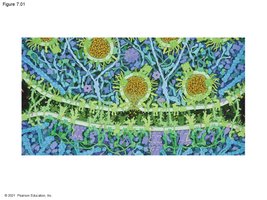
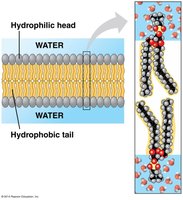
Fluid Mosaic Model: Lipids and Proteins
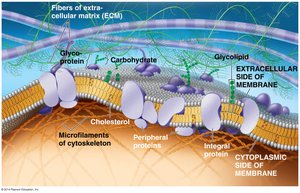
The fluid mosaic model highlights the diversity and mobility of membrane components. Proteins embedded in the lipid bilayer determine the membrane's specific functions.
Peripheral proteins: Located on one side of the bilayer; hydrophilic.
Integral proteins: Span the membrane (transmembrane); contain hydrophobic regions that interact with the lipid tails.
Distinct faces: Membranes have an inside (cytoplasmic) and outside (extracellular) face, each with unique protein and lipid compositions.
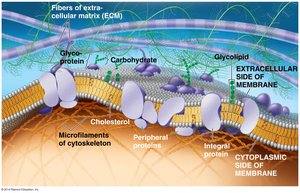
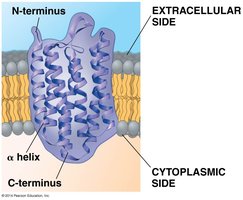
Lipid and Protein Modifications
Membrane lipids and proteins can be modified with carbohydrates, increasing structural and functional diversity.
Glycolipids: Carbohydrates covalently bound to lipids.
Glycoproteins: Carbohydrates covalently bound to proteins.
Diversity: Variations in these modifications contribute to cell recognition and signaling.
Functions of Membrane Proteins
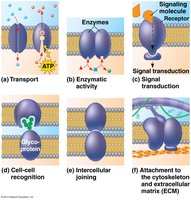
Membrane proteins perform six major functions, each essential for cellular activity and communication.
Transport: Move substances across the membrane.
Enzymatic activity: Catalyze reactions at the membrane surface.
Signal transduction: Relay signals from outside to inside the cell.
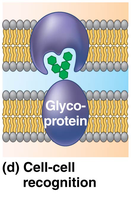
Cell-cell recognition: Identify and interact with other cells.
Intercellular joining: Connect cells together.
Attachment: Anchor the membrane to the cytoskeleton and extracellular matrix.
Cell-Cell Recognition and Glycoproteins
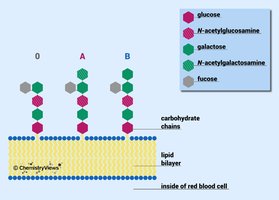
Glycoproteins on the external side of the plasma membrane serve as markers, distinguishing one cell from another. This is crucial for immune response and blood group identification.
ABO blood groups: Determined by specific carbohydrate chains on glycoproteins.
Emergent property: Cell recognition is a result of complex molecular interactions.
Selective Permeability of Membranes
Membrane structure enables selective permeability, regulating molecular traffic based on size, polarity, and charge. Large polar and charged molecules generally require assistance to cross.
Nonpolar molecules: Pass easily (e.g., O2, CO2).
Polar/charged molecules: Require transport proteins.
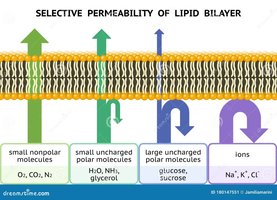
Transport Proteins: Channel and Carrier Proteins
Large polar, hydrophilic, or charged molecules cross the membrane via transport proteins. These proteins facilitate movement without energy input (passive transport).
Channel proteins: Form pores for molecules to pass through.
Carrier proteins: Change shape to move molecules across.
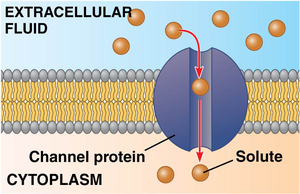
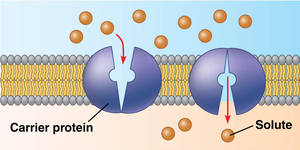
Passive Transport: Diffusion
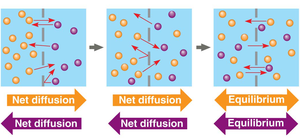
Diffusion is the passive movement of molecules from high to low concentration, reaching equilibrium. No energy or proteins are required for simple diffusion.
Concentration gradient: Drives diffusion.
Equilibrium: Achieved when concentrations are equal on both sides.
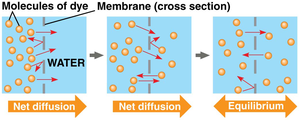
Osmosis: Passive Transport of Water
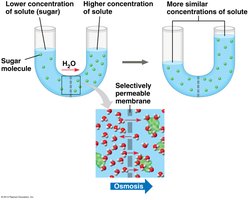
Osmosis is the diffusion of water across a selectively permeable membrane. Water moves from areas of low solute concentration to high solute concentration.
Isotonic solution: Equal solute concentration; no net water movement.
Hypertonic solution: Higher solute concentration outside; cell loses water.
Hypotonic solution: Lower solute concentration outside; cell gains water.
Facilitated Diffusion
Facilitated diffusion is a passive process requiring transmembrane proteins (channel or carrier) to move substances down their concentration gradient.
No energy required: Movement is driven by concentration gradient.
Protein involvement: Essential for large or charged molecules.
Active Transport
Active transport moves solutes against their concentration gradients, requiring energy (usually ATP) and carrier proteins. This process is essential for maintaining cellular ion concentrations.
Sodium-potassium pump: Moves Na+ out and K+ into the cell, maintaining membrane potential.
Membrane potential: Voltage difference across the membrane due to ion distribution.
Equation for membrane potential:
Additional info: The sodium-potassium pump exchanges 3 Na+ ions for 2 K+ ions, using ATP to drive the process.
Bulk Transport: Exocytosis and Endocytosis
Bulk transport moves large molecules across the membrane via vesicles, requiring energy.
Exocytosis: Vesicles fuse with the membrane to release contents outside the cell (e.g., secretion of insulin).
Endocytosis: Cell takes in macromolecules by forming vesicles from the membrane; includes phagocytosis and pinocytosis.
Application Problems: Diffusion and Osmosis
Understanding diffusion and osmosis is essential for predicting movement of water and solutes across membranes. Application problems often involve U-tube experiments with selectively permeable membranes.
Osmosis direction: Water moves toward higher solute concentration.
Solute movement: Depends on membrane permeability.
