Indietro
Membrane Structure and Function: Study Notes for General Biology
Guida di studio - Note intelligenti
 Appunti personalizzati basati sui tuoi materiali, ampliati con definizioni chiave, esempi e contesto.
Membrane Structure and Function
The Fluid Mosaic Model of the Cell Membrane
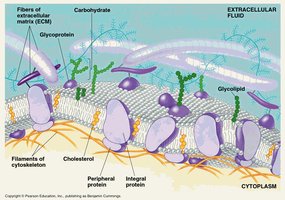
The cell membrane is described by the fluid mosaic model, which highlights its dynamic and complex structure. The membrane is composed of a phospholipid bilayer with embedded proteins, carbohydrates, and cholesterol, allowing for both structural integrity and flexibility.
Mosaic: Membrane proteins are interspersed throughout the lipid bilayer, resembling a mosaic pattern.
Fluid: Both lipids and proteins can move laterally within the layer, making the membrane flexible and self-healing.
Components: Includes phospholipids, integral and peripheral proteins, glycoproteins, glycolipids, cholesterol, and cytoskeletal elements.
Membrane Fluidity
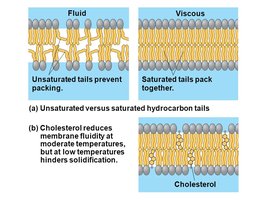
Membrane fluidity is essential for proper membrane function, affecting permeability and the movement of membrane proteins. Several factors influence fluidity:
Fatty Acid Composition: Unsaturated hydrocarbon tails prevent tight packing, increasing fluidity; saturated tails pack closely, making the membrane more viscous.
Cholesterol: Acts as a fluidity buffer, reducing fluidity at moderate temperatures but preventing solidification at low temperatures.
Selective Permeability of the Membrane
The cell membrane is selectively permeable, allowing some substances to cross more easily than others. This property is crucial for maintaining homeostasis.
Can Pass Through: Small, nonpolar, and uncharged molecules (e.g., O2, CO2).
Cannot Pass Through: Large, polar, or charged molecules (e.g., ions, glucose).
Diffusion
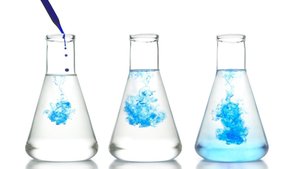
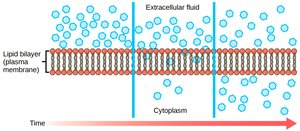
Diffusion is the passive movement of molecules from an area of high concentration to an area of low concentration, down the concentration gradient. This process continues until equilibrium is reached, where molecules still move but there is no net change in concentration.
Key Principle: No energy input is required for diffusion.
Example: Oxygen entering a cell and carbon dioxide leaving a cell.
Facilitated Diffusion
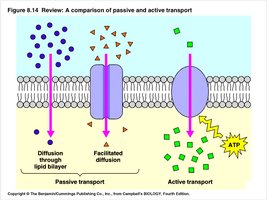
Facilitated diffusion is a type of passive transport where large, polar, or charged molecules move across the membrane through specific transmembrane protein channels. This process does not require energy because molecules move down their concentration gradient.
Transport Proteins: Channel proteins and carrier proteins facilitate the movement of substances like glucose and ions.
Example: Glucose transport into red blood cells.
Gated Ion Channels
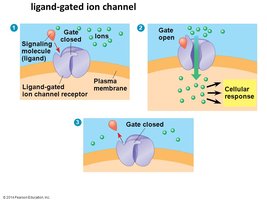
Gated ion channels are specialized facilitated diffusion channels that open or close in response to specific stimuli, such as chemical signals (ligands) or changes in electrical charge.
Function: Allow selective passage of ions like Na+, K+, or Ca2+ in response to signals.
Example: Nerve impulse transmission relies on gated ion channels.
Osmosis
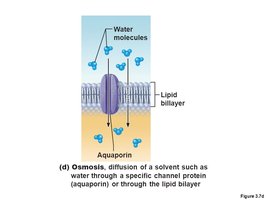
Osmosis is the diffusion of water across a selectively permeable membrane. Water moves from an area of lower solute concentration to an area of higher solute concentration.
Simple Diffusion: Water can pass directly through the lipid bilayer due to its small size.
Facilitated Diffusion: Water moves more efficiently through channel proteins called aquaporins.
Effects of Osmosis on Cells
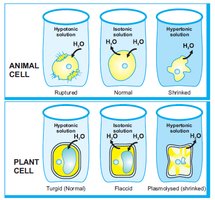
The movement of water by osmosis can cause cells to swell, shrink, or remain unchanged, depending on the surrounding solution's tonicity:
Hypertonic Solution: Higher solute concentration outside the cell; water leaves the cell, causing it to shrink.
Hypotonic Solution: Lower solute concentration outside the cell; water enters the cell, causing it to swell or burst.
Isotonic Solution: Equal solute concentration; no net water movement, cell remains stable.
Types of Membrane Transport
Transport across the membrane can be classified as passive or active:
Passive Transport: Does not require energy; includes diffusion, facilitated diffusion, and osmosis.
Active Transport: Requires energy (usually ATP) to move substances against their concentration gradient.
Bulk Transport: Endocytosis and exocytosis move large particles or volumes via vesicles.
Active Transport
Active transport moves substances against their concentration gradient, from low to high concentration, using energy from ATP and specialized pump proteins.
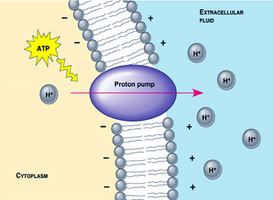
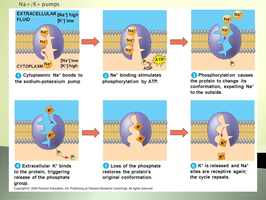
Pump Proteins: Examples include the sodium-potassium (Na+/K+) pump and proton (H+) pump.
ATP: Adenosine triphosphate provides the energy for these processes.
Ion Pumps and Membrane Potential
Ion pumps create an electrochemical gradient, or membrane potential, by moving ions across the membrane. This gradient is essential for processes such as nerve impulse transmission and muscle contraction.
Proton Pump: Moves H+ ions out of the cell, generating a positive charge outside.
Na+/K+ Pump: Moves 3 Na+ out and 2 K+ in, maintaining cell potential.
Cotransport
Cotransport involves coupling the downhill movement of one molecule with the uphill movement of another, allowing cells to efficiently use energy gradients.
Example: Sucrose-H+ cotransport in plant cells.
Endocytosis and Exocytosis
Bulk transport mechanisms move large molecules or particles into or out of the cell using vesicles:
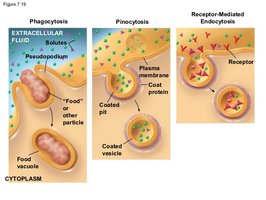
Endocytosis: The cell engulfs material by forming vesicles from the plasma membrane. Types include phagocytosis ("cell eating"), pinocytosis ("cell drinking"), and receptor-mediated endocytosis (specific uptake).
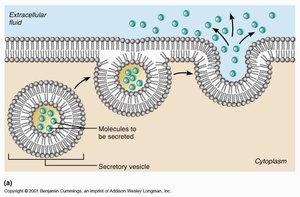
Exocytosis: Vesicles fuse with the plasma membrane to release contents outside the cell.