 Indietro
Membrane Structure and Function: Study Notes for General Biology
Guida di studio - Note intelligenti
 Appunti personalizzati basati sui tuoi materiali, ampliati con definizioni chiave, esempi e contesto.
Membrane Structure and Function
Overview of Membrane Structure
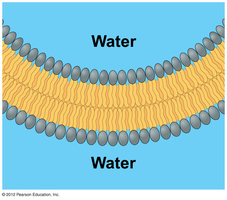
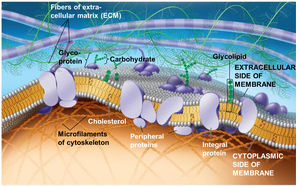
The cell membrane, also known as the plasma membrane, is a fundamental structure that separates the interior of the cell from its external environment. It is primarily composed of a phospholipid bilayer with embedded proteins, cholesterol, and carbohydrates, forming a dynamic and selectively permeable barrier.
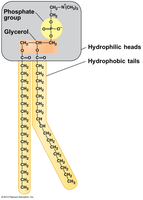
Phospholipid Bilayer: The basic structure consists of two layers of phospholipids, with hydrophilic heads facing outward and hydrophobic tails facing inward.
Fluid Mosaic Model: Describes the membrane as a mosaic of proteins floating in or attached to a fluid lipid bilayer.
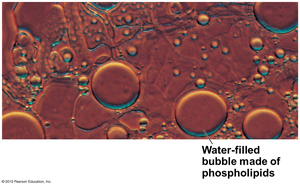
Amphipathic Nature: Phospholipids possess both hydrophilic and hydrophobic regions, allowing spontaneous formation of bilayers in aqueous environments.
Fluid Mosaic Model
The fluid mosaic model explains the dynamic nature of the membrane, where proteins and lipids move laterally within the layer, contributing to membrane fluidity and function.
Membrane Fluidity: Phospholipids move rapidly, while proteins move more slowly. Fluidity is influenced by temperature, fatty acid saturation, and cholesterol content.
Cholesterol: Reduces fluidity at high temperatures and prevents solidification at low temperatures.
Protein Mobility: Some proteins are anchored to the cytoskeleton or extracellular matrix, limiting their movement.
Membrane Proteins and Their Functions
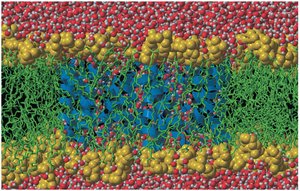
Membrane proteins are essential for various cellular processes. They are classified as integral (embedded in the bilayer) or peripheral (attached to the membrane surface).
Integral Proteins: Span the membrane and are involved in transport, signaling, and structural support.
Peripheral Proteins: Loosely attached to the membrane surface, often involved in signaling or maintaining cell shape.
Major Functions: Transport, enzymatic activity, signal transduction, cell-cell recognition, intercellular joining, and attachment to cytoskeleton/ECM.
Selective Permeability of Membranes
The cell membrane allows certain molecules to pass while restricting others, maintaining homeostasis.
Non-polar Molecules: (e.g., O2, CO2, hydrocarbons) cross easily without assistance.
Polar Molecules: (e.g., glucose, ions, water) require transport proteins to cross.
Gatekeeper Function: The phospholipid bilayer and integral proteins regulate transport.
Transport Across Membranes
Passive Transport
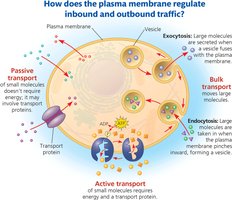
Passive transport involves the movement of molecules down their concentration gradient without energy input.
Diffusion: Movement from high to low concentration.
Facilitated Diffusion: Uses transport proteins for polar molecules; still moves down the gradient.
Osmosis: Diffusion of water across a membrane from low solute to high solute concentration.
Active Transport
Active transport requires energy (usually ATP) to move molecules against their concentration gradient.
Pumps: Such as the sodium-potassium pump, maintain membrane potential and ion gradients.
Cotransport: Uses the movement of one molecule down its gradient to drive another molecule against its gradient.
Bulk Transport
Bulk transport moves large molecules or particles via vesicles.
Exocytosis: Vesicles fuse with the membrane to release contents outside the cell.
Endocytosis: Membrane engulfs material to bring it into the cell; includes phagocytosis, pinocytosis, and receptor-mediated endocytosis.
Membrane Structure and Cell Communication
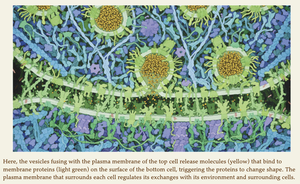
The membrane's structure enables cell communication and recognition, crucial for immune responses and tissue formation.
Glycoproteins: Serve as identification markers for cell-cell recognition (e.g., ABO blood types).
Receptors: Bind signaling molecules, triggering cellular responses.
Summary Table: Types of Membrane Transport
Type | Energy Required? | Direction | Example |
|---|---|---|---|
Passive Transport | No | Down gradient | O2 diffusion |
Facilitated Diffusion | No | Down gradient | Glucose via channel |
Osmosis | No | Water down gradient | Water movement |
Active Transport | Yes (ATP) | Against gradient | Sodium-potassium pump |
Bulk Transport | Yes (ATP) | Variable | Exocytosis, endocytosis |
Key Equations
Diffusion: No specific equation, but follows concentration gradient.
Osmosis: Water moves from low to high solute concentration.
Membrane Potential: (Ohm's Law, for electrical potential across membranes)
Additional info:
Membrane fluidity is crucial for proper function, including transport, signaling, and cell movement.
Specialized proteins (aquaporins) facilitate water transport across membranes.
Bulk transport is essential for processes such as neurotransmitter release and immune cell function.
