 Indietro
Membrane Structure and Function: Study Notes for General Biology
Guida di studio - Note intelligenti
 Appunti personalizzati basati sui tuoi materiali, ampliati con definizioni chiave, esempi e contesto.
Membrane Structure and Function
Overview of Membrane Transport
The plasma membrane regulates the movement of substances into and out of the cell, ensuring cellular homeostasis. Transport mechanisms include passive transport, active transport, and bulk transport, each suited for different types of molecules.
Passive transport: Small molecules move across the membrane without energy input, sometimes requiring transport proteins.
Active transport: Requires energy and transport proteins to move molecules against their concentration gradient.
Bulk transport: Large molecules are moved via exocytosis or endocytosis.
Fluid Mosaic Model of Membrane Structure
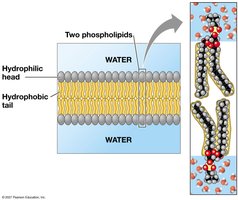
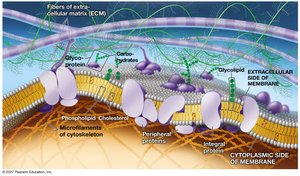
Cellular membranes are dynamic structures composed mainly of lipids and proteins, with carbohydrates playing a key role in cell recognition. The fluid mosaic model describes the membrane as a mosaic of proteins floating in a fluid bilayer of phospholipids.
Phospholipids: Amphipathic molecules with hydrophobic tails and hydrophilic heads.
Proteins: Not randomly distributed; often grouped for specific functions.
Carbohydrates: Important for cell-cell recognition.
Membrane Fluidity
Membrane fluidity is essential for proper function, affecting permeability and protein movement. Fluidity is influenced by lipid composition and temperature.
Hydrophobic interactions: Hold the membrane together, allowing lateral movement of lipids and proteins.
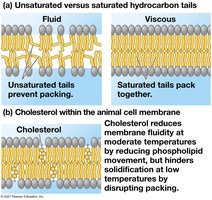
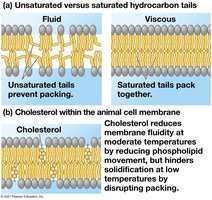
Unsaturated hydrocarbon tails: Increase fluidity by preventing tight packing.
Cholesterol: Reduces fluidity at moderate temperatures but prevents solidification at low temperatures.
Membrane Proteins and Their Functions
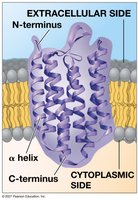
Membrane proteins are classified as peripheral or integral, with transmembrane proteins spanning the bilayer. They perform diverse functions essential for cell survival.
Peripheral proteins: Bound to the membrane surface.
Integral proteins: Penetrate the hydrophobic core; transmembrane proteins span the membrane.
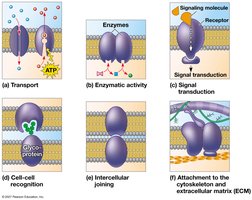
Functions: Transport, enzymatic activity, signal transduction, cell-cell recognition, intercellular joining, attachment to cytoskeleton and extracellular matrix.
Membrane Carbohydrates and Cell-Cell Recognition
Cell-surface carbohydrates, often attached to lipids (glycolipids) or proteins (glycoproteins), serve as markers for cell identification and facilitate cell-cell recognition.
Glycolipids: Carbohydrates bonded to lipids.
Glycoproteins: Carbohydrates bonded to proteins.
Diversity: Enables specific cell identification.
Selective Permeability of Membranes
The plasma membrane allows selective passage of substances, maintaining internal conditions distinct from the external environment.
Hydrophobic molecules: Pass rapidly through the lipid bilayer.
Hydrophilic molecules: Passage is impeded; may require transport proteins.
Transport Proteins
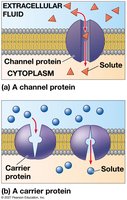
Transport proteins facilitate the movement of hydrophilic substances across the membrane. Channel proteins provide a hydrophilic tunnel, while carrier proteins change shape to shuttle molecules.
Passive Transport: Diffusion and Osmosis
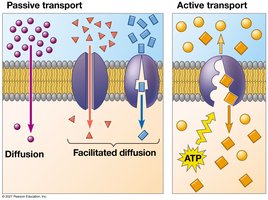
Passive transport involves the movement of substances down their concentration gradient without energy expenditure. Diffusion and osmosis are key examples.
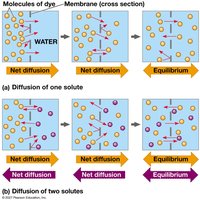
Diffusion: Movement of particles from high to low concentration until equilibrium is reached.
Osmosis: Diffusion of free water across a selectively permeable membrane, from lower to higher solute concentration.
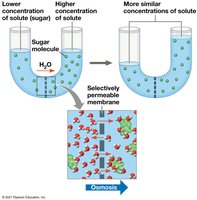
Water Balance and Tonicity
Tonicity describes the effect of a solution on cell water balance. Cells without walls are affected by the concentration of solutes that cannot cross the membrane, while plant cells rely on turgor pressure for structural integrity.
Hypotonic solution: Cell gains water; plant cells become turgid.
Hypertonic solution: Cell loses water; plant cells undergo plasmolysis.
Isotonic solution: No net water movement.
Facilitated Diffusion
Facilitated diffusion is a form of passive transport where transport proteins speed the movement of molecules across the membrane.
Channel proteins: Provide passageways for specific molecules.
Carrier proteins: Bind and transport molecules by changing shape.
Active Transport
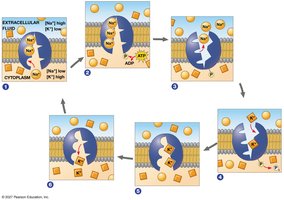
Active transport moves solutes against their concentration gradients, requiring energy (usually ATP) and specific transport proteins.
Sodium-potassium pump: Maintains membrane potential in animal cells by pumping Na+ out and K+ in.
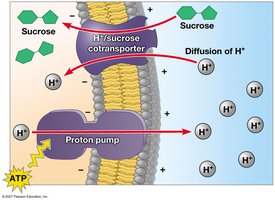
Proton pump: Main electrogenic pump in plants, fungi, and bacteria, transporting H+ ions.
Membrane Potential and Electrochemical Gradients
Membrane potential is the voltage across a membrane, created by ion distribution. The electrochemical gradient combines chemical and electrical forces, driving ion diffusion.
Electrogenic pumps: Generate voltage across membranes, storing energy for cellular work.
Cotransport: Coupled transport of two substances via a membrane protein, often driven by a concentration gradient.
Bulk Transport: Exocytosis and Endocytosis
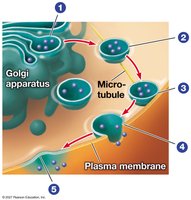
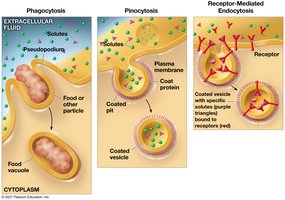
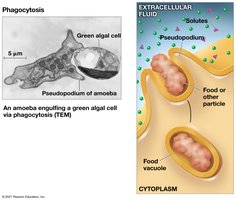
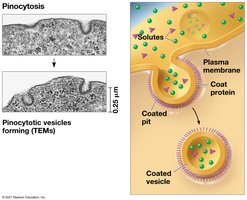
Bulk transport moves large molecules across the membrane via vesicles. Exocytosis exports materials, while endocytosis imports them.
Exocytosis: Vesicles fuse with the membrane to release contents outside the cell.
Endocytosis: Includes phagocytosis (cellular eating), pinocytosis (cellular drinking), and receptor-mediated endocytosis.
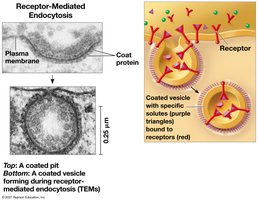
Summary Table: Types of Membrane Transport
The following table summarizes the main types of membrane transport:
Type | Energy Required | Transport Protein | Direction | Example |
|---|---|---|---|---|
Passive Diffusion | No | No | Down gradient | O2 diffusion |
Facilitated Diffusion | No | Yes | Down gradient | Glucose transport |
Active Transport | Yes (ATP) | Yes | Against gradient | Sodium-potassium pump |
Bulk Transport | Yes | No | Varies | Exocytosis, endocytosis |
Key Equations
Membrane transport often involves concentration gradients and osmotic pressure:
Osmosis: Water moves from low to high solute concentration.
Membrane potential: (where V is voltage, Q is charge, C is capacitance)
Additional info:
Organisms adapt membrane lipid composition to survive extreme temperatures.
Membrane carbohydrates are critical for immune response and tissue development.
