 Indietro
Membrane Structure and Function: Study Notes for General Biology
Guida di studio - Note intelligenti
 Appunti personalizzati basati sui tuoi materiali, ampliati con definizioni chiave, esempi e contesto.
The Membrane
Membrane Structure and Function
The plasma membrane is a critical cellular structure that regulates the movement of substances into and out of the cell. It is composed primarily of lipids, proteins, and carbohydrates, each contributing to its function and structure.
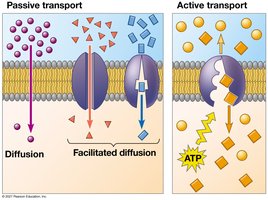
Passive Transport: Small molecules move across the membrane without energy input, sometimes requiring transport proteins.
Active Transport: Some molecules require both energy and transport proteins to cross the membrane.
Bulk Transport: Large molecules use exocytosis or endocytosis to move in and out of the cell.
Fluid Mosaic Model of Membrane Structure
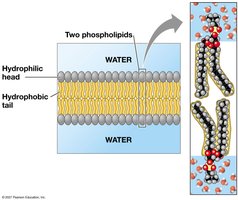
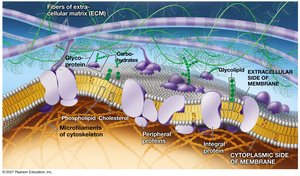
The fluid mosaic model describes the membrane as a dynamic structure with proteins embedded in a fluid bilayer of phospholipids. Proteins are organized to carry out specific functions, and carbohydrates are present for cell recognition.
Phospholipids: Amphipathic molecules with hydrophobic tails and hydrophilic heads.
Proteins: Integral and peripheral proteins are distributed non-randomly.
Carbohydrates: Important for cell-cell recognition.
Membrane Fluidity
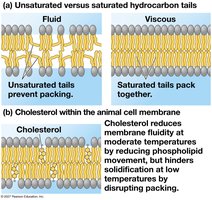
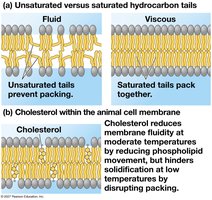
Membrane fluidity is essential for proper function, affecting permeability and protein movement. Fluidity is influenced by lipid composition and temperature.
Hydrophobic Interactions: Hold the membrane together.
Lateral Movement: Most lipids and some proteins move sideways; flip-flop is rare.
Adaptation: Organisms adjust membrane composition for extreme temperatures.
Membrane Proteins and Their Functions
Membrane proteins are classified as peripheral or integral, with transmembrane proteins spanning the membrane. Their hydrophobic regions are often α helices.
Peripheral Proteins: Bound to the membrane surface.
Integral Proteins: Penetrate the hydrophobic core.
Transmembrane Proteins: Span the entire membrane.
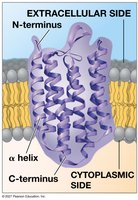
Cell-surface membrane proteins perform various functions:
Transport
Enzymatic Activity
Signal Transduction
Cell-Cell Recognition
Intercellular Joining
Attachment to Cytoskeleton and ECM
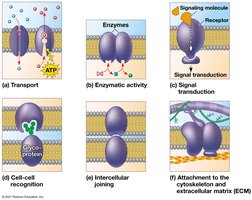
Membrane Carbohydrates and Cell-Cell Recognition
Carbohydrates attached to lipids (glycolipids) or proteins (glycoproteins) serve as markers for cell identification, enabling cells to recognize each other.
Glycolipids: Carbohydrates bonded to lipids.
Glycoproteins: Carbohydrates bonded to proteins.
Diversity: Surface carbohydrates are diverse, aiding in cell recognition.
Selective Permeability
Permeability of the Lipid Bilayer
The plasma membrane is selectively permeable, allowing some substances to cross more easily than others. Hydrophobic molecules pass rapidly, while hydrophilic molecules are impeded.
Hydrophobic Molecules: Nonpolar molecules (e.g., hydrocarbons) dissolve and cross quickly.
Hydrophilic Molecules: Polar molecules (e.g., sugars, water, ions) cross slowly or not at all.
Transport Proteins
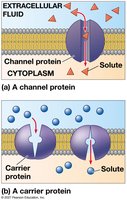
Hydrophilic substances use transport proteins to cross the membrane. Channel proteins provide a tunnel, while carrier proteins change shape to shuttle molecules.
Channel Proteins: Hydrophilic channel for specific molecules or ions.
Carrier Proteins: Bind and change shape to move molecules across.
Passive Transport
Diffusion
Diffusion is the movement of particles from high to low concentration, resulting in equilibrium. It is a passive process requiring no energy.
Dynamic Equilibrium: Equal movement in both directions.
Concentration Gradient: Drives diffusion, representing potential energy.
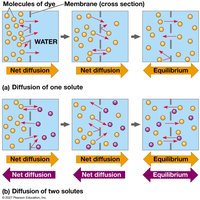
Osmosis
Osmosis is the diffusion of free water across a selectively permeable membrane. Water moves from lower to higher solute concentration until equilibrium is reached.
Free Water: Water molecules not clustered around solutes.
Direction: From low solute to high solute concentration.
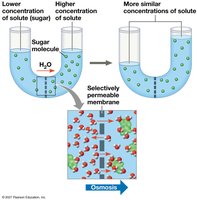
Water Balance and Tonicity
Tonicity describes a solution's ability to cause a cell to gain or lose water, depending on solute concentration relative to the cell.
Hypertonic: Higher solute concentration outside; cell loses water.
Hypotonic: Lower solute concentration outside; cell gains water.
Isotonic: Equal solute concentration; no net water movement.
Water Balance in Cells with Cell Walls
Plant, prokaryote, fungi, and some protist cells have cell walls. In hypotonic solutions, plant cells become turgid due to turgor pressure. In hypertonic environments, plasmolysis occurs, causing wilting.
Turgor Pressure: Pressure exerted by the cell wall when the cell swells.
Plasmolysis: Membrane pulls away from the wall; cell shrivels.
Facilitated Diffusion
Facilitated diffusion uses transport proteins to speed passive movement of molecules across the membrane. Channel and carrier proteins are involved.
Channel Proteins: Provide passage for specific molecules.
Carrier Proteins: Change shape to move molecules.
Active Transport
Active Transport Mechanisms
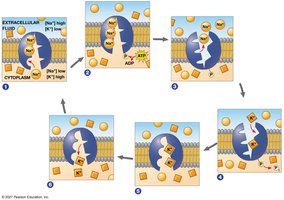
Active transport moves solutes against their concentration gradients using energy, typically from ATP. This process is essential for maintaining cellular homeostasis.
Facilitated Diffusion: Passive, down gradient, no energy required.
Active Transport: Against gradient, energy required.
Ion Pumps and Membrane Potential
Membrane potential is the voltage across a membrane, created by ion distribution. The electrochemical gradient combines chemical and electrical forces to drive ion diffusion.
Electrogenic Pump: Generates voltage across the membrane.
Sodium-Potassium Pump: Main electrogenic pump in animals.
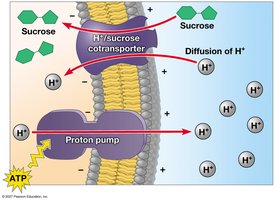
Proton Pump: Main electrogenic pump in plants, fungi, and bacteria.
Cotransport
Cotransport involves the coupled transport of two substances by a membrane protein. For example, sodium and glucose are absorbed together in the intestine, which is critical during conditions like diarrhea.
Cotransporters: Use the gradient of one molecule to drive the transport of another.
Medical Application: Oral rehydration therapy uses sodium and glucose cotransport.
Bulk Transport
Exocytosis
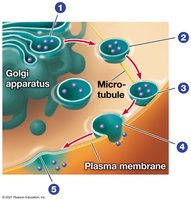
Exocytosis is the process by which cells export large molecules by fusing vesicles with the plasma membrane. Secretory cells, such as those in the pancreas, use exocytosis to release products like insulin.
Transport Vesicles: Carry molecules to the membrane.
Fusion: Vesicle merges with membrane, releasing contents.
Endocytosis
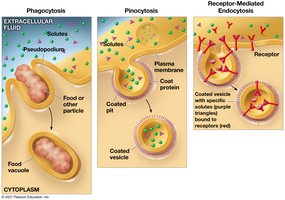
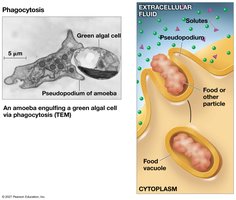
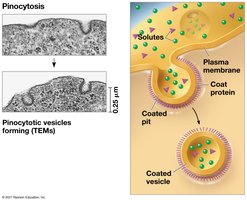
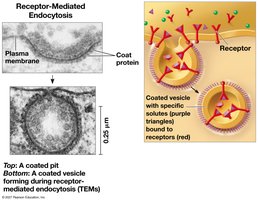
Endocytosis is the process of importing large molecules by engulfing them in vesicles. There are three types: phagocytosis, pinocytosis, and receptor-mediated endocytosis.
Phagocytosis: "Cellular eating"; cell engulfs particles.
Pinocytosis: "Cellular drinking"; cell takes in fluid.
Receptor-Mediated Endocytosis: Specific molecules are taken in after binding to receptors.
Scientific Skills Exercise
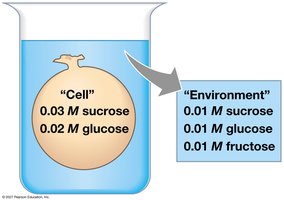
Cell in Solution
Understanding how a cell responds to its environment is crucial for predicting water and solute movement. The concentration of solutes inside and outside the cell determines the direction of osmosis and diffusion.
Example: A cell in a beaker with different concentrations of sucrose, glucose, and fructose.
Summary Table: Types of Membrane Transport
Type | Energy Required | Direction | Example |
|---|---|---|---|
Passive Transport | No | Down gradient | Diffusion, Osmosis |
Facilitated Diffusion | No | Down gradient | Channel/Carrier Proteins |
Active Transport | Yes (ATP) | Against gradient | Sodium-Potassium Pump |
Bulk Transport | Yes (ATP) | Variable | Exocytosis, Endocytosis |
Key Equations
Osmosis and Water Potential
Water potential () determines the direction of water movement:
Formula:
= solute potential
= pressure potential
Membrane Potential
The Nernst equation calculates equilibrium potential for ions:
= equilibrium potential
= gas constant
= temperature
= charge of ion
= Faraday's constant
Conclusion
The plasma membrane is a dynamic, selectively permeable structure essential for cellular function. Its composition and transport mechanisms ensure proper regulation of the internal environment, supporting life processes.
