 Indietro
Membrane Structure and Function: Study Notes for General Biology
Guida di studio - Note intelligenti
 Appunti personalizzati basati sui tuoi materiali, ampliati con definizioni chiave, esempi e contesto.
Membrane Structure and Function
Overview of Membrane Function
The plasma membrane is a dynamic structure that regulates the movement of substances into and out of the cell. It enables selective transport, maintains cellular integrity, and supports communication between cells.
Passive transport: Small molecules move across the membrane without energy input, sometimes requiring transport proteins.
Active transport: Requires energy and transport proteins to move molecules against their concentration gradients.
Bulk transport: Large molecules are moved via exocytosis or endocytosis.
Fluid Mosaic Model of Membrane Structure
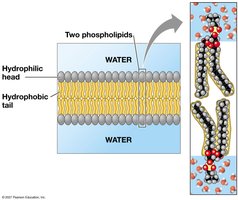
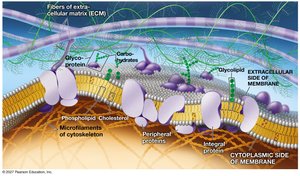
Cellular membranes are composed primarily of lipids and proteins, with carbohydrates also playing important roles. The fluid mosaic model describes the membrane as a mosaic of proteins floating in a fluid bilayer of phospholipids.
Phospholipids: Amphipathic molecules with hydrophobic tails and hydrophilic heads.
Proteins: Not randomly distributed; often grouped for specific functions.
Carbohydrates: Important for cell recognition and signaling.
Membrane Fluidity
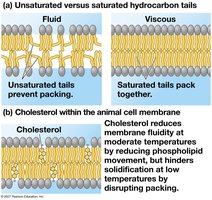
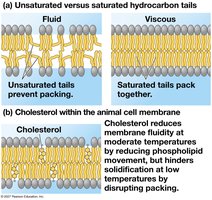
Membrane fluidity is essential for proper function, affecting permeability and protein movement. Fluidity is influenced by lipid composition and temperature.
Hydrophobic interactions: Hold the membrane together, allowing lateral movement of lipids and proteins.
Unsaturated hydrocarbon tails: Increase fluidity by preventing tight packing.
Saturated hydrocarbon tails: Decrease fluidity by allowing tight packing.
Cholesterol: Modulates fluidity; reduces movement at moderate temperatures, prevents solidification at low temperatures.
Membrane Proteins and Their Functions
Membrane proteins are crucial for transport, communication, and structural support. They are classified as peripheral or integral proteins.
Peripheral proteins: Bound to the membrane surface.
Integral proteins: Penetrate the hydrophobic core; transmembrane proteins span the entire membrane.
Hydrophobic regions: Often composed of nonpolar amino acids in α helices.
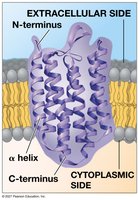
Functions of membrane proteins:
Transport
Enzymatic activity
Signal transduction
Cell-cell recognition
Intercellular joining
Attachment to cytoskeleton and extracellular matrix (ECM)
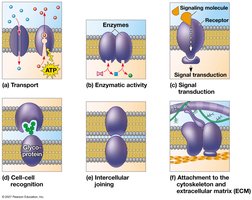
Membrane Carbohydrates and Cell-Cell Recognition
Carbohydrates attached to lipids (glycolipids) or proteins (glycoproteins) serve as markers for cell identification and facilitate cell-cell recognition.
Glycolipids: Carbohydrates bonded to lipids.
Glycoproteins: Carbohydrates bonded to proteins.
Diversity: Surface carbohydrates provide unique markers for each cell type.
Selective Permeability of Membranes
The plasma membrane allows some substances to cross more easily than others, maintaining homeostasis and regulating cellular environment.
Hydrophobic molecules: Pass through rapidly (e.g., hydrocarbons).
Hydrophilic molecules: Pass through slowly or require transport proteins (e.g., sugars, water, ions).
Transport Proteins
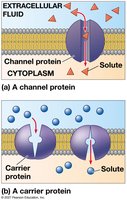
Transport proteins facilitate the movement of hydrophilic substances across the membrane.
Channel proteins: Provide hydrophilic tunnels for molecules or ions.
Carrier proteins: Bind and change shape to shuttle molecules across.
Passive Transport: Diffusion and Osmosis
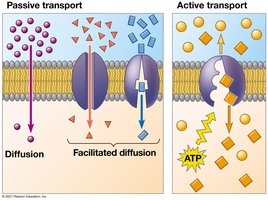
Passive transport involves the movement of substances down their concentration gradient without energy expenditure.
Diffusion: Random movement of particles leading to even distribution.
Dynamic equilibrium: Equal movement in both directions across the membrane.
Concentration gradient: Drives diffusion; represents potential energy.
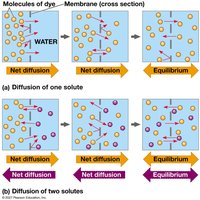
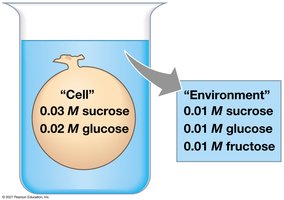
Osmosis: Diffusion of free water across a selectively permeable membrane from lower to higher solute concentration.
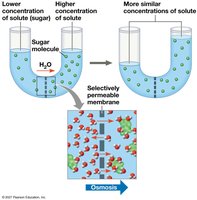
Water Balance and Tonicity
Tonicity describes the effect of a solution on cell water balance, depending on solute concentration relative to the cell.
Cells without cell walls: Water movement depends on tonicity; can cause cells to gain or lose water.
Cells with cell walls: Plant cells become turgid in hypotonic solutions (healthy state); lose water and undergo plasmolysis in hypertonic environments.
Facilitated Diffusion
Facilitated diffusion is a form of passive transport where transport proteins speed up the movement of molecules across the membrane.
Channel proteins: Allow specific molecules to pass through.
Carrier proteins: Change shape to move molecules across.
Active Transport
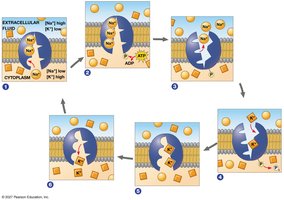
Active transport moves solutes against their concentration gradients using energy, typically from ATP.
Facilitated diffusion: Passive, down gradient, no energy required.
Active transport: Requires energy to move solutes up their gradient.
Membrane Potential and Ion Pumps
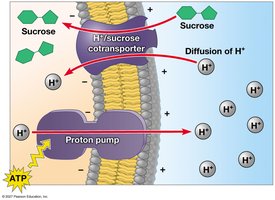
Membrane potential is the voltage across a membrane, created by ion distribution. Ion pumps maintain this potential and drive transport.
Electrochemical gradient: Combination of chemical and electrical forces driving ion diffusion.
Electrogenic pumps: Generate voltage; sodium-potassium pump in animals, proton pump in plants, fungi, and bacteria.
Bulk Transport: Exocytosis and Endocytosis
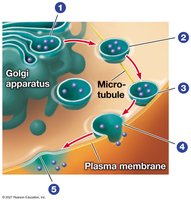
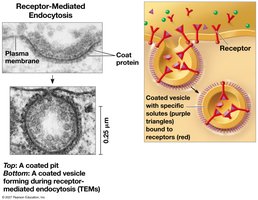
Bulk transport moves large molecules across the membrane via vesicles.
Exocytosis: Vesicles fuse with the membrane to release contents outside the cell (e.g., insulin secretion).
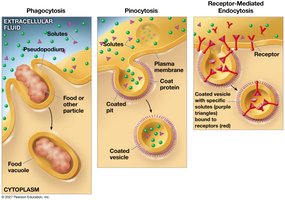
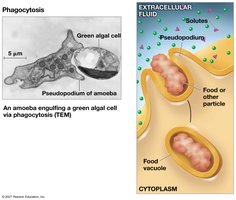
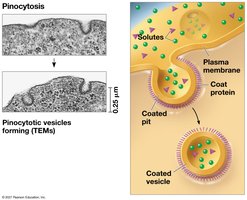
Endocytosis: Three types:
Phagocytosis: "Cellular eating" of particles.
Pinocytosis: "Cellular drinking" of fluids.
Receptor-mediated endocytosis: Specific uptake of molecules via receptors.
Test Your Understanding: Osmosis and Tonicity
Understanding the effects of solute concentration on water movement is essential for predicting cell behavior in different environments.
Summary Table: Types of Membrane Transport
Type | Energy Required | Direction | Example |
|---|---|---|---|
Passive Transport | No | Down gradient | Diffusion, Osmosis |
Facilitated Diffusion | No | Down gradient | Channel/Carrier proteins |
Active Transport | Yes (ATP) | Against gradient | Sodium-potassium pump |
Bulk Transport | Yes (ATP) | Variable | Exocytosis, Endocytosis |
Key Equations
Osmosis: Water moves from low to high solute concentration across a selectively permeable membrane.
Membrane potential: Where = voltage, = charge difference, = capacitance
Additional info:
Membrane structure and function are foundational concepts for understanding cell biology, physiology, and biochemistry.
Adaptive differences in membrane composition are crucial for organisms living in extreme environments.
