 Indietro
Membrane Structure and Function: Study Notes for General Biology
Guida di studio - Note intelligenti
 Appunti personalizzati basati sui tuoi materiali, ampliati con definizioni chiave, esempi e contesto.
Membrane Structure and Function
Overview of Cellular Membranes
Cellular membranes are essential structures that separate the cell from its environment and regulate the movement of substances in and out. They are primarily composed of lipids, proteins, and carbohydrates, each contributing to membrane function and structure.
Phospholipids are amphipathic molecules, containing both hydrophobic and hydrophilic regions.
Membrane proteins are also often amphipathic, with hydrophilic regions facing the cytosol and extracellular fluid, and hydrophobic regions embedded in the bilayer.
Carbohydrates are present as glycolipids and glycoproteins, important for cell recognition.
The Fluid Mosaic Model
The fluid mosaic model describes the membrane as a dynamic structure with proteins embedded in a fluid bilayer of phospholipids.
Proteins are not randomly distributed; they often form functional groups.
Membranes are held together by weak hydrophobic interactions, allowing lateral movement of lipids and proteins.
Rarely, lipids may flip-flop between layers.
Membrane Fluidity and Lipid Composition
Membrane fluidity is crucial for proper function and is influenced by lipid composition and temperature.
Unsaturated fatty acids increase fluidity; saturated fatty acids decrease it.
Cholesterol modulates fluidity: restrains movement at warm temperatures, prevents tight packing at cool temperatures.
Organisms adapt membrane lipid composition to environmental conditions (e.g., winter wheat increases unsaturated phospholipids in cold).
Membrane Proteins: Types and Functions
Proteins embedded in the membrane determine its specific functions. There are two main types:
Peripheral proteins: Bound to the membrane surface.
Integral proteins: Penetrate the hydrophobic core; transmembrane proteins span the membrane.
Integral proteins often have hydrophobic regions composed of nonpolar amino acids, frequently forming α helices.
Some proteins are anchored by the cytoskeleton or extracellular matrix (e.g., integrins).
Functions of Membrane Proteins
Transport
Enzymatic activity
Signal transduction
Cell-cell recognition
Intercellular joining
Attachment to cytoskeleton and extracellular matrix
Membrane Carbohydrates and Cell Recognition
Membrane carbohydrates are crucial for cell-cell recognition.
Glycolipids: Carbohydrates bonded to lipids.
Glycoproteins: Carbohydrates bonded to proteins.
Diversity of surface carbohydrates allows cells to be identified and distinguished.
Sidedness of Membranes
Membranes have distinct inside and outside faces, with asymmetrical distribution of proteins, lipids, and carbohydrates.
This sidedness is established during membrane synthesis and is important for function.
Membrane Permeability and Transport
Selective Permeability
The plasma membrane controls the exchange of materials, exhibiting selective permeability.
Hydrophobic (nonpolar) molecules (e.g., hydrocarbons, O2, CO2) pass rapidly.
Hydrophilic (polar) molecules (e.g., sugars, water, ions) pass slowly or require transport proteins.
Transport Proteins
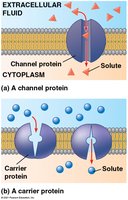
Transport proteins facilitate the movement of hydrophilic substances across the membrane.
Channel proteins: Provide hydrophilic tunnels for specific molecules or ions.
Carrier proteins: Bind to molecules and change shape to shuttle them across.
Aquaporins: Channel proteins that greatly increase water passage.
Specificity of Transport Proteins
Each transport protein moves only specific substances (e.g., glucose carrier proteins transport only glucose).
Passive Transport: Diffusion and Osmosis
Diffusion
Diffusion is the movement of particles from high to low concentration, driven by the concentration gradient.
At dynamic equilibrium, molecules cross the membrane equally in both directions.
Diffusion across a membrane is passive transport; no energy is required.
Osmosis
Osmosis is the diffusion of free water across a selectively permeable membrane.
Water moves from lower solute concentration to higher solute concentration.
Continues until solute concentrations are equal on both sides.
Tonicity and Water Balance
Tonicity describes how a solution affects cell water balance.
Isotonic: Equal solute concentration; cell volume stable.
Hypertonic: Higher solute outside; cell loses water and shrivels.
Hypotonic: Lower solute outside; cell gains water, swells, and may burst.
Osmoregulation
Organisms in extreme environments use osmoregulation to control water balance.
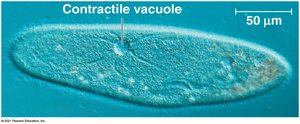
Paramecium uses a contractile vacuole to expel excess water in hypotonic environments.
Water Balance in Cells with Cell Walls
Plant cells in hypotonic solution become turgid (firm) due to turgor pressure.
In isotonic solution, plant cells become flaccid (limp).
In hypertonic solution, plant cells undergo plasmolysis (membrane pulls away from wall).
Facilitated Diffusion
Facilitated diffusion is passive transport aided by proteins.
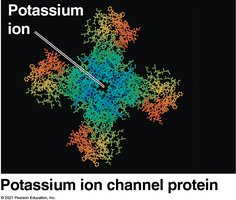
Channel proteins provide corridors for specific molecules or ions.
Aquaporins facilitate water movement.
Ion channels facilitate ion transport; some are gated and respond to stimuli.
Carrier proteins change shape to move solutes across the membrane.
Active Transport
Active transport uses energy (usually ATP) to move solutes against their concentration gradients.
All active transport proteins are carrier proteins.
Example: Sodium-potassium pump moves Na+ out and K+ into animal cells.
Phosphate group from ATP energizes the pump.
Membrane Potential and Electrochemical Gradient
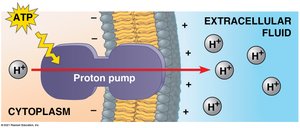
Membrane potential is the voltage across a membrane, created by ion distribution.
Electrochemical gradient combines chemical and electrical forces driving ion diffusion.
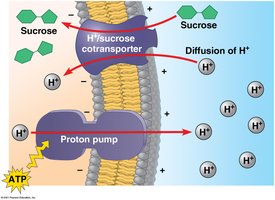
Electrogenic pumps generate voltage; main types are sodium-potassium pump (animals) and proton pump (plants, fungi, bacteria).
Cotransport
Cotransport couples the active transport of one solute with the passive transport of another.
Plant cells use proton pumps to create H+ gradients; cotransporters move sucrose into cells using the H+ gradient.
Animal cells use Na+/glucose cotransporters in the intestine.
Bulk Transport: Exocytosis and Endocytosis
Exocytosis
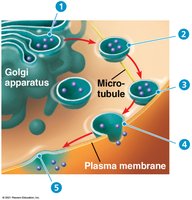
Exocytosis is the process by which cells export large molecules by vesicle fusion with the plasma membrane.
Secretory cells (e.g., pancreas) use exocytosis to release products like insulin.
Endocytosis
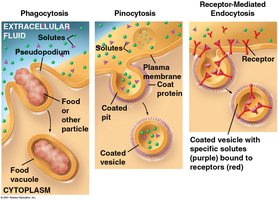
Endocytosis is the process by which cells import macromolecules by forming vesicles from the plasma membrane.
Three types: phagocytosis (cell eating), pinocytosis (cell drinking), receptor-mediated endocytosis (specific uptake).
Receptor-mediated endocytosis is used for cholesterol uptake (LDL particles).
Summary Table: Types of Membrane Transport
Type | Energy Required? | Protein Involved? | Direction | Example |
|---|---|---|---|---|
Simple Diffusion | No | No | Down gradient | O2, CO2 |
Facilitated Diffusion | No | Yes | Down gradient | Glucose, ions |
Active Transport | Yes (ATP) | Yes | Against gradient | Na+/K+ pump |
Osmosis | No | Sometimes (aquaporins) | Down water gradient | Water |
Bulk Transport (Exocytosis/Endocytosis) | Yes | No | Bulk movement | Insulin secretion, LDL uptake |
