 Indietro
Membrane Structure and Function: Study Notes for General Biology
Guida di studio - Note intelligenti
 Appunti personalizzati basati sui tuoi materiali, ampliati con definizioni chiave, esempi e contesto.
Membrane Structure and Function
Overview
The plasma membrane is a fundamental structure in all cells, responsible for regulating the movement of substances into and out of the cell. Its unique composition allows it to maintain homeostasis, communicate with other cells, and facilitate various cellular processes.
Cellular Membranes: Fluid Mosaics of Lipids and Proteins
Phospholipids and Amphipathic Molecules
Phospholipids are the main component of cell membranes. They are amphipathic, meaning they have both hydrophobic (water-fearing) tails and hydrophilic (water-loving) heads.
Other membrane constituents, such as proteins, are also often amphipathic.
Phospholipids spontaneously form a bilayer in aqueous environments, with hydrophobic tails facing inward and hydrophilic heads facing outward.
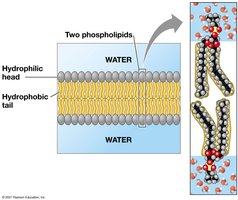
The Fluid Mosaic Model
The fluid mosaic model describes the membrane as a mosaic of proteins bobbing in a fluid bilayer of phospholipids.
Proteins are not randomly distributed; they often form functional groups.
Carbohydrates are also present, mainly on the extracellular surface, contributing to cell recognition.
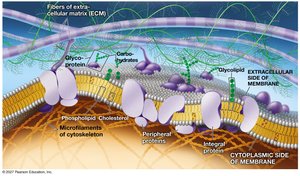
Membrane Fluidity
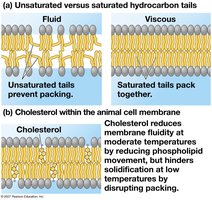
Membranes are held together by weak hydrophobic interactions, allowing lipids and some proteins to move laterally.
Fluidity is affected by temperature and lipid composition:
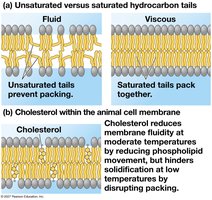
Unsaturated fatty acids increase fluidity (prevent tight packing).
Saturated fatty acids decrease fluidity (allow tight packing).
Cholesterol acts as a fluidity buffer, restraining movement at high temperatures and preventing solidification at low temperatures.
Membrane Proteins
Membrane proteins determine most of the membrane’s functions.
Two main types:
Peripheral proteins: Bound to the membrane surface.
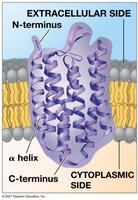
Integral proteins: Penetrate the hydrophobic core; transmembrane proteins span the membrane.
Hydrophobic regions of integral proteins are often α helices.
Functions of Membrane Proteins
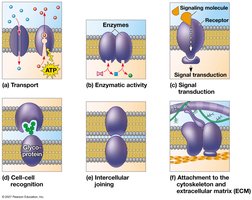
Transport
Enzymatic activity
Signal transduction
Cell-cell recognition
Intercellular joining
Attachment to the cytoskeleton and extracellular matrix (ECM)
Membrane Carbohydrates and Cell-Cell Recognition
Carbohydrates attached to lipids (glycolipids) or proteins (glycoproteins) serve as recognition markers.
The diversity of these carbohydrates allows for specific cell identification.
Synthesis and Sidedness of Membranes
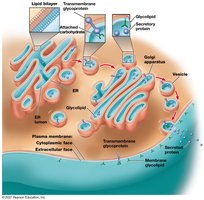
Membranes have distinct inside and outside faces due to the asymmetric distribution of proteins, lipids, and carbohydrates.
This sidedness arises during membrane synthesis in the endoplasmic reticulum and Golgi apparatus.
Membrane Structure and Selective Permeability
Selective Permeability
The plasma membrane allows some substances to cross more easily than others.
Hydrophobic (nonpolar) molecules pass through rapidly; hydrophilic (polar) molecules and ions require transport proteins.
Transport Proteins
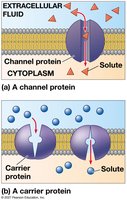
Channel proteins provide hydrophilic tunnels for specific molecules or ions.
Carrier proteins bind to molecules and change shape to shuttle them across the membrane.
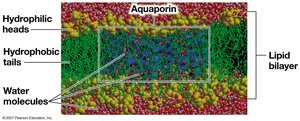
Aquaporins are channel proteins that facilitate rapid water transport.
Passive Transport: Diffusion and Osmosis
Diffusion
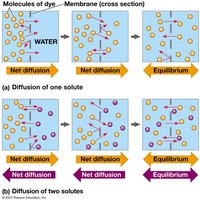
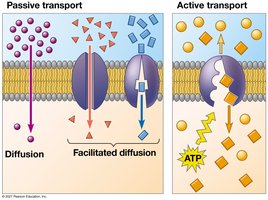
Diffusion is the movement of particles from an area of higher concentration to lower concentration (down their concentration gradient).
It is a passive process, requiring no energy input.
At equilibrium, movement continues but there is no net change in concentration.
Osmosis
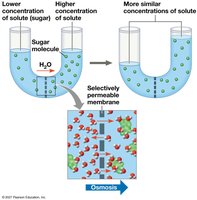
Osmosis is the diffusion of free water across a selectively permeable membrane.
Water moves from regions of lower solute concentration to higher solute concentration until equilibrium is reached.
Tonicity and Water Balance
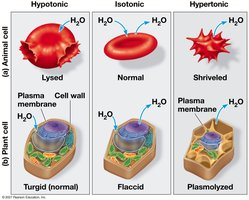
Tonicity describes the ability of a solution to cause a cell to gain or lose water.
Isotonic: Solute concentration is equal inside and outside; no net water movement.
Hypertonic: Higher solute concentration outside; cell loses water and shrivels.
Hypotonic: Lower solute concentration outside; cell gains water and may burst (lyse).
Facilitated Diffusion
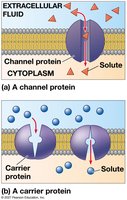
Transport proteins (channel and carrier proteins) assist the passive movement of molecules across the membrane.
Channel proteins provide corridors; carrier proteins change shape to move substances.
Facilitated diffusion does not require energy and moves substances down their concentration gradients.
Active Transport
Mechanism and Importance
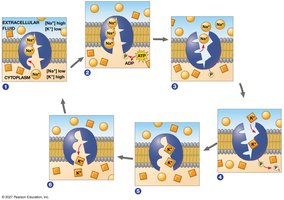
Active transport moves substances against their concentration gradients, requiring energy (usually from ATP).
All active transport proteins are carrier proteins.
Active transport allows cells to maintain internal concentrations of small molecules that differ from those in the environment.
Electrochemical Gradients and Ion Pumps
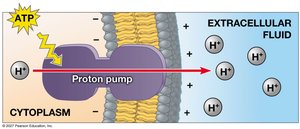
Membrane potential is the voltage across a membrane, created by differences in ion distribution.
The electrochemical gradient combines the chemical gradient (concentration) and electrical gradient (charge).
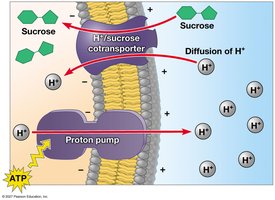
Electrogenic pumps generate voltage across membranes (e.g., sodium-potassium pump in animals, proton pump in plants, fungi, and bacteria).
Cotransport
Cotransport occurs when the active transport of one solute indirectly drives the transport of another.
For example, in plants, a proton pump creates a gradient used to drive the uptake of sucrose via a cotransporter.
Bulk Transport: Exocytosis and Endocytosis
Exocytosis
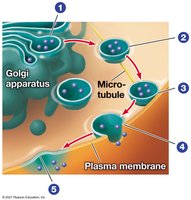
Exocytosis is the process by which cells export large molecules by fusing vesicles with the plasma membrane.
Example: Secretion of insulin by pancreatic cells.
Endocytosis
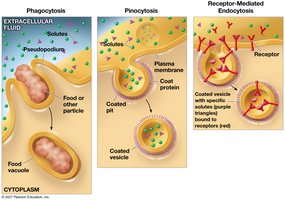
Endocytosis is the process by which cells import large molecules by engulfing them in vesicles.
Three types:
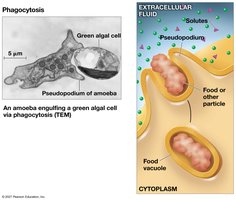
Phagocytosis (“cellular eating”): Engulfing large particles.
Pinocytosis (“cellular drinking”): Engulfing extracellular fluid and solutes.
Receptor-mediated endocytosis: Specific uptake of molecules via receptor proteins.
Summary Table: Types of Membrane Transport
Type | Energy Required? | Direction | Example |
|---|---|---|---|
Simple Diffusion | No | Down concentration gradient | O2, CO2 |
Facilitated Diffusion | No | Down concentration gradient | Glucose, ions via channels |
Active Transport | Yes (ATP) | Against concentration gradient | Na+/K+ pump |
Bulk Transport (Exocytosis/Endocytosis) | Yes | In or out (vesicles) | Secretion of proteins, uptake of cholesterol |
Additional info: This summary integrates textbook content with logical academic context to ensure completeness and clarity for exam preparation.
