 Indietro
Membrane Structure and Function: The Fluid Mosaic Model and Membrane Transport
Guida di studio - Note intelligenti
 Appunti personalizzati basati sui tuoi materiali, ampliati con definizioni chiave, esempi e contesto.
Membrane Structure and Function
The Fluid Mosaic Model
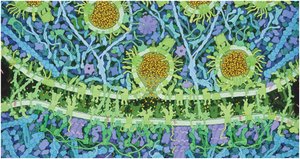
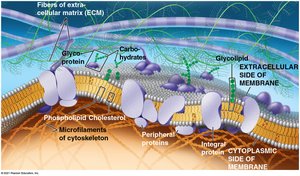
The plasma membrane is a dynamic and complex structure that separates the interior of the cell from its external environment. It is described by the fluid mosaic model, which highlights the fluid nature of the lipid bilayer and the mosaic arrangement of proteins and carbohydrates within it.
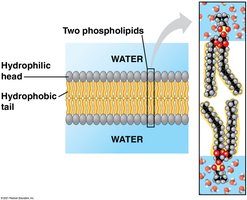
Phospholipids are the main structural components, forming a bilayer with hydrophilic heads facing outward and hydrophobic tails inward.
Proteins are interspersed throughout the membrane, serving various functions such as transport, signaling, and structural support.
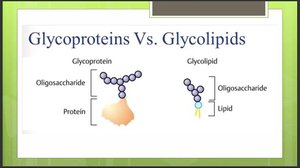
Carbohydrates are attached to proteins (glycoproteins) or lipids (glycolipids) on the extracellular surface, playing roles in cell recognition and stability.
Phospholipid Structure and Amphipathic Nature
Phospholipids are amphipathic molecules, meaning they have both hydrophilic (water-attracting) and hydrophobic (water-repelling) regions. This property drives the formation of the bilayer, which is essential for membrane function.
Hydrophilic heads interact with aqueous environments inside and outside the cell.
Hydrophobic tails face inward, away from water, creating a semi-permeable barrier.
Membrane Composition
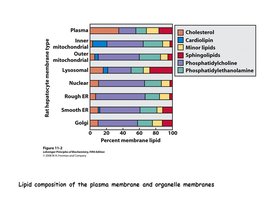
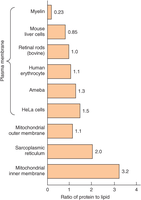
The composition of the plasma membrane varies depending on cell type and function. Lipids constitute about 50% of the membrane, but the ratio of proteins to lipids can differ significantly among membranes.
Lipid types include phospholipids, cholesterol, and glycolipids.
Protein content can equal or exceed lipid content, especially in membranes with high metabolic activity.
Membrane Fluidity
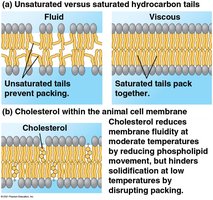
Membrane fluidity is crucial for proper function, allowing for the movement of proteins within the bilayer and the fusion of membranes during processes like vesicle transport. Fluidity is influenced by lipid composition and temperature.
Unsaturated fatty acid tails increase fluidity by preventing tight packing.
Saturated fatty acid tails decrease fluidity by allowing closer packing of phospholipids.
Cholesterol acts as a fluidity buffer, reducing movement at moderate temperatures and preventing solidification at low temperatures.
Membrane Proteins
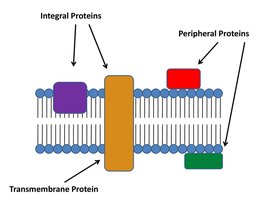
Proteins embedded in or associated with the membrane perform a wide range of functions. They can be classified as integral (transmembrane) or peripheral proteins.
Integral proteins span the membrane and are involved in transport and signaling.
Peripheral proteins are attached to the membrane surface and often play roles in signaling or maintaining cell shape.
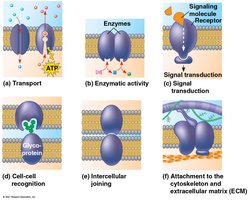
Protein functions include transport, enzymatic activity, signal transduction, cell-cell recognition, intercellular joining, and attachment to the cytoskeleton and extracellular matrix.
Membrane Carbohydrates
Carbohydrates are found on the extracellular surface of the plasma membrane, where they contribute to cell recognition and stability. They are covalently bonded to proteins (glycoproteins) or lipids (glycolipids).
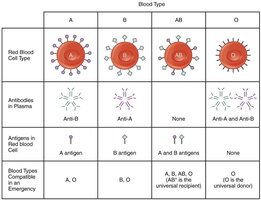
Glycoproteins and glycolipids are important for immune recognition and blood type determination.
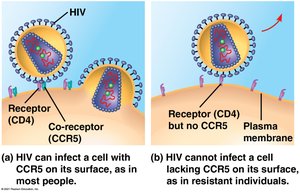
Carbohydrates also play a role in pathogen recognition, such as HIV binding to CD4 glycoproteins on host cells.
Membrane Permeability and Transport
Selective Permeability
The plasma membrane is selectively permeable, allowing some substances to cross more easily than others. This property is essential for maintaining homeostasis.
Small nonpolar molecules (e.g., O2, CO2) can diffuse freely across the membrane.
Ions and large polar molecules require transport proteins to cross the membrane.
Passive Transport
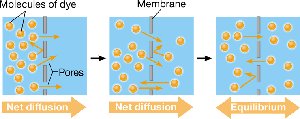
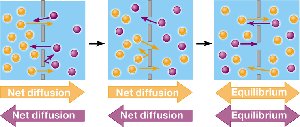
Passive transport is the movement of substances across the membrane without energy input, driven by concentration gradients.
Simple diffusion: Movement of molecules from high to low concentration.
Facilitated diffusion: Movement of molecules via channel or carrier proteins.
Osmosis: Diffusion of water across a selectively permeable membrane.
Osmosis and Tonicity
Osmosis is the passive movement of water across a membrane. Tonicity describes the ability of a surrounding solution to cause a cell to gain or lose water.
Isotonic solution: No net movement of water; cell volume remains stable.
Hypotonic solution: Water enters the cell; cell may swell and burst (lysis).
Hypertonic solution: Water leaves the cell; cell shrivels (crenation).
Active Transport
Active transport moves substances against their concentration gradients, requiring energy (usually from ATP). This process is essential for maintaining concentration differences across membranes.
Pumps such as the sodium-potassium (Na+/K+) pump maintain ion gradients crucial for nerve impulses and muscle contraction.
Proton (H+) pumps generate membrane potential used for ATP synthesis and secondary transport.
Cotransporters couple the movement of one substance down its gradient to the movement of another against its gradient.
Bulk Transport: Exocytosis and Endocytosis
Large molecules and particles are transported across the membrane via vesicles in processes called exocytosis (export) and endocytosis (import).
Phagocytosis: "Cell eating"; uptake of large particles.
Pinocytosis: "Cell drinking"; uptake of extracellular fluid.
Receptor-mediated endocytosis: Specific uptake of molecules via receptor binding.
Summary Table: Types of Membrane Transport
Transport Type | Energy Required? | Direction | Example |
|---|---|---|---|
Simple Diffusion | No | Down gradient | O2, CO2 |
Facilitated Diffusion | No | Down gradient | Glucose via carrier protein |
Osmosis | No | Down water potential gradient | Water via aquaporins |
Active Transport | Yes (ATP) | Against gradient | Na+/K+ pump |
Bulk Transport | Yes | Both | Exocytosis, Endocytosis |
Key Equations
Fick's Law of Diffusion:
$ J = -D \frac{dC}{dx} $
Where J is the rate of diffusion, D is the diffusion coefficient, and \frac{dC}{dx} is the concentration gradient.
Major Points to Remember
The plasma membrane is a fluid mosaic of lipids, proteins, and carbohydrates that confer selective permeability.
Lipid composition impacts fluidity of the plasma membrane.
Passive transport occurs spontaneously down a substance’s concentration gradient and includes diffusion, facilitated diffusion, and osmosis.
Active transport requires energy to move molecules against their concentration gradient and includes movement through protein pumps, cotransport, and bulk transport (endocytosis and exocytosis).
