 Indietro
Membrane Structure and Function: The Fluid Mosaic Model and Membrane Transport
Guida di studio - Note intelligenti
 Appunti personalizzati basati sui tuoi materiali, ampliati con definizioni chiave, esempi e contesto.
Membrane Structure and Function
Overview of the Plasma Membrane
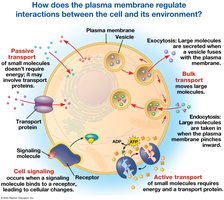
The plasma membrane is a fundamental cellular structure that separates the interior of the cell from its external environment. It regulates the movement of substances into and out of the cell, enabling communication, transport, and cellular integrity.
Selective Permeability: The membrane allows certain molecules to pass while restricting others, maintaining homeostasis.
Fluid Mosaic Model: The membrane is composed of a dynamic bilayer of phospholipids with embedded proteins, carbohydrates, and cholesterol.
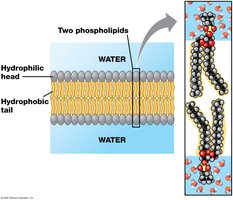
Phospholipid Structure and Bilayer Formation
Phospholipids are the most abundant lipids in cellular membranes. Their amphipathic nature (having both hydrophilic and hydrophobic regions) drives the formation of the bilayer, which serves as a stable boundary between aqueous compartments.
Hydrophilic Head: Attracted to water, faces outward toward aqueous environments.
Hydrophobic Tails: Repelled by water, face inward, shielded from water.
The Fluid Mosaic Model
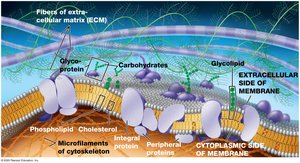
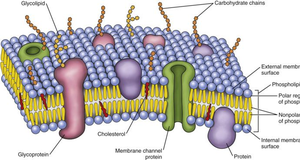
The fluid mosaic model describes the plasma membrane as a mosaic of protein molecules bobbing in a fluid bilayer of phospholipids. Both lipids and proteins can move laterally within the layer, contributing to membrane fluidity and function.
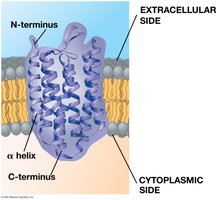
Integral Proteins: Span the membrane and are involved in transport and signaling.
Peripheral Proteins: Loosely attached to the membrane surface, often involved in signaling or maintaining cell shape.
Carbohydrates: Attached to proteins (glycoproteins) or lipids (glycolipids), play roles in cell recognition.
Membrane Fluidity
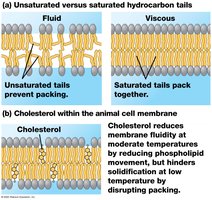
Membrane fluidity is influenced by temperature, the composition of fatty acids, and cholesterol content. Fluidity is essential for membrane function, including the movement of proteins and lipids and the fusion of membranes during vesicle formation.
Unsaturated Hydrocarbon Tails: Increase fluidity by preventing tight packing.
Saturated Hydrocarbon Tails: Decrease fluidity by allowing tight packing.
Cholesterol: Acts as a fluidity buffer, restraining movement at high temperatures and preventing solidification at low temperatures.
Membrane Proteins and Their Functions
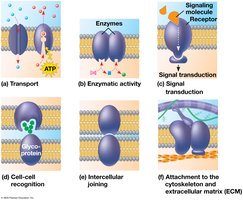
Membrane proteins are crucial for the diverse functions of the plasma membrane. They can be classified as integral or peripheral proteins, each with specific roles.
Transport: Move substances across the membrane.
Enzymatic Activity: Catalyze chemical reactions.
Signal Transduction: Relay signals from the external environment to the cell's interior.
Cell-Cell Recognition: Allow cells to identify each other.
Intercellular Joining: Connect adjacent cells.
Attachment: Anchor the membrane to the cytoskeleton and extracellular matrix.
Membrane Carbohydrates and Cell-Cell Recognition
Carbohydrates on the extracellular surface of the plasma membrane are involved in cell-cell recognition. They are covalently bonded to proteins (glycoproteins) or lipids (glycolipids) and vary among species, individuals, and cell types.
Membrane Transport Mechanisms
Selective Permeability
The plasma membrane's structure results in selective permeability, allowing some substances to cross more easily than others. Hydrophobic molecules pass through easily, while hydrophilic molecules require transport proteins.
Passive Transport: Diffusion and Facilitated Diffusion
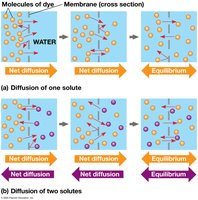
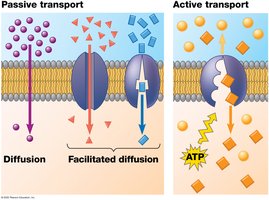
Passive transport is the movement of substances across the membrane without energy input from the cell. It includes simple diffusion and facilitated diffusion.
Diffusion: Movement of molecules from high to low concentration until equilibrium is reached.
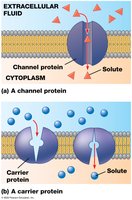
Facilitated Diffusion: Transport proteins (channel or carrier proteins) help hydrophilic substances cross the membrane.
Osmosis and Water Balance
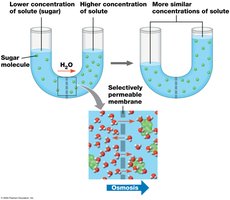
Osmosis is the diffusion of water across a selectively permeable membrane. Water moves from areas of lower solute concentration to higher solute concentration until equilibrium is achieved.
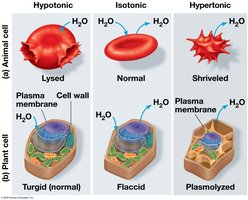
Tonicity: The ability of a solution to cause a cell to gain or lose water (isotonic, hypertonic, hypotonic).
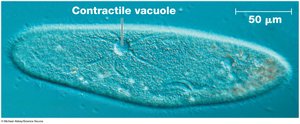
Osmoregulation: The control of water balance, crucial for cells without cell walls.
Active Transport
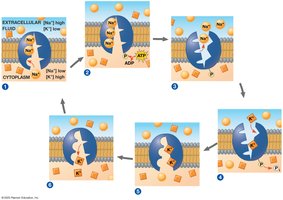
Active transport moves substances against their concentration gradients, requiring energy (usually ATP). This process allows cells to maintain internal concentrations of small molecules that differ from those in the environment.
Sodium-Potassium Pump: Exchanges Na+ for K+ across the plasma membrane of animal cells.
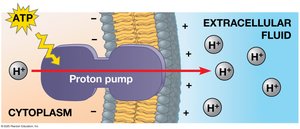
Membrane Potential: The voltage across a membrane, created by differences in ion distribution.
Electrochemical Gradient: The combined effect of the concentration gradient and membrane potential on ion movement.
Cotransport
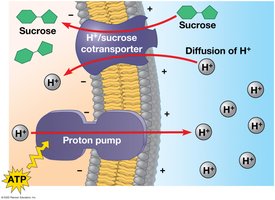
Cotransport occurs when a transport protein couples the downhill diffusion of one solute to the uphill transport of another. In plants, the proton gradient generated by proton pumps drives the active transport of nutrients.
Bulk Transport: Exocytosis and Endocytosis
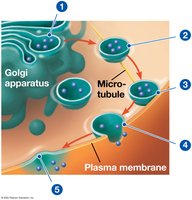
Large molecules cross the membrane in bulk via vesicles, a process that requires energy.
Exocytosis: Vesicles fuse with the plasma membrane to release contents outside the cell.
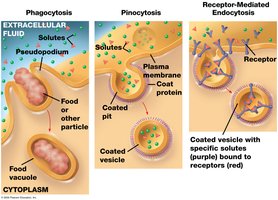
Endocytosis: The cell takes in molecules by forming vesicles from the plasma membrane. Types include phagocytosis, pinocytosis, and receptor-mediated endocytosis.
Summary Table: Types of Membrane Transport
Transport Type | Energy Required? | Direction | Example |
|---|---|---|---|
Simple Diffusion | No | Down concentration gradient | O2, CO2 |
Facilitated Diffusion | No | Down concentration gradient | Glucose, ions via channels |
Active Transport | Yes (ATP) | Against concentration gradient | Na+/K+ pump |
Osmosis | No | Water down its potential gradient | Water movement in/out of cells |
Bulk Transport (Exocytosis/Endocytosis) | Yes | Bulk movement | Secretion of hormones, uptake of cholesterol |
Additional info: The notes above integrate foundational concepts from Chapter 7: Membrane Structure and Function, including the fluid mosaic model, membrane transport mechanisms, and the physiological importance of membrane dynamics in cellular life.
