 Indietro
Membrane Structure and Function: The Fluid Mosaic Model and Membrane Transport
Guida di studio - Note intelligenti
 Appunti personalizzati basati sui tuoi materiali, ampliati con definizioni chiave, esempi e contesto.
Membrane Structure and Function
Introduction
The plasma membrane is a dynamic structure that separates the interior of the cell from its external environment. It regulates the movement of substances into and out of the cell, maintaining homeostasis and enabling communication between cells.
The Fluid Mosaic Model of Membrane Structure
Composition of Cellular Membranes
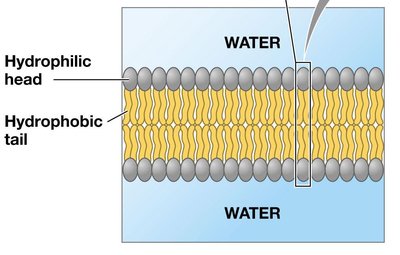
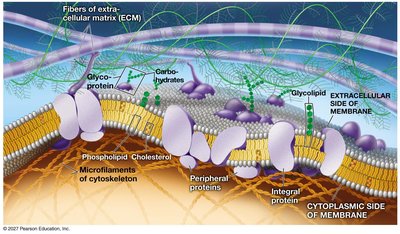
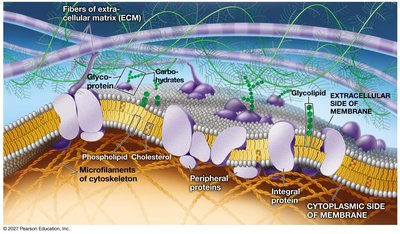
Phospholipids are the primary component, forming a bilayer with hydrophilic heads facing outward and hydrophobic tails inward.
Proteins are embedded within or associated with the bilayer, contributing to the membrane's mosaic nature.
Carbohydrates are attached to proteins (glycoproteins) or lipids (glycolipids) on the extracellular surface, playing roles in cell recognition.
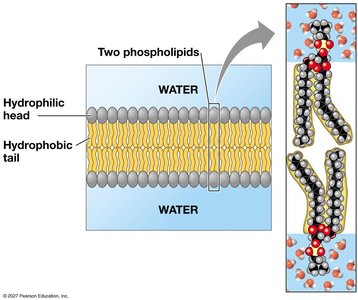
Phospholipid Arrangement and Amphipathic Nature
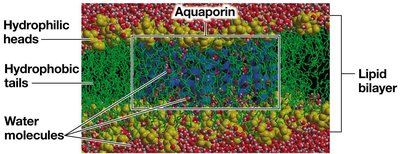
Phospholipids are amphipathic, containing both hydrophilic (water-attracting) heads and hydrophobic (water-repelling) tails.
They spontaneously form a bilayer in aqueous environments, with hydrophobic tails shielded from water.
Membrane Proteins
Membrane proteins can be integral (spanning the bilayer) or peripheral (attached to the membrane surface).
Many are amphipathic, with hydrophobic regions interacting with the bilayer interior and hydrophilic regions exposed to aqueous environments.
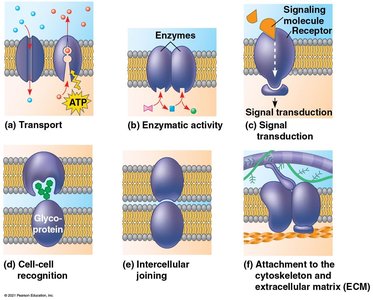
Proteins are responsible for most membrane functions, including transport, enzymatic activity, signal transduction, cell recognition, intercellular joining, and attachment to the cytoskeleton and extracellular matrix.
Membrane Fluidity
Membranes are held together by weak hydrophobic interactions, allowing lipids and some proteins to move laterally within the layer.
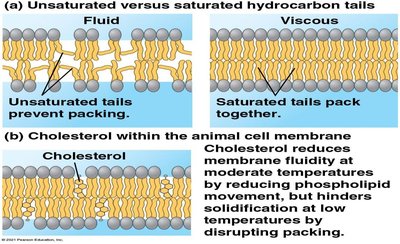
Fluidity is influenced by temperature, fatty acid composition, and cholesterol content.
Unsaturated fatty acids increase fluidity due to kinks in their tails, while saturated fatty acids decrease fluidity by allowing tight packing.
Cholesterol acts as a fluidity buffer, reducing movement at moderate temperatures but preventing solidification at low temperatures.
Membrane Asymmetry and Synthesis
Membranes are asymmetric, with distinct inside and outside faces established during synthesis in the endoplasmic reticulum (ER) and Golgi apparatus.
This asymmetry is crucial for membrane function and cell signaling.
Selective Permeability of Membranes
Principles of Selective Permeability
The plasma membrane allows some substances to cross more easily than others, based on size, polarity, and charge.
Small, nonpolar molecules (e.g., O2, CO2) cross easily; small polar molecules (e.g., H2O) cross slowly; ions and large polar molecules cannot readily cross without assistance.
Transport Proteins
Channel proteins provide hydrophilic passageways for specific molecules or ions.
Carrier proteins bind and transport specific substances across the membrane.
Transport proteins are essential for the movement of ions and polar molecules.
Passive Transport
Diffusion
Diffusion is the net movement of molecules from an area of higher concentration to an area of lower concentration (down the concentration gradient).
It requires no energy input and continues until dynamic equilibrium is reached.
Facilitated Diffusion
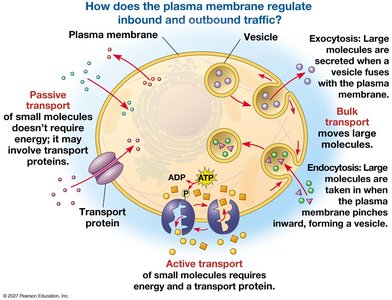
Facilitated diffusion uses transport proteins to move substances down their concentration gradient without energy input.
Examples include the movement of ions through channel proteins and glucose via carrier proteins.
Osmosis
Osmosis is the diffusion of water across a selectively permeable membrane.
Water moves from areas of lower solute concentration to higher solute concentration until equilibrium is achieved.
Tonicity describes the ability of a solution to cause a cell to gain or lose water (isotonic, hypotonic, hypertonic).
Active Transport
Mechanisms of Active Transport
Active transport moves substances against their concentration gradients (from low to high concentration), requiring energy (usually from ATP).
Transport proteins called pumps are involved in active transport.
The Sodium-Potassium Pump
The sodium-potassium pump (Na+/K+ pump) moves 3 Na+ ions out of the cell and 2 K+ ions into the cell per ATP hydrolyzed, maintaining electrochemical gradients essential for cell function.
Electrochemical Gradients and Cotransport
Active transport creates electrochemical gradients, which store potential energy.
Cotransport uses the energy stored in one gradient to drive the transport of another substance against its gradient.
Bulk Transport: Exocytosis and Endocytosis
Exocytosis
Exocytosis is the process by which large molecules are exported from the cell via vesicles that fuse with the plasma membrane.
Examples include the secretion of hormones, neurotransmitters, and digestive enzymes.
Endocytosis
Endocytosis is the process by which cells take in large molecules by engulfing them in vesicles formed from the plasma membrane.
Three types: phagocytosis (cell eating), pinocytosis (cell drinking), and receptor-mediated endocytosis (specific uptake).
Membrane Carbohydrates and Cell Recognition
Role of Membrane Carbohydrates
Short, branched carbohydrate chains on the membrane surface serve as cell-identification markers.
They are crucial for cell-cell recognition, immune response, and tissue organization.
Example: HIV and Cell-Surface Proteins
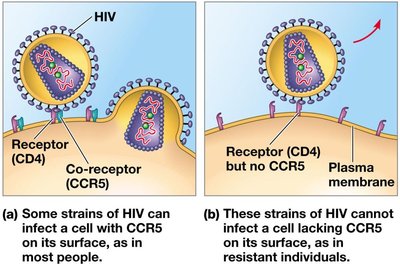
HIV binds to CD4 and a co-receptor (often CCR5) to enter target cells.
Individuals lacking CCR5 are resistant to certain strains of HIV, making CCR5 a target for prevention and treatment.
Summary Table: Membrane Transport Mechanisms
Transport Type | Energy Required? | Direction Relative to Gradient | Transport Protein Involved? | Examples |
|---|---|---|---|---|
Simple Diffusion | No | Down | No | O2, CO2 |
Facilitated Diffusion | No | Down | Yes | Glucose, ions |
Osmosis | No | Down | Sometimes (aquaporins) | Water |
Active Transport | Yes (ATP or gradient) | Against | Yes | Na+/K+ pump |
Bulk Transport (Exocytosis/Endocytosis) | Yes | Either | No (uses vesicles) | Proteins, polysaccharides |
Key Equations
ATP Hydrolysis (energy for active transport):
Dynamic Equilibrium (diffusion): (when concentrations are equal)
Additional info:
Membrane structure and function are foundational to understanding cell biology, physiology, and many biomedical applications.
Disruptions in membrane transport can lead to diseases such as cystic fibrosis, diabetes, and neurological disorders.
