 Indietro
Membrane Structure and Transport: Lipids, Diffusion, and Membrane Proteins
Guida di studio - Note intelligenti
 Appunti personalizzati basati sui tuoi materiali, ampliati con definizioni chiave, esempi e contesto.
Membrane Structure and Function
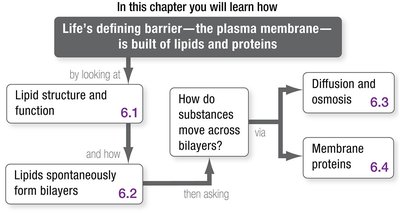
Overview of the Plasma Membrane
The plasma membrane is a fundamental cellular structure composed primarily of lipids and proteins. It acts as a selective barrier, regulating the movement of substances into and out of the cell.
Lipids form the basic structural framework of the membrane.
Proteins are embedded within or attached to the lipid bilayer, facilitating transport and communication.
The membrane's selective permeability is essential for maintaining cellular homeostasis.
Diffusion and Osmosis
Diffusion Across Membranes
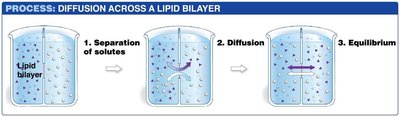
Diffusion is the spontaneous movement of molecules from regions of high concentration to regions of low concentration, driven by a concentration gradient.
Passive transport does not require energy input.
Equilibrium is reached when concentrations are equal on both sides of the membrane.
Diffusion is exergonic (spontaneous).
Osmosis: Diffusion of Water
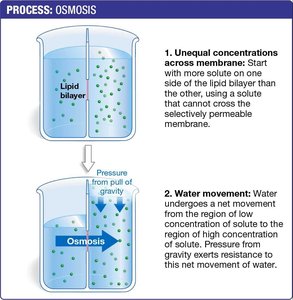
Osmosis is the movement of water across a selectively permeable membrane, from areas of low solute concentration to areas of high solute concentration.
Water moves to balance solute concentrations.
Osmosis can change the volume of cells, depending on the external environment.
Tonicity and Cell Volume
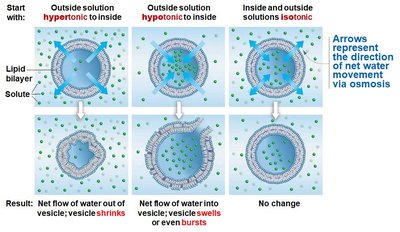
Tonicity describes the effect of a solution on cell volume, based on osmotic movement of water.
Hypertonic solutions cause cells to shrink (water leaves the cell).
Hypotonic solutions cause cells to swell or burst (water enters the cell).
Isotonic solutions result in no net change in cell volume.
Lipid Bilayer and Selective Permeability
Selective Permeability of Lipid Bilayers
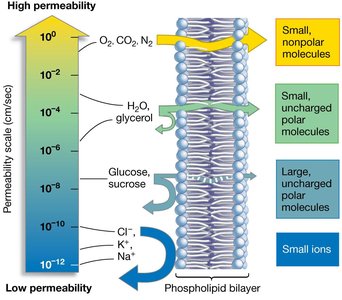
The lipid bilayer restricts the movement of hydrophilic molecules and ions, allowing selective permeability based on size and charge.
Small, nonpolar molecules (e.g., O2, CO2) pass easily.
Small, uncharged polar molecules (e.g., H2O, glycerol) pass less readily.
Large, uncharged polar molecules and ions (e.g., glucose, Na+) are largely excluded.
Membrane Proteins and the Fluid Mosaic Model
Fluid Mosaic Model
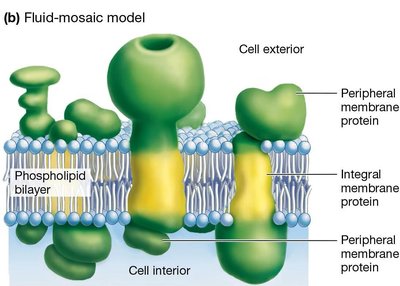
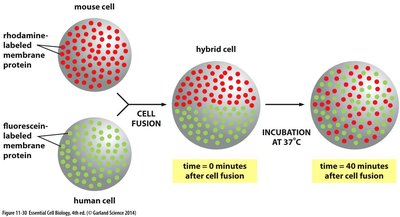
The fluid mosaic model describes the dynamic nature of the plasma membrane, where proteins move laterally within the lipid bilayer.
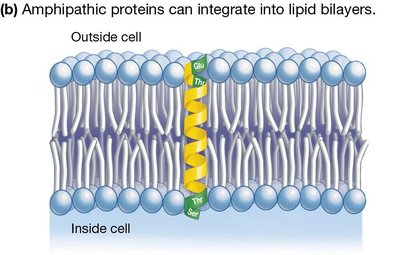
Integral membrane proteins span the bilayer and are amphipathic.
Peripheral membrane proteins are attached to the membrane surface.
The membrane is flexible and proteins can diffuse within it.
Amphipathic Nature of Membrane Proteins
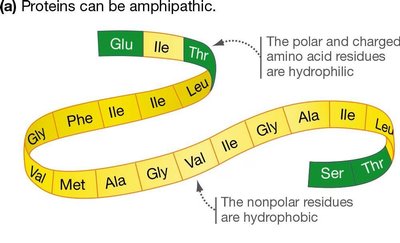
Amphipathic proteins contain both hydrophilic and hydrophobic regions, allowing them to integrate into the lipid bilayer.
Hydrophilic regions interact with aqueous environments.
Hydrophobic regions interact with the lipid core.
Membrane Transport Proteins
Channel Proteins and Pores
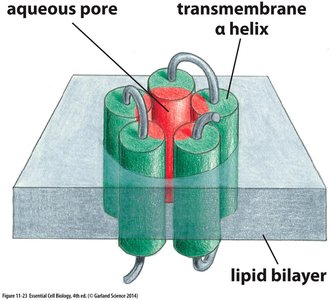
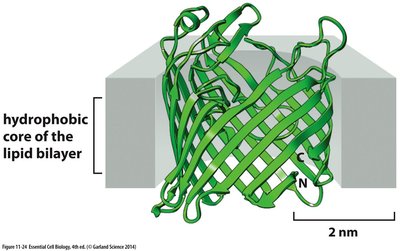
Membrane proteins can form channels or pores, allowing selective passage of specific molecules or ions.
Channels are highly selective and often gated.
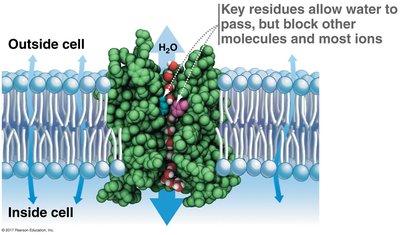
Aquaporins are water channel proteins.
Gated Ion Channels
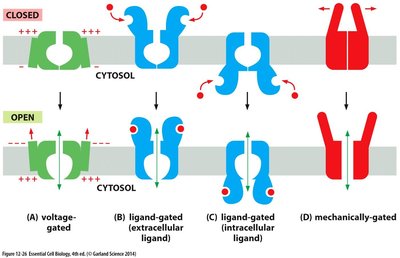
Gated channels open or close in response to specific signals, such as voltage changes or ligand binding.
Voltage-gated channels respond to changes in membrane potential.
Ligand-gated channels respond to binding of specific molecules.
Mechanically-gated channels respond to physical deformation.
Electrochemical Gradients
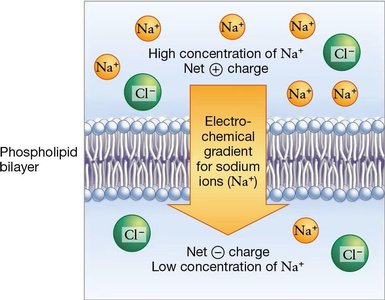
An electrochemical gradient combines differences in solute concentration and electrical charge across the membrane, driving ion movement.
Membrane potential is typically negative inside cells.
Ion concentrations differ between intracellular and extracellular environments.
Facilitated Diffusion via Carrier Proteins
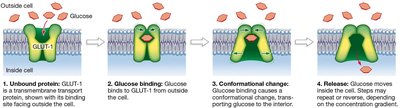
Carrier proteins facilitate diffusion by undergoing conformational changes to transport solutes across the membrane.
Transport occurs along the concentration gradient.
Carrier proteins are selective for specific molecules.
Active and Passive Transport
Passive vs. Active Transport
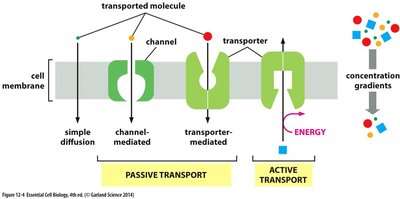
Molecules can be transported across membranes by passive (no energy required) or active (energy required) mechanisms.
Passive transport: simple diffusion, channel-mediated, transporter-mediated.
Active transport: requires energy, moves solutes against their concentration gradient.
Primary Active Transport: Sodium-Potassium Pump
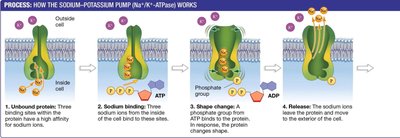
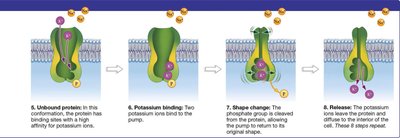
The sodium-potassium pump (Na+/K+ ATPase) uses ATP to move sodium and potassium ions against their gradients.
Three sodium ions are pumped out, two potassium ions are pumped in per ATP hydrolyzed.
This maintains the electrochemical gradient essential for cell function.
Secondary Active Transport: Cotransporters
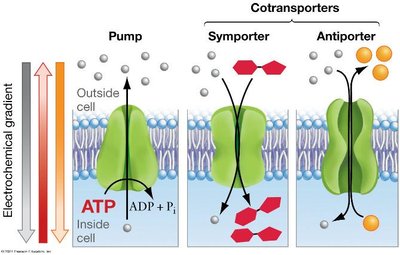
Secondary active transport uses the energy stored in electrochemical gradients to move other solutes.
Symport: both solutes move in the same direction.
Antiport: solutes move in opposite directions.
Examples include sodium-glucose symporter and proton-sucrose cotransport in plants.
Summary Table: Types of Membrane Transport
Transport Type | Energy Required? | Direction | Example |
|---|---|---|---|
Simple Diffusion | No | Down gradient | O2, CO2 |
Facilitated Diffusion | No | Down gradient | Glucose via GLUT1 |
Channel-mediated | No | Down gradient | Aquaporin, ion channels |
Primary Active Transport | Yes (ATP) | Against gradient | Na+/K+ pump |
Secondary Active Transport | Yes (gradient) | Against gradient | Na+/Glucose symporter |
Key Equations
ATP Hydrolysis (for Active Transport)
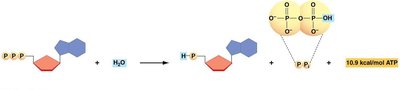
ATP hydrolysis releases energy for primary active transport:
Conclusion
Understanding the structure and function of the plasma membrane, as well as the mechanisms of transport across it, is essential for comprehending cellular physiology. The interplay between lipids, proteins, and transport processes ensures that cells maintain homeostasis and respond to their environment.
