 Indietro
Membrane Transport and Bulk Transport in Cells
Guida di studio - Note intelligenti
 Appunti personalizzati basati sui tuoi materiali, ampliati con definizioni chiave, esempi e contesto.
Membrane Transport and Cell Signaling
Passive and Active Transport
The cell membrane regulates the movement of substances into and out of the cell. Transport mechanisms are classified as passive or active based on energy requirements and direction relative to concentration gradients.
Passive Transport: Movement of substances down their concentration gradient (from high to low concentration) without energy input. Examples include diffusion and facilitated diffusion.
Active Transport: Movement of substances against their concentration gradient (from low to high concentration), requiring energy, usually in the form of ATP. Examples include proton pumps and sodium-potassium pumps.
Concentration Gradient: The difference in concentration of a substance across a membrane.
ATP (Adenosine Triphosphate): The primary energy carrier in cells, used to drive active transport.
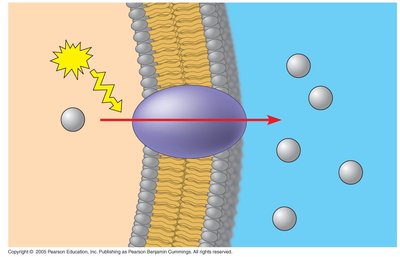
Proton Pumps and Cotransport
Proton pumps are membrane proteins that use ATP to move protons (H+) across the membrane, creating an electrochemical gradient. This gradient can be used to drive the transport of other substances via cotransporters.
Cotransport: A mechanism where the movement of one substance down its gradient provides energy for the transport of another substance against its gradient. For example, the H+/sucrose cotransporter uses the proton gradient to import sucrose into the cell.
Example: In plant cells, proton pumps establish a gradient that enables the uptake of sucrose through cotransport.
Bulk Transport: Exocytosis and Endocytosis
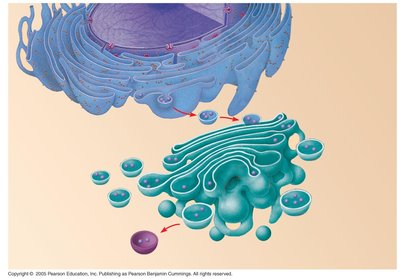
Bulk transport involves the movement of large molecules or particles via vesicles. This process is essential for the transport of proteins, polysaccharides, and even whole cells.
Exocytosis: Vesicles containing substances fuse with the plasma membrane, releasing their contents outside the cell. This is a common mechanism for protein secretion.
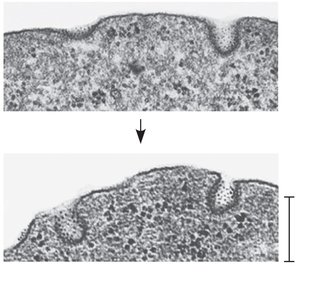
Endocytosis: The plasma membrane folds inward to form a vesicle, bringing substances into the cell. Types include phagocytosis (cell eating), pinocytosis (cell drinking), and receptor-mediated endocytosis (specific uptake of molecules).
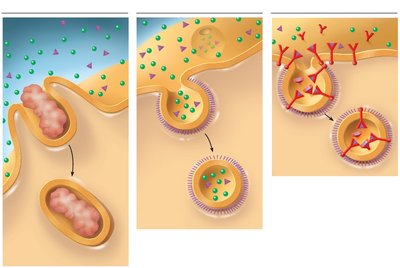
Types of Endocytosis
Endocytosis is subdivided based on the nature of the material taken in and the mechanism:
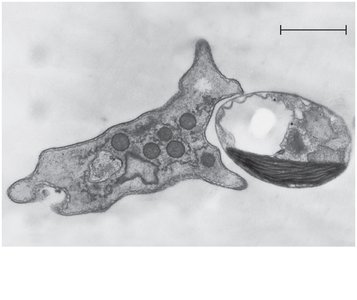
Phagocytosis: The cell engulfs large particles or cells, forming a phagosome. This is typical in immune cells like macrophages.
Pinocytosis: The cell takes in extracellular fluid and dissolved solutes via small vesicles.
Receptor-Mediated Endocytosis: Specific molecules bind to receptors on the cell surface, triggering vesicle formation. This allows selective uptake of substances such as cholesterol.
Type | Main Function | Example |
|---|---|---|
Phagocytosis | Uptake of large particles | Bacteria engulfed by white blood cell |
Pinocytosis | Uptake of fluid and solutes | Absorption of nutrients by intestinal cells |
Receptor-Mediated Endocytosis | Selective uptake of molecules | Cholesterol uptake via LDL receptors |
Summary Table: Membrane Transport Mechanisms
Transport Type | Energy Required? | Direction | Example |
|---|---|---|---|
Passive Transport | No | Down gradient | O2 diffusion |
Active Transport | Yes (ATP) | Against gradient | Na+/K+ pump |
Cotransport | Indirect (uses gradient) | Varies | H+/sucrose cotransport |
Bulk Transport | Yes (vesicle formation) | Varies | Exocytosis, endocytosis |
Key Equations
Membrane potential and transport can be described mathematically:
Nernst Equation: Used to calculate equilibrium potential for ions across a membrane.
ATP Hydrolysis: Energy released by ATP hydrolysis drives active transport.
Additional info: The notes above expand on the original content by providing definitions, examples, and context for each transport mechanism, as well as relevant equations and tables for comparison.
