 Indietro
Membrane Transport and Introduction to Metabolism: Study Notes for General Biology
Guida di studio - Note intelligenti
 Appunti personalizzati basati sui tuoi materiali, ampliati con definizioni chiave, esempi e contesto.
Membrane Transport
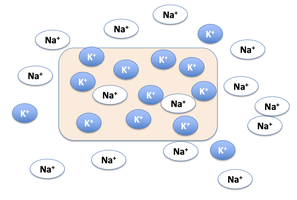
Ion Concentration in Animal Cells
Animal cells maintain a higher concentration of potassium ions (K+) and a lower concentration of sodium ions (Na+) inside the cell compared to their surroundings. This difference is essential for various cellular functions, including nerve impulse transmission and muscle contraction.
Key Point: The cell membrane is selectively permeable, allowing specific ions to be transported in and out.
Key Point: The sodium-potassium pump is responsible for maintaining these ion gradients.
Example: Nerve cells use these gradients to generate action potentials.
Active Transport
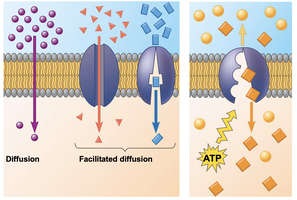
Active transport is a cellular process that moves substances against their concentration gradients, requiring energy input, usually from ATP.
Key Point: ATP-powered carrier proteins, such as the sodium-potassium pump, facilitate active transport.
Key Point: Active transport is essential for maintaining cellular homeostasis.
Sodium-Potassium Pump Mechanism
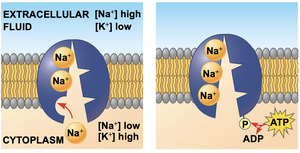
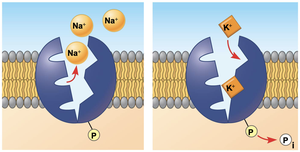
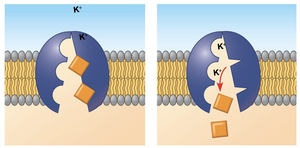
The sodium-potassium pump (Na+/K+ ATPase) is a membrane protein that exchanges three Na+ ions out of the cell for two K+ ions into the cell, using ATP.
Step 1: Loading of Na+ ions and phosphorylation by ATP causes a conformational change.
Step 2: Release of Na+ ions outside the cell, loading of K+ ions, and loss of phosphorylation.
Step 3: Release of K+ ions inside the cell.
Passive vs. Active Transport
Passive Transport: Movement of substances down their concentration gradient without energy input (e.g., diffusion, facilitated diffusion).
Active Transport: Movement against the gradient, requiring energy (e.g., sodium-potassium pump).
Exocytosis and Endocytosis
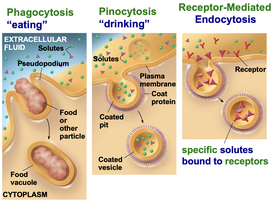
Cells transport large molecules, such as polysaccharides and proteins, across the membrane using exocytosis and endocytosis, both of which require energy.
Exocytosis: Secretion of substances out of the cell.
Endocytosis: Import of substances into the cell.
Types of Endocytosis
There are three main types of endocytosis:
Phagocytosis: "Eating"—engulfing large particles.
Pinocytosis: "Drinking"—engulfing extracellular fluid.
Receptor-Mediated Endocytosis: Specific uptake of molecules bound to receptors.
Cholesterol Uptake and Lipoproteins
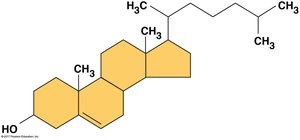
Animal cells take up cholesterol via receptor-mediated endocytosis. Cholesterol is crucial for membrane fluidity and serves as a precursor for steroid hormones, bile acids, and vitamin D.
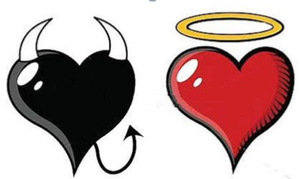
Key Point: Cholesterol is transported in the blood by lipoproteins: LDL (low-density) and HDL (high-density).
Key Point: There is only one type of cholesterol, but it is carried by different lipoproteins.
Introduction to Metabolism
What is Metabolism?
Metabolism refers to all the chemical reactions that transform matter and energy within an organism. These reactions are organized into metabolic pathways and are governed by the laws of thermodynamics.
Key Point: Metabolic pathways can be catabolic (breaking down molecules) or anabolic (building molecules).
Key Point: Metabolism is essential for growth, maintenance, and energy production.
Forms of Energy
Energy is the capacity to cause change. It exists in various forms:
Kinetic Energy: Energy of motion (e.g., moving particles, photons).
Thermal Energy: Energy from the movement of particles.
Light Energy: Energy carried by photons.
Potential Energy: Stored energy due to position or structure (e.g., chemical bonds).
Chemical Energy: Energy stored in molecular bonds (e.g., glucose, firewood).
First Law of Thermodynamics
The first law states that energy cannot be created or destroyed, only transferred or transformed.
Key Point: The total energy of the universe is constant.
Example: Cells convert chemical energy from food into kinetic and thermal energy.
Second Law of Thermodynamics
The second law states that the entropy (disorder) of the universe always increases.
Key Point: Energy transformations are never 100% efficient; some energy is lost as heat.
Free Energy Change (ΔG)
Free energy change () measures the potential energy available to do work.
Key Point: for spontaneous processes.
Key Point: for equilibrium.
Equation:
where is enthalpy, is temperature, and is entropy.
Exergonic and Endergonic Reactions
Exergonic Reaction: Releases energy; is negative; spontaneous (e.g., catabolic metabolism).
Endergonic Reaction: Requires energy input; is positive; non-spontaneous (e.g., anabolic metabolism).
ATP: Cellular Energy Currency
Cells store released energy in the form of ATP (adenosine triphosphate), which is used to drive endergonic reactions.
Key Point: ATP couples exergonic and endergonic processes.
Enzymes and Metabolic Pathways
Enzymes are biological catalysts that speed up metabolic reactions by lowering the activation energy ().
Key Point: Enzymes are specific to substrates and reactions.
Example: Sucrase catalyzes the hydrolysis of sucrose into glucose and fructose.
Equation for Activation Energy:
Example: Sucrose () + → Glucose () + Fructose ($C_6H_{12}O_6$) Additional info: Enzymes do not alter the overall free energy change () of a reaction; they only affect the rate.
