 Indietro
Membrane Transport and the Endomembrane System: Structure and Function in Cells
Guida di studio - Note intelligenti
 Appunti personalizzati basati sui tuoi materiali, ampliati con definizioni chiave, esempi e contesto.
Cells: Membrane Transport and the Endomembrane System
Fluid Mosaic Model: Structure of the Plasma Membrane
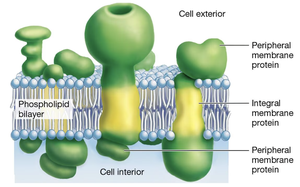
The plasma membrane is a dynamic structure composed of a phospholipid bilayer with embedded proteins, described by the fluid mosaic model. This model explains how proteins and lipids move laterally within the membrane, allowing flexibility and diverse functions.
Phospholipid bilayer: Provides a semi-permeable barrier between the cell interior and exterior.
Integral membrane proteins: Span the bilayer and are involved in transport, signaling, and structural support.
Peripheral membrane proteins: Attach to the membrane surface and assist in cell communication and structure.
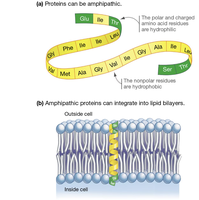
Amphipathic proteins: Contain both hydrophobic and hydrophilic regions, allowing them to interact with the lipid bilayer.
Chemical Properties of Membrane Proteins
Membrane proteins interact with the plasma membrane based on their chemical properties. Amphipathic proteins have hydrophobic regions that anchor them within the lipid bilayer, while hydrophilic regions interact with the aqueous environment.
Hydrophobic amino acids: Anchor proteins within the membrane.
Hydrophilic amino acids: Exposed to the cell's interior or exterior.
Amphipathic nature: Enables proteins to integrate into membranes and perform diverse functions.
Membrane Transport Proteins
Types of Membrane Transport
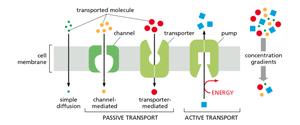
Transport proteins facilitate the movement of molecules across the cell membrane. Transport can be passive (no energy required) or active (requires energy input).
Passive transport: Molecules move from high to low concentration (down the gradient).
Active transport: Molecules move from low to high concentration (against the gradient), requiring energy (usually ATP).
Modes of Solute Transport
Solute transport across the membrane occurs via several mechanisms:
Simple diffusion: Direct movement of small, nonpolar molecules through the lipid bilayer.
Facilitated diffusion: Movement of molecules via channel or transporter proteins, without energy input.
Active transport: Movement of molecules against the concentration gradient, requiring energy.

Transport Proteins: Channels and Transporters
Transport proteins are classified based on their mechanism and directionality:
Channels: Provide a passage for molecules to move passively along the concentration gradient. Examples include aquaporins (water channels) and gated channels (open/close in response to signals).
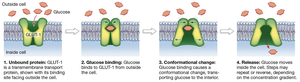
Transporters: Undergo conformational changes to move molecules. Can be involved in both passive and active transport.
Active transporters (pumps): Use energy to move molecules against the gradient.
Type | Direction | Energy Requirement | Example |
|---|---|---|---|
Channel | Passive (down gradient) | No | Aquaporin |
Transporter | Passive or Active | Varies | GLUT (glucose transporter) |
Pump | Active (against gradient) | Yes (ATP) | Na+/K+ pump |
Types of Transporters
Transporters are further classified based on the number and direction of molecules transported:
Uniporter: Transports one type of molecule.
Symporter: Transports two different molecules in the same direction.
Antiporter: Transports two different molecules in opposite directions.
Examples of Transporters and Pumps
Transporters undergo conformational changes to move molecules across membranes. Pumps use energy to transport molecules against the gradient.
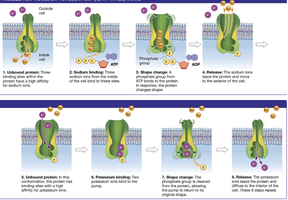
Active Transport: Primary and Secondary
Primary Active Transport
Primary active transport uses ATP directly to move molecules against their concentration gradient. The classic example is the Na+/K+ pump, which maintains cellular ion balance.
ATP-driven pumps: Hydrolyze ATP to provide energy for transport.
Light-driven pumps: Use light energy for transport (e.g., in some bacteria).
Secondary Active Transport
Secondary active transport uses the energy stored in gradients created by primary active transport. For example, the H+/Sucrose symporter uses the H+ gradient to transport sucrose.
Symporters: Couple the movement of one molecule with another.
Antiporters: Exchange molecules in opposite directions.
Type | Energy Source | Example |
|---|---|---|
Primary Active Transport | ATP | Na+/K+ pump |
Secondary Active Transport | Gradient (e.g., H+) | H+/Sucrose symporter |
Cell Types and Membranes
Prokaryotic vs. Eukaryotic Cells
Both prokaryotic and eukaryotic cells have cell membranes, but eukaryotic cells also possess internal organelle membranes, such as the nuclear membrane and organellar membranes.
Prokaryotic cells: Have a single cell membrane.
Eukaryotic cells: Have multiple membranes, including those surrounding organelles.
The Endomembrane System
Structure and Function
The endomembrane system is a network of membranes and organelles in eukaryotic cells that work together to modify, package, and transport proteins. It includes the endoplasmic reticulum (ER), Golgi apparatus, vesicles, and plasma membrane.
Secretory pathway: Proteins are synthesized in the ER, processed in the Golgi, and transported via vesicles.
Exocytosis: Vesicles fuse with the plasma membrane to release contents outside the cell.
Endocytosis: The cell membrane engulfs material to bring it into the cell for recycling or degradation.
Mechanism of Protein Entry into the ER
Proteins enter the ER via a complex involving the translocon and the SRP receptor. These are integral membrane proteins that facilitate the passage of newly synthesized proteins into the ER lumen.
Translocon: Acts as a channel for protein entry.
SRP receptor: Recognizes signal sequences and directs proteins to the translocon.
Protein Sorting in the Golgi Apparatus
Proteins are sorted and packaged into vesicles in the Golgi apparatus, which are then targeted to specific destinations within or outside the cell.
Endocytosis: Recycling and Degradation
Endocytosis allows cells to internalize material for recycling or degradation, maintaining cellular homeostasis and responding to environmental changes.
Key Takeaways
Integral membrane proteins are essential for transport, signaling, and structural support.
Active and passive transport differ in energy requirements and directionality.
Channels and pumps are distinct types of transport proteins.
Simple diffusion and facilitated diffusion are forms of passive transport.
Primary and secondary active transport use different energy sources.
Prokaryotic and eukaryotic cells differ in membrane complexity.
Endocytosis and exocytosis are vital for material exchange and cellular function.
The endomembrane system coordinates protein modification, sorting, and transport.
