 Indietro
Membrane Transport: Regulating Traffic Across the Cell's Borders
Guida di studio - Note intelligenti
 Appunti personalizzati basati sui tuoi materiali, ampliati con definizioni chiave, esempi e contesto.
The Plasma Membrane: Structure and Function
Overview of the Plasma Membrane
The plasma membrane is a dynamic boundary that separates the cell's internal environment from the external surroundings. Its structure enables selective permeability, allowing the cell to regulate the movement of substances and maintain homeostasis.
Purpose: Separates cytoplasmic (intracellular) and extracellular environments.
Composition: Consists of phospholipids, proteins, and carbohydrates.
Function: Maintains integrity, supports metabolism, gene regulation, and cellular signaling.
Lipid Bilayer and Amphipathic Nature
The lipid bilayer forms the fundamental structure of the plasma membrane, with amphipathic molecules that self-assemble in aqueous environments.
Phospholipids: Spontaneously form a bilayer in water.
Amphipathic: Molecules have both hydrophilic (water-loving) heads and hydrophobic (water-fearing) tails.
Bilayer Arrangement: Hydrophobic tails face inward, hydrophilic heads face outward.
Fluid Mosaic Model
The fluid mosaic model describes the membrane as a flexible structure with proteins embedded in a sea of phospholipids.
Fluidity: Components move laterally within the membrane.
Mosaic: Proteins, phospholipids, and cholesterol are distributed throughout the bilayer.
Factors Affecting Membrane Fluidity
Membrane fluidity is influenced by temperature and the presence of cholesterol.
Temperature:
Cooler temperatures cause membranes to solidify.
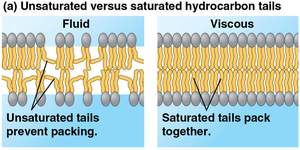
Unsaturated fatty acids (with kinks) increase fluidity and permeability, ideal for cold environments.
Saturated fatty acids (straight tails) decrease fluidity, ideal for warm environments.
Example: Fish in cold waters have more unsaturated fatty acids in their membranes.
Cholesterol:
At warm temperatures, cholesterol restrains phospholipid movement, decreasing fluidity.
At cool temperatures, cholesterol prevents tight packing, maintaining fluidity.
Plants use related steroids for fluidity regulation.
Membrane Components
Proteins
Membrane proteins are essential for the membrane's function and are often grouped to carry out specific tasks.
Amphipathic: Have hydrophobic regions interacting with the membrane core and hydrophilic regions exposed to aqueous environments.
Types:
Peripheral Proteins: Loosely bound to the membrane surface, do not penetrate the core.
Integral Proteins: Penetrate the hydrophobic core, often span the entire membrane (transmembrane proteins).
Attachment: Can be attached to the cytoskeleton or extracellular matrix.
Carbohydrates
Membrane carbohydrates play a key role in cell-to-cell recognition and are covalently bonded to lipids or proteins.
Glycolipids: Carbohydrates attached to lipids.
Glycoproteins: Carbohydrates attached to proteins.
Function: Allow cells to distinguish "self" from "non-self" and recognize signals.
Membrane Sidedness: Membranes have distinct inside (cytoplasmic) and outside (extracellular) faces, with asymmetrical distribution of components.
Membrane Transport: Regulating the Flow of Molecules
Selective Permeability
The plasma membrane's selective permeability allows only certain molecules to pass, maintaining cellular homeostasis.
Lipid Bilayer:
Small, hydrophobic (nonpolar) molecules (e.g., hydrocarbons, CO2, O2) pass rapidly by simple diffusion.
Hydrophilic (polar) molecules and ions are blocked by the hydrophobic interior and require assistance.
Transport Proteins:
Channel Proteins: Provide hydrophilic channels for specific molecules or ions (e.g., aquaporins for water, ion channels for Na+, Cl−).
Carrier Proteins: Bind to molecules and change shape to shuttle them across the membrane.
Specificity: Transport proteins are highly specific for certain substances.
Types of Membrane Transport
Passive Transport
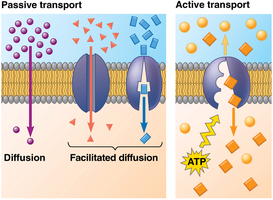
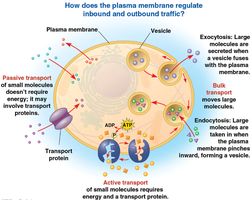
Passive transport moves substances down their concentration gradient without energy input.
Diffusion: Spontaneous movement of particles from high to low concentration.
Example: Oxygen and carbon dioxide diffusion across the membrane.
Osmosis: Diffusion of water across a selectively permeable membrane.
Tonicity:
Isotonic: Equal solute concentration inside and outside; no net water movement.
Hypertonic: Higher solute concentration outside; cell loses water.
Hypotonic: Lower solute concentration outside; cell gains water.
Osmoregulation: Control of solute concentrations and water balance (e.g., Paramecium's contractile vacuole).
Facilitated Diffusion: Passive transport assisted by transport proteins, moving substances down their concentration gradient.
Carrier proteins change shape; channel proteins provide tunnels.
Active Transport
Active transport moves substances against their concentration gradient, requiring energy (ATP).
Carrier Proteins: All active transport proteins are carrier proteins.
Example: Sodium-Potassium Pump (Na+/K+ pump):
Pumps 3 Na+ out and 2 K+ in, maintaining membrane potential.
Membrane potential is an electrochemical gradient (chemical concentration + electrical charge).
Proton Pump: Main electrogenic pump in plants, fungi, and bacteria; transports H+ out, generating a proton gradient.
Cotransport: Active transport of one solute drives the transport of another (e.g., H+-sucrose cotransporter).
Bulk Transport
Bulk transport moves large molecules or collections of molecules using vesicles and requires energy.
Exocytosis: Vesicles fuse with the plasma membrane to release contents outside the cell (e.g., insulin secretion).
Endocytosis: Plasma membrane engulfs substances, forming vesicles that enter the cell.
Phagocytosis: Cell engulfs large particles ("cell eating").
Pinocytosis: Cell "gulps" extracellular fluid ("cell drinking").
Receptor-Mediated Endocytosis: Specific solutes bind to receptors, triggering vesicle formation.
Summary Table: Types of Membrane Transport
Type | Energy Required? | Direction | Example |
|---|---|---|---|
Simple Diffusion | No | High to Low | O2, CO2 |
Osmosis | No | High to Low (water) | Water movement |
Facilitated Diffusion | No | High to Low | Glucose transport |
Active Transport | Yes (ATP) | Low to High | Na+/K+ pump |
Bulk Transport | Yes | Varies | Exocytosis, Endocytosis |
Key Equations
Membrane Potential Equation
The membrane potential is determined by the distribution of ions across the membrane.
Nernst Equation: Used to calculate the equilibrium potential for a particular ion.
Osmosis Equation
Osmosis is driven by differences in solute concentration.
Osmotic Pressure: where is osmotic pressure, is the van 't Hoff factor, is molarity, is the gas constant, and is temperature.
Conclusion
The plasma membrane is a sophisticated structure that enables cells to regulate their internal environment, communicate, and interact with their surroundings. Understanding its structure and transport mechanisms is fundamental to cell biology and physiology. Additional info: Academic context was added to clarify the roles of membrane components, transport types, and key equations for exam preparation.
