 Indietro
Membrane Transport: Structure and Function of the Plasma Membrane
Guida di studio - Note intelligenti
 Appunti personalizzati basati sui tuoi materiali, ampliati con definizioni chiave, esempi e contesto.
The Plasma Membrane: Structure and Function
Overview of the Plasma Membrane
The plasma membrane is a dynamic boundary that separates the cell's internal environment from the external surroundings. Its structure enables selective permeability, allowing the cell to regulate the movement of substances and maintain homeostasis.
Purpose: Maintains cellular integrity and regulates traffic of molecules.
Composition: Consists of phospholipids, proteins, and carbohydrates.
Organization: The membrane is organized as a fluid mosaic, with components moving laterally within the bilayer.
Lipid Bilayer and Amphipathic Nature
The lipid bilayer forms the fundamental structure of the plasma membrane, with amphipathic phospholipids self-assembling in water.
Phospholipids: Have hydrophilic heads facing outward and hydrophobic tails facing inward.
Amphipathic: Both phospholipids and membrane proteins possess hydrophilic and hydrophobic regions, crucial for membrane assembly.
Fluid Mosaic Model: Describes the membrane as a mosaic of proteins floating in a fluid bilayer of phospholipids.
Factors Affecting Membrane Fluidity
Membrane fluidity is influenced by temperature, fatty acid composition, and cholesterol content.
Temperature: Lower temperatures cause membranes to solidify; higher temperatures increase fluidity.
Unsaturated Fatty Acids: Prevent tight packing, increasing fluidity and permeability.
Saturated Fatty Acids: Pack tightly, making the membrane more viscous and less fluid.
Cholesterol: Buffers fluidity; restrains movement at high temperatures and prevents tight packing at low temperatures.
Example: Fish in cold environments have membranes rich in unsaturated fatty acids to maintain fluidity. 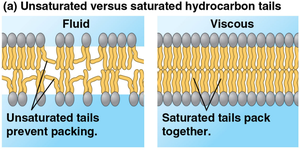
Membrane Components
Proteins
Membrane proteins are essential for the diverse functions of the plasma membrane.
Peripheral Proteins: Loosely bound to the membrane surface; do not penetrate the hydrophobic core.
Integral Proteins: Penetrate the hydrophobic core; many are transmembrane proteins spanning the entire membrane.
Attachment: Proteins may be attached to the cytoskeleton or extracellular matrix for structural support.
Carbohydrates
Membrane carbohydrates play a key role in cell-to-cell recognition.
Glycolipids: Carbohydrates covalently bonded to lipids.
Glycoproteins: Carbohydrates covalently bonded to proteins.
Function: Allow cells to distinguish "self" from "non-self" and recognize specific signals.
Membrane Sidedness: Membranes have distinct cytoplasmic and extracellular faces, with asymmetrical distribution of components.
Membrane Transport: Regulating the Flow of Molecules
Selective Permeability
The plasma membrane allows only certain molecules to pass, maintaining cellular homeostasis.
Small, hydrophobic molecules: Pass through rapidly by simple diffusion (e.g., O2, CO2).
Hydrophilic molecules and ions: Require transport proteins to cross the membrane.
Transport Proteins: Channel and carrier proteins facilitate the passage of specific substances.
Types of Membrane Transport
Passive Transport
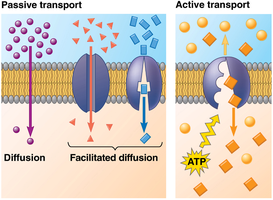
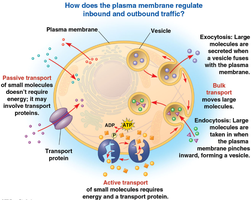
Passive transport moves substances down their concentration gradient without energy input.
Diffusion: Spontaneous movement from high to low concentration.
Osmosis: Diffusion of water across a selectively permeable membrane.
Tonicity:
Isotonic: No net water movement; animal cells are stable, plant cells are flaccid.
Hypertonic: Cell loses water; animal cells shrivel, plant cells undergo plasmolysis.
Hypotonic: Cell gains water; animal cells may burst, plant cells become turgid.
Facilitated Diffusion: Passive transport assisted by transport proteins; no energy required.
Active Transport
Active transport moves substances against their concentration gradient, requiring energy (ATP).
Carrier Proteins: All active transport proteins are carrier proteins.
Sodium-Potassium Pump: Pumps 3 Na+ out and 2 K+ in, maintaining membrane potential.
Proton Pump: Main electrogenic pump in plants, fungi, and bacteria; creates a proton gradient.
Cotransport: Active transport of one solute drives the transport of another (e.g., proton-sucrose cotransporter).
Bulk Transport
Bulk transport moves large molecules or collections of molecules using vesicles.
Exocytosis: Vesicles fuse with the membrane to release contents outside the cell.
Endocytosis: Membrane engulfs substances, forming vesicles that enter the cell.
Types of Endocytosis:
Phagocytosis: Cell engulfs large particles.
Pinocytosis: Cell "gulps" extracellular fluid.
Receptor-Mediated Endocytosis: Specific solutes bind to receptors, triggering vesicle formation.
Summary Table: Types of Membrane Transport
Type | Energy Required? | Direction | Example |
|---|---|---|---|
Simple Diffusion | No | High to Low | O2, CO2 |
Facilitated Diffusion | No | High to Low | Glucose via carrier protein |
Osmosis | No | High to Low (water) | Water via aquaporins |
Active Transport | Yes (ATP) | Low to High | Na+/K+ pump |
Bulk Transport | Yes | Varies | Exocytosis, Endocytosis |
Additional info: The notes expand on the original content by providing definitions, examples, and a summary table for clarity and completeness.
