 Indietro
Mendel and the Gene Idea: Foundations of Classical Genetics
Guida di studio - Note intelligenti
 Appunti personalizzati basati sui tuoi materiali, ampliati con definizioni chiave, esempi e contesto.
Genetics: The Study of Heredity and Variation
Definitions and Concepts
Genetics is the scientific study of heredity and variation.
Heredity: The transmission of traits from one generation to the next.
Variation: Differences in appearance that offspring show from parents or siblings.
Why Offspring Resemble Parents
Offspring resemble their parents more than unrelated individuals due to the inheritance of genetic material, which encodes traits.
Introduction to Mendelian Genetics
Gregor Mendel and His Experiments
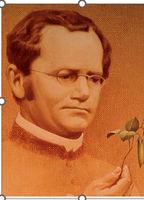
Gregor Mendel (1822–1884), known as the 'Father of Genetics', was an Austrian monk who discovered the fundamental laws of inheritance through experiments with pea plants.
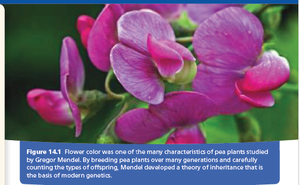
Pea plants are self-pollinators and have many observable heritable traits.
Mendel identified dominant and recessive traits and formulated laws explaining heredity.
Characters and Traits in Pea Plants
Mendel tracked characters that occurred in two distinct alternative forms.
Character: A heritable feature that varies among individuals (e.g., flower color).
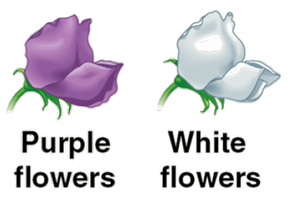
Trait: Each variant for a character (e.g., purple or white flowers).
Seven Characters Studied by Mendel
Mendel studied seven characters in pea plants, each with two contrasting traits. 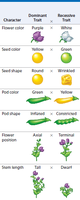
Monohybrid Crosses and True Breeding
Monohybrid Cross
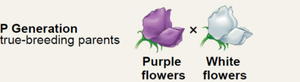
A monohybrid cross follows a single character, such as flower color (purple × white).
True breeding: Over many generations of self-pollination, plants produced offspring identical to the parent.
Mendel's Experimental Approach
Mendel used a scientific approach to identify two laws of inheritance: the Law of Segregation and the Law of Independent Assortment.
Monohybrid Cross Breeding Experiment
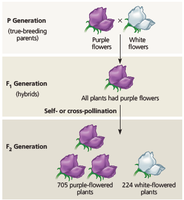
Parental generation (P): True-breeding parents.
F1 generation: Hybrid offspring.
F2 generation: Offspring from crossing two F1 individuals.
F2 ratio: 3 purple : 1 white.
Results Across Seven Characters
Mendel observed the same 3:1 ratio in the F2 generation for all seven characters. 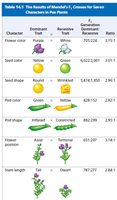
Dominant and Recessive Traits
Dominant trait: The trait that appears in the F1 generation (e.g., purple flowers).
Recessive trait: The trait masked in the F1 generation but reappears in F2 (e.g., white flowers).
Mendel's Model: Genes, Alleles, and Loci
Gene, Allele, and Locus
Gene: A length of DNA coding for a particular protein.
Allele: Alternative form of a gene.
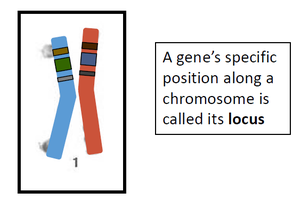
Locus: Position of the gene on the chromosome.
Homologous chromosomes carry the same genes but not necessarily the same alleles.
Transmission of Traits
Alternative versions of a gene (alleles) account for different traits, such as purple or white flower color. 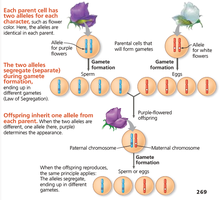
Genetic Vocabulary
Dominant allele: Represented by a capital letter; determines the organism’s appearance.
Recessive allele: Represented by a lowercase letter; has no noticeable effect when dominant allele is present.
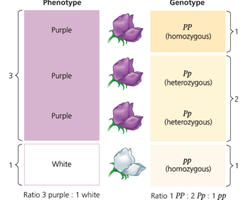
Homozygote: Pair of identical alleles (PP or pp).
Heterozygote: Pair of different alleles (Pp).
Genotype: Genetic makeup (e.g., PP, Pp, pp).
Phenotype: Observable expression of a trait (e.g., purple or white flowers).
Mendelian Laws of Inheritance
Law of Segregation
In diploid organisms, two alleles for each trait are inherited, one from each parent. These alleles segregate during gamete formation, so each gamete carries only one allele for each gene.
Chromosomal Basis of Segregation
Segregation of alleles corresponds to the distribution of homologous chromosomes to different gametes in meiosis.
Punnett Squares
A Punnett square is a diagram used to predict genotypes and phenotypes of offspring, visualizing how alleles combine during fertilization.
Monohybrid cross: Pp × Pp
Law of Segregation illustrated
Law of Independent Assortment and Dihybrid Crosses
Law of Independent Assortment
Genes for different traits are inherited independently.
Dihybrid cross: Inheritance of two different characters.
Phenotypic ratio in F2: 9:3:3:1
Patterns of Inheritance
Dominance, Incomplete Dominance, and Codominance
Dominance: One allele masks the effect of another.
Incomplete dominance: Traits blend together, producing intermediate phenotypes (e.g., snapdragon flower color: red, pink, white).
Codominance: Both alleles affect the phenotype in separate, distinguishable ways (e.g., coat color in cattle, ABO blood groups).
Multiple Alleles
Some genes have more than two alleles, such as the ABO blood group system.
IA and IB are dominant to i.
IA and IB are codominant when present together.
Epistasis
The phenotypic expression of one gene alters that of another gene at a different locus.
Example: Pigment deposition gene is epistatic to pigment color gene in animals.
Polygenic Inheritance
More than one gene affects phenotype, with additive effects.
Examples: Skin color, height, eye color in humans.
Genetic Disorders and Pleiotropy
Recessively Inherited Disorders
Recessive allele (a): Homozygous recessive (aa) individuals have the disease.
Heterozygotes (Aa) are carriers.
Examples: Sickle cell disease, cystic fibrosis, albinism.
Pleiotropy
One gene affects multiple phenotypic characters.
Example: Sickle cell disease affects red blood cell shape, oxygen carrying capacity, and causes multiple symptoms.
Heterozygote Advantage
Heterozygotes for sickle cell allele (Aa) have reduced frequency and severity of malaria attacks, illustrating evolutionary implications.
Dominant Disorders
Achondroplasia: Dominant allele causes dwarfism.
Huntington’s disease: Only one copy of the allele needed for the disorder.
Pedigree Analysis and Chromosomal Basis of Inheritance
Pedigree Analysis
Pedigree analysis is used to study inheritance patterns in humans, as breeding experiments are not possible.
Family trees describe traits across generations.
Used to identify carriers and inheritance of dominant/recessive alleles.
Chromosomes and Karyotypes
A karyotype is an ordered display of chromosomes from a cell.
Homologous chromosomes carry genes controlling the same inherited characters.
Autosomes: 22 pairs; Sex chromosomes: 23rd pair (XX female, XY male).
Sex-Linked Inheritance
Inheritance of X-Linked Genes
Alleles located on the X chromosome.
Males are more frequently affected (e.g., hemophilia, colorblindness).
Genetic Testing and Counseling
Methods
Testing blood or cheek cells.
Fetal testing: Ultrasound, amniocentesis, chorionic villus sampling (CVS).
Newborn screening: Biochemical tests.
Chromosomal Basis of Mendel’s Laws
Relationship Between Genes and Chromosomes
Mendelian inheritance has its physical basis in the behavior of chromosomes during meiosis.
Law of Segregation: Separation of alleles during gamete formation.
Law of Independent Assortment: Independent inheritance of genes for different traits.
Summary Table: Mendel's Seven Characters and F2 Ratios
Character | Dominant Trait | Recessive Trait | F2 Ratio |
|---|---|---|---|
Flower color | Purple | White | 3:1 |
Seed color | Yellow | Green | 3:1 |
Seed shape | Round | Wrinkled | 3:1 |
Pod color | Green | Yellow | 3:1 |
Pod shape | Inflated | Constricted | 3:1 |
Flower position | Axial | Terminal | 3:1 |
Stem length | Tall | Dwarf | 3:1 |
Key Equations
Probability in Genetics
Multiplication Rule: Probability of two independent events occurring together is the product of their probabilities.
Addition Rule: Probability of either of two mutually exclusive events occurring is the sum of their probabilities.
Example Equation
Conclusion
Mendelian genetics forms the foundation of modern genetics, explaining how traits are inherited and predicting outcomes using laws, Punnett squares, and probability. Understanding dominant, recessive, and other inheritance patterns is essential for studying genetic disorders, evolution, and breeding practices.
