 Indietro
Mendel and the Gene Idea: Principles of Inheritance
Guida di studio - Note intelligenti
 Appunti personalizzati basati sui tuoi materiali, ampliati con definizioni chiave, esempi e contesto.
Chapter 14: Mendel and the Gene Idea
Introduction to Mendel's Experiments
Mendel's pioneering work with pea plants established the foundational principles of heredity. By carefully controlling breeding and analyzing trait inheritance, Mendel formulated two key laws: the Law of Segregation and the Law of Independent Assortment.
Mendel’s Experimental Approach
Character: A heritable feature that varies among individuals (e.g., flower color).
Trait: Each variant for a character (e.g., purple or white flowers).
Advantages of Pea Plants:
Distinct heritable traits and varieties
Short generation time and large offspring numbers
Controlled mating (self- or cross-pollination)
Both male and female organs in each plant
Use of true-breeding varieties
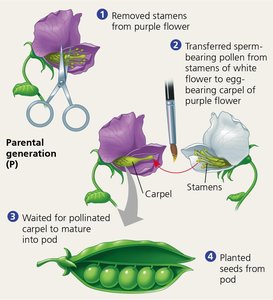
Mendel’s Use of Hybridization
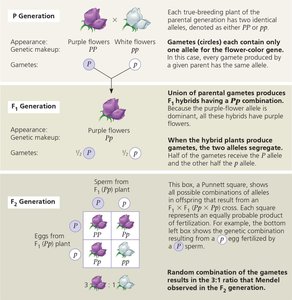
Mendel mated two contrasting, true-breeding varieties (P generation) to produce hybrid offspring (F1 generation). F1 plants were then self- or cross-pollinated to produce the F2 generation.
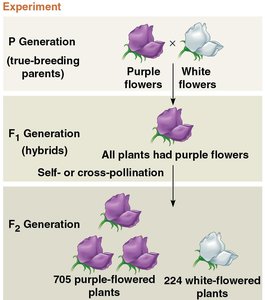
Key Discoveries from the F2 Generation
Traits missing in F1 reappeared in F2, disproving the blending hypothesis.
Quantitative analysis revealed a consistent 3:1 ratio of dominant to recessive traits.
Dominant and Recessive Traits
Dominant trait: Expressed in F1 hybrids (e.g., purple flowers).
Recessive trait: Masked in F1, reappears in F2 (e.g., white flowers).
Observed across multiple traits, always yielding similar ratios.
Mendel’s Model of Inheritance
Mendel developed a model to explain the 3:1 ratio observed in F2 offspring, based on four key concepts:
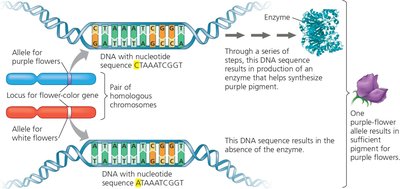
1. Alternative versions of genes (alleles) account for variations in inherited characters.
2. Each organism inherits two alleles for each gene, one from each parent.
3. Dominant alleles mask recessive alleles in heterozygotes.
4. Law of Segregation: The two alleles for a character segregate during gamete formation.
Application: Punnett Squares and Genetic Ratios
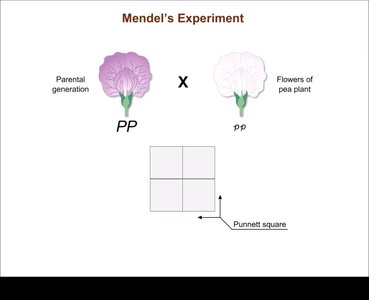
Punnett squares are used to predict the outcomes of genetic crosses. For flower color, the dominant allele (P) produces purple flowers, while the recessive allele (p) produces white flowers.
Phenotype and Genotype
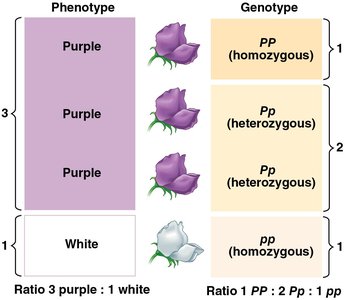
Phenotype: Observable traits (e.g., purple or white flowers).
Genotype: Genetic makeup (e.g., PP, Pp, or pp).
Homozygous: Two identical alleles (PP or pp).
Heterozygous: Two different alleles (Pp).
Results Across Multiple Traits
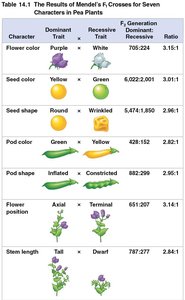
Mendel observed similar inheritance patterns for seven different characters in pea plants, each showing a dominant and recessive trait.
Character | Dominant Trait | Recessive Trait | F2 Generation Ratio |
|---|---|---|---|
Flower color | Purple | White | 3.15:1 |
Seed color | Yellow | Green | 3.01:1 |
Seed shape | Round | Wrinkled | 2.96:1 |
Pod color | Green | Yellow | 2.82:1 |
Pod shape | Inflated | Constricted | 2.56:1 |
Flower position | Axial | Terminal | 3.14:1 |
Stem length | Tall | Dwarf | 2.84:1 |
The Law of Independent Assortment
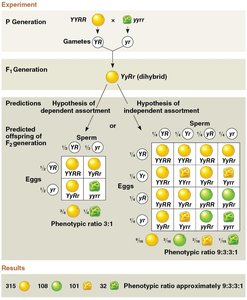
Mendel's second law states that allele pairs segregate independently during gamete formation. This law applies to genes located on different chromosomes or far apart on the same chromosome.
Dihybrid Cross: Cross between parents differing in two traits (e.g., seed color and shape).
Phenotypic Ratio: F2 generation shows a 9:3:3:1 ratio for dihybrid crosses.
Exception: Linked genes (close together on the same chromosome) do not assort independently.
Summary of Mendel’s Laws
Law of Segregation: Each individual has two alleles for each gene, which segregate during gamete formation.
Law of Independent Assortment: Alleles of different genes assort independently during gamete formation.
Useful Genetic Vocabulary
Allele: Different versions of the same gene.
Homozygous: Genotype with identical alleles (true-breeding).
Heterozygous: Genotype with different alleles (not true-breeding).
Dominant: Allele that is always expressed in the phenotype.
Recessive: Allele expressed only in the homozygous state.
Phenotype: Observable traits.
Genotype: Genetic makeup.
Formulas and Equations
Monohybrid Cross Ratio:
Dihybrid Cross Ratio:
Probability of genotype:
Example Application
In a cross between a homozygous dominant (PP) and a homozygous recessive (pp) plant, all F1 offspring are heterozygous (Pp) and display the dominant phenotype. Self-pollination of F1 yields F2 with a 3:1 phenotypic ratio.
Additional info: Mendel’s principles laid the foundation for modern genetics, including the understanding of genes, alleles, and chromosomal inheritance.
