 Indietro
Mendel and the Gene: Principles of Inheritance
Guida di studio - Note intelligenti
 Appunti personalizzati basati sui tuoi materiali, ampliati con definizioni chiave, esempi e contesto.
Mendel and the Gene: Principles of Inheritance
Introduction to Mendelian Genetics
Mendelian genetics forms the foundation of classical genetics, describing how traits are inherited from one generation to the next. Gregor Mendel's experiments with garden peas established the basic rules of heredity and introduced key concepts such as genes, alleles, and dominant/recessive traits. 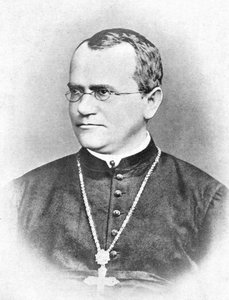
Key Terms and Concepts
- Trait: Any characteristic of an individual, such as seed color or flower shape. - Heredity: The transmission of traits from parents to offspring. - Phenotype: The observable physical expression of a trait (e.g., green seed color). - Genotype: The specific combination of alleles an individual carries. - Allele: Different forms of a gene, which can be dominant or recessive.
Mendel’s Experimental System
Mendel chose the garden pea as his model organism due to its ease of cultivation, short generation time, ability to produce many seeds, and the presence of several polymorphic traits. These features allowed Mendel to control crosses and observe inheritance patterns clearly. 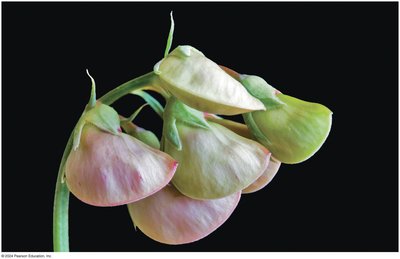

Self-Fertilization vs. Cross-Fertilization
Mendel prevented self-pollination by removing male organs from the flower and transferred pollen from another flower for cross-fertilization, enabling controlled genetic crosses. 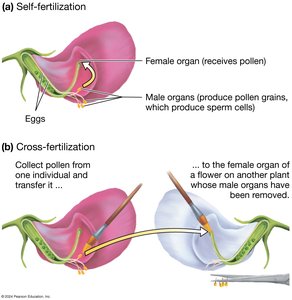
Traits Studied by Mendel
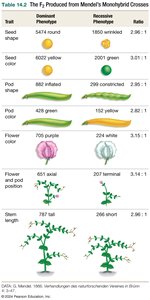
Mendel examined seven distinct traits in peas, each with two contrasting phenotypes. He always used pure (true-breeding) lines, ensuring each parent produced only one phenotype if self-fertilized.
Table: Traits Studied by Mendel
Trait | Dominant Phenotype | Recessive Phenotype | Ratio |
|---|---|---|---|
Seed shape | Round | Wrinkled | 2.96 : 1 |
Seed color | Yellow | Green | 2.96 : 1 |
Pod shape | Inflated | Constricted | 2.96 : 1 |
Pod color | Green | Yellow | 2.87 : 1 |
Flower color | Purple | White | 3.15 : 1 |
Flower position | Axial | Terminal | 2.96 : 1 |
Stem length | Tall | Short | 2.96 : 1 |

Mendel’s Experiments with a Single Trait (Monohybrid Crosses)
Mendel crossed pure lines differing in one trait, such as round vs. wrinkled seed shape. The parental generation (P) produced the F1 generation, which was then self-fertilized to produce the F2 generation. 
Results and Ratios
- The F2 generation consistently showed a 3:1 ratio of dominant to recessive phenotypes. - Dominant trait: The trait that appears in the F1 generation (e.g., round seeds). - Recessive trait: The trait that reappears in the F2 generation (e.g., wrinkled seeds). 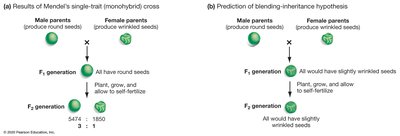
Reciprocal Crosses
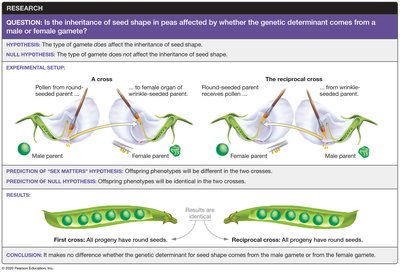
Reciprocal crosses tested whether the inheritance of a trait depended on whether the genetic determinant came from the male or female parent. Results showed that inheritance was not affected by the sex of the parent. 
Genotype and Phenotype
- Genotype: The combination of alleles (e.g., RR, Rr, rr). - Phenotype: The observable trait determined by the genotype.
Mendel’s Principle of Segregation (First Law)
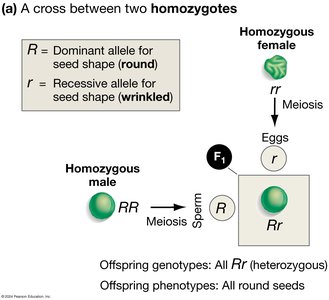
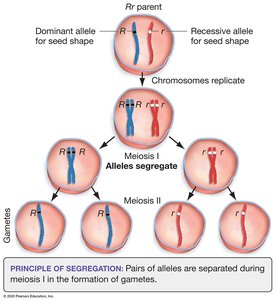
The two alleles for a gene segregate into different gametes during the formation of egg or sperm. Mendel used capital letters for dominant alleles and lowercase for recessive. - Homozygous: Two identical alleles (RR or rr). - Heterozygous: Two different alleles (Rr). 



Punnett Square Example
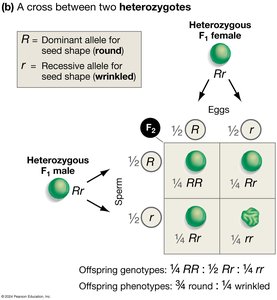
- Cross between two heterozygotes (Rr x Rr): Genotypic ratio: 1 RR : 2 Rr : 1 rr Phenotypic ratio: 3 round : 1 wrinkled 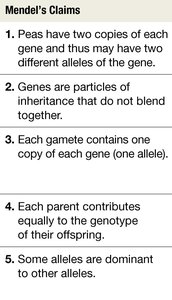

Mendel’s Experiments with Two Traits (Dihybrid Crosses)
Mendel used dihybrid crosses to test whether alleles of different genes segregate independently or together. 
Principle of Independent Assortment (Second Law)
- Independent assortment: Alleles of different genes are transmitted independently. - Dependent assortment: Alleles of different genes are transmitted together. - Dihybrid crosses produced a 9:3:3:1 phenotypic ratio in the F2 generation. 
Practice Problem: Dihybrid Cross
- Cross between AaBb and AAbb: Use a Punnett square to determine phenotypic ratios. 
Testcrosses
A testcross determines the genotype of an individual with a dominant phenotype by crossing it with a homozygous recessive individual. - If all offspring show the dominant phenotype, the tested individual is homozygous dominant. - If offspring are half dominant and half recessive, the tested individual is heterozygous. 
The Chromosome Theory of Inheritance
Mendel’s principles are explained by the behavior of chromosomes during meiosis.
Principle of Segregation
The physical separation of homologous chromosomes in Anaphase I of meiosis explains why alleles segregate. Gametes receive only one allele for each trait. 
Principle of Independent Assortment
The random alignment of homologous chromosomes in Metaphase I explains why alleles of different genes assort independently. 

Mendel’s Claims Summarized
# | Claim |
|---|---|
1 | Peas have two copies of each gene and may have two different alleles. |
2 | Genes are particles of inheritance that do not blend together. |
3 | Each gamete contains one copy of each gene (one allele). |
4 | Each parent contributes equally to the genotype of their offspring. |
5 | Some alleles are dominant to others. |

Summary
Mendel’s experiments established the fundamental laws of inheritance: the Principle of Segregation and the Principle of Independent Assortment. These principles are explained by the behavior of chromosomes during meiosis and are foundational to understanding genetics. Practice using Punnett squares and understanding ratios is essential for mastering Mendelian genetics.
Key Equations
Additional info:
The notes have been expanded to include definitions, examples, and context for each concept, ensuring completeness and academic quality for exam preparation.
