 Indietro
Mendel and the Gene: Principles of Inheritance
Guida di studio - Note intelligenti
 Appunti personalizzati basati sui tuoi materiali, ampliati con definizioni chiave, esempi e contesto.
Chapter 14: Mendel and the Gene
Introduction to Mendel and the Gene
The study of inheritance in biology began with Gregor Mendel, whose experiments with garden peas established the foundation for the chromosome theory of inheritance. This theory, later expanded by Sutton and Boveri, asserts that genetic information is transmitted from one generation to the next via genes located on chromosomes. Genetics is the branch of biology that focuses on the mechanisms and patterns of inheritance.
Heredity: The transmission of traits from parents to offspring.
Trait: Any characteristic of an individual, such as flower color or seed shape.
Chromosome Theory of Inheritance: Genes are located on chromosomes, and their physical separation during meiosis explains Mendel’s principles.
Mendel’s Experimental System
Mendel sought to understand heredity by testing two prevailing hypotheses:
Blending Inheritance: Parental traits blend so that offspring have intermediate traits.
Inheritance of Acquired Characteristics: Parental traits are modified through use and then passed on.
Mendel’s experiments disproved these hypotheses and led to the concept of particulate inheritance.
Particulate Inheritance
Mendel proposed that hereditary determinants (genes) do not blend or change through use. Instead, they act as discrete, unchanging particles, maintaining their integrity across generations.
Key Point: Traits are inherited as distinct units (genes), not as blended mixtures.
Summary Table: Terms Used in Mendelian Genetics
The following table summarizes key terms used in Mendelian genetics:
Term | Definition |
|---|---|
Gene | Hereditary determinant for a trait |
Allele | Different versions of a gene |
Genotype | Genetic makeup of an organism |
Phenotype | Observable traits of an organism |
Homozygous | Having two identical alleles for a gene |
Heterozygous | Having two different alleles for a gene |
Dominant | Allele that determines phenotype in heterozygotes |
Recessive | Allele whose phenotype is masked in heterozygotes |
Locus | Physical location of a gene on a chromosome |
Additional info: | Terms inferred from standard Mendelian genetics |
The Chromosome Theory of Inheritance
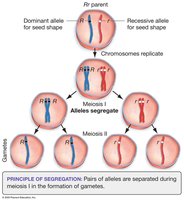
The chromosome theory of inheritance arose from observations of meiosis. Genes are located at specific loci on chromosomes, and the physical separation of alleles during meiosis is responsible for Mendel’s principle of segregation.
Principle of Segregation: Pairs of alleles are separated during meiosis I in the formation of gametes.
Meiosis Explains Mendel’s Principles
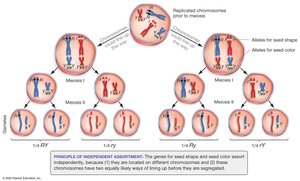
Genes for different traits assort independently during meiosis because they are located on different nonhomologous chromosomes. This explains Mendel’s principle of independent assortment.
Principle of Independent Assortment: Genes for different traits are inherited independently of each other.
Linkage: Genes Located on the Same Chromosome
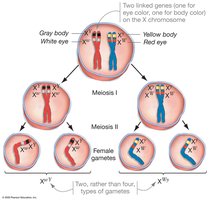
Linkage refers to the tendency of genes located on the same chromosome to be inherited together. This is distinct from sex-linkage, which refers to genes located on sex chromosomes but does not specify their relative positions.
Linked Genes: Genes located close together on the same chromosome are often inherited together.
Sex-Linkage: Refers to genes on sex chromosomes, not their proximity to each other.
The Role of Crossing Over
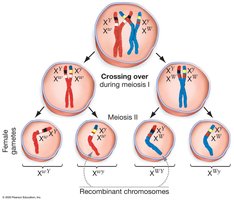
Genes on the same chromosome do not always stay linked. Morgan’s experiments with fruit flies showed that crossing over during prophase of meiosis can generate recombinant genotypes. Linked genes are inherited together unless crossing over occurs, resulting in genetic recombination.
Crossing Over: Exchange of genetic material between homologous chromosomes during meiosis.
Genetic Recombination: Production of offspring with combinations of traits different from those in the parents.
Frequency of Crossing Over: Used to estimate the relative distance between genes and create genetic maps.
Estimating Gene Distance and Genetic Mapping
Genes are more likely to cross over when they are far apart on a chromosome. The percentage of recombinant offspring can be used to estimate the relative distance between genes, forming the basis for genetic mapping.
Genetic Map: Diagram showing the relative positions of genes along a chromosome.
Recombination Frequency: The proportion of recombinant offspring, used to infer gene distance.
Formula: Recombination frequency (%) =
Additional info: Genetic mapping is a fundamental tool in genetics for understanding gene linkage and chromosomal structure.
