 Indietro
Mendelian Genetics and Extensions: Patterns of Inheritance
Guida di studio - Note intelligenti
 Appunti personalizzati basati sui tuoi materiali, ampliati con definizioni chiave, esempi e contesto.
Mendelian Genetics: Basic Principles
Gregor Mendel's Experiments and Laws
Mendel's work with pea plants established the foundation of modern genetics. By breeding pea plants and analyzing their offspring, Mendel identified two fundamental laws of inheritance: the Law of Segregation and the Law of Independent Assortment.
Character: A heritable feature that varies among individuals (e.g., flower color).
Trait: Each variant for a character (e.g., purple or white flowers).
Advantages of Pea Plants: Short generation time, large numbers of offspring, and controlled mating.
Mendel's Experimental Approach
Mendel used true-breeding plants and tracked characters with two distinct forms. He performed hybridization by crossing contrasting varieties, producing the P (parental), F1 (first filial), and F2 (second filial) generations.
Hybridization: Mating two contrasting, true-breeding varieties.
P Generation: True-breeding parents.
F1 Generation: Hybrid offspring of the P generation.
F2 Generation: Offspring from self- or cross-pollinated F1 individuals.
The Law of Segregation
Mendel observed a 3:1 ratio of dominant to recessive traits in the F2 generation, leading to the Law of Segregation:
The two alleles for a heritable character segregate during gamete formation and end up in different gametes.
This corresponds to the distribution of homologous chromosomes during meiosis.
Genetic Vocabulary
Alleles: Alternative versions of a gene.
Homozygote: Two identical alleles for a gene.
Heterozygote: Two different alleles for a gene.
Phenotype: Physical appearance.
Genotype: Genetic makeup.
Punnett Squares and Testcrosses
Punnett squares are used to predict the outcome of genetic crosses. A testcross can determine the genotype of an individual with a dominant phenotype by crossing it with a homozygous recessive individual.
The Law of Independent Assortment
Dihybrid Crosses
Mendel's second law states that each pair of alleles segregates independently during gamete formation. This law applies to genes on different chromosomes or those far apart on the same chromosome.
Dihybrid Cross: Cross between F1 hybrids for two characters.
Independent Assortment: Alleles of different genes segregate independently.
Probability in Genetics
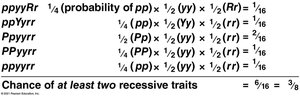
Multiplication Rule: Probability of two independent events occurring together is the product of their individual probabilities.
Addition Rule: Probability of any one of two or more mutually exclusive events is the sum of their individual probabilities.
Extensions of Mendelian Genetics
Degrees of Dominance
Complete Dominance: Heterozygote and dominant homozygote have identical phenotypes.
Incomplete Dominance: F1 hybrids have intermediate phenotypes.
Codominance: Both alleles affect the phenotype in distinguishable ways.
Multiple Alleles and Pleiotropy
Multiple Alleles: More than two allelic forms exist for a gene (e.g., ABO blood groups).
Pleiotropy: One gene affects multiple phenotypic traits (e.g., sickle-cell disease).
Epistasis and Polygenic Inheritance
Epistasis: One gene affects the expression of another gene (e.g., coat color in Labrador retrievers).
Polygenic Inheritance: Multiple genes independently affect a single trait (e.g., height, skin color).
Environmental Impact on Phenotype
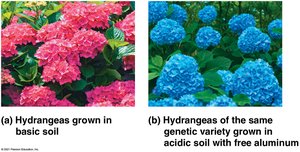
The environment can influence the expression of genetic traits, leading to multifactorial inheritance.
Multifactorial Traits: Traits influenced by both genetic and environmental factors.
Human Genetics and Mendelian Patterns
Pedigree Analysis
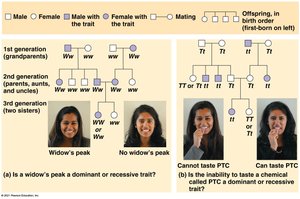
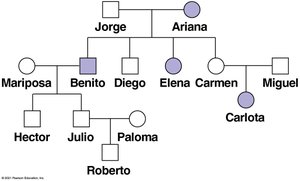
Pedigrees are used to track inheritance patterns in families.
Pedigree: Family tree showing inheritance of traits across generations.
Recessively Inherited Disorders
Albinism: Lack of pigmentation due to recessive alleles.
Cystic Fibrosis: Defective chloride transport channels; recessive inheritance.
Sickle-Cell Disease: Abnormal hemoglobin; recessive inheritance with evolutionary implications.
Dominantly Inherited Disorders
Achondroplasia: Dwarfism caused by a dominant allele.
Huntington's Disease: Degenerative nervous system disorder; dominant allele with late onset.
Genetic Testing and Counseling
Genetic counselors help assess risks for inherited diseases. Fetal and newborn testing can detect genetic disorders early.
Amniocentesis: Testing fetal cells from amniotic fluid.
Chorionic Villus Sampling (CVS): Testing placental cells.
Newborn Screening: Routine tests for genetic disorders in newborns.
Summary Table: Key Mendelian Concepts
Concept | Description |
|---|---|
Law of Segregation | Alleles separate during gamete formation |
Law of Independent Assortment | Alleles of different genes segregate independently |
Complete Dominance | Dominant allele masks recessive |
Incomplete Dominance | Intermediate phenotype in heterozygotes |
Codominance | Both alleles expressed |
Multiple Alleles | More than two alleles for a gene |
Pleiotropy | One gene affects multiple traits |
Epistasis | One gene affects expression of another |
Polygenic Inheritance | Multiple genes affect one trait |
Multifactorial Traits | Genetic and environmental influences |
Probability Equations in Genetics
Multiplication Rule:
Addition Rule:
Conclusion
Mendelian genetics provides the foundation for understanding inheritance, but real-world patterns are often more complex due to dominance relationships, multiple alleles, gene interactions, and environmental effects. Pedigree analysis and genetic testing are essential tools for studying human inheritance and managing genetic disorders. Additional info: The notes include expanded explanations and context for each concept to ensure completeness and academic quality.
