 Indietro
Chapter 14
Guida di studio - Note intelligenti
 Appunti personalizzati basati sui tuoi materiali, ampliati con definizioni chiave, esempi e contesto.
Mendelian Genetics: Principles and Applications
Key Concepts and Vocabulary
This section introduces the foundational concepts of Mendelian genetics, including the difference between a character and a trait, the significance of pea plants in genetic studies, and the laws of inheritance.
Character: A heritable feature that varies among individuals (e.g., flower color).
Trait: Each variant for a character (e.g., purple or white flowers).
Allele: Alternative versions of a gene found at the same locus on homologous chromosomes.
Genotype: The genetic makeup of an organism.
Phenotype: The observable physical traits of an organism.
Peas are ideal for genetic testing due to their short generation time, large numbers of offspring, and controlled mating capabilities.
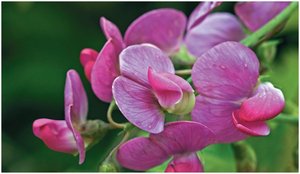
Mendel's Experimental Approach
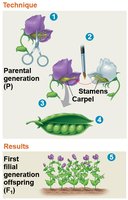
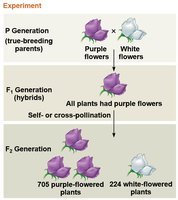
Mendel used garden peas to study inheritance, tracking characters with two distinct forms and starting with true-breeding varieties. He performed hybridization by crossing contrasting varieties and observed the resulting generations.
P Generation: True-breeding parents.
F1 Generation: Hybrid offspring of the P generation.
F2 Generation: Offspring from self- or cross-pollination of F1 individuals.
Mendel's Laws of Inheritance
Mendel identified two fundamental laws: the Law of Segregation and the Law of Independent Assortment. He observed consistent patterns of inheritance across multiple pea plant characters.
Law of Segregation: Two alleles for a heritable character separate during gamete formation, so each gamete carries only one allele.
Law of Independent Assortment: Each pair of alleles segregates independently during gamete formation, applying to genes on different chromosomes or far apart on the same chromosome.
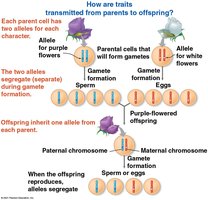
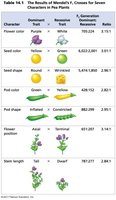
Genetic Vocabulary and Mendel's Model
Mendel developed a model to explain inheritance patterns, introducing the concepts of alleles, homozygosity, heterozygosity, dominance, and recessiveness.
Homozygous: Two identical alleles for a gene (e.g., PP or pp).
Heterozygous: Two different alleles for a gene (e.g., Pp).
Dominant allele: Determines the organism's appearance.
Recessive allele: Has no noticeable effect on appearance unless homozygous.
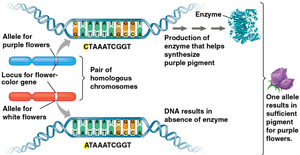
Punnett Squares and Genetic Ratios
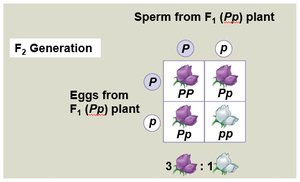
Punnett squares are used to predict the outcome of genetic crosses. The classic monohybrid cross yields a 3:1 phenotypic ratio in the F2 generation.
Punnett Square: Diagram showing possible combinations of alleles from parental gametes.
Phenotypic Ratio: 3 purple : 1 white in F2 generation.
Genotypic Ratio: 1 PP : 2 Pp : 1 pp.
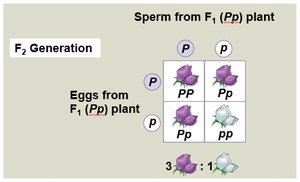
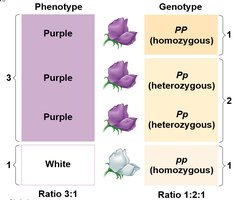
The Testcross
A testcross is used to determine the genotype of an individual with a dominant phenotype by crossing it with a homozygous recessive individual.
If any offspring display the recessive phenotype, the mystery parent is heterozygous.
Law of Independent Assortment and Dihybrid Crosses
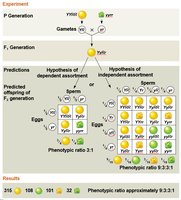
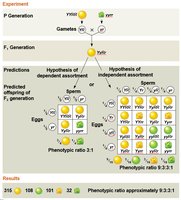
Dihybrid crosses involve two characters and demonstrate the law of independent assortment, resulting in a 9:3:3:1 phenotypic ratio in the F2 generation.
Dihybrid Cross: Cross between individuals heterozygous for two characters.
Phenotypic Ratio: 9:3:3:1 for independent assortment.
Probability Rules in Genetics
Probability laws govern Mendelian inheritance. The multiplication rule calculates the probability of independent events occurring together, while the addition rule calculates the probability of mutually exclusive events.
Multiplication Rule:
Addition Rule: Probability of either event occurring is the sum of their individual probabilities.

Complex Patterns of Inheritance
Inheritance patterns can deviate from simple Mendelian genetics due to incomplete dominance, codominance, multiple alleles, pleiotropy, epistasis, and polygenic inheritance.
Complete Dominance: Heterozygote and dominant homozygote have identical phenotypes.
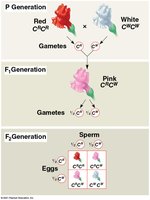
Incomplete Dominance: F1 hybrids have intermediate phenotypes.
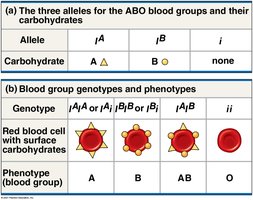
Codominance: Both alleles affect the phenotype in distinguishable ways.
Multiple Alleles: More than two allelic forms exist (e.g., ABO blood groups).
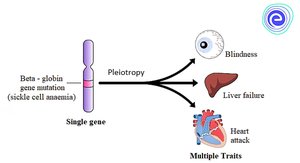
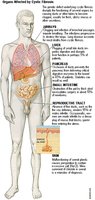
Pleiotropy: One gene affects multiple traits.
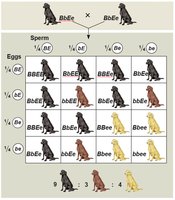
Epistasis: One gene alters the expression of another gene.
Polygenic Inheritance: Multiple genes contribute to a single phenotype.
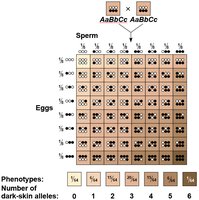
Environmental Impact on Phenotype
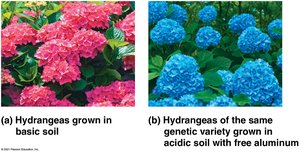
Phenotype can be influenced by environmental factors as well as genotype. Multifactorial traits depend on both genetic and environmental components.
Example: Hydrangea flower color varies with soil pH.
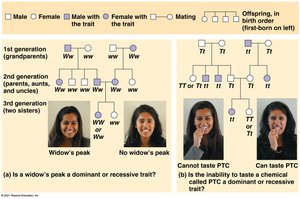
Human Genetics and Pedigree Analysis
Human genetics relies on pedigree analysis to study inheritance patterns. Pedigrees are family trees that track traits across generations and help predict probabilities of future offspring inheriting specific traits.
Pedigree: Diagram showing inheritance of traits in families.
Inherited Disorders: Recessive and Dominant
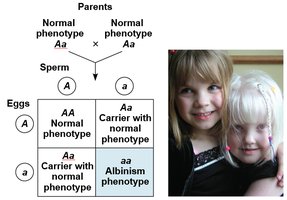
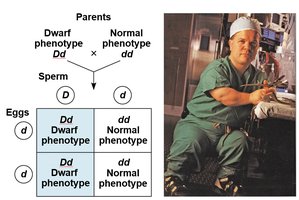
Inherited disorders can be recessive or dominant. Recessive disorders appear only in homozygous individuals, while dominant disorders can appear in heterozygotes.
Recessive Disorders: Albinism, cystic fibrosis.
Dominant Disorders: Achondroplasia, Huntington's disease.
Carriers: Heterozygous individuals who carry the recessive allele but are phenotypically normal.
Multifactorial Disorders and Genetic Counseling
Many diseases have both genetic and environmental components. Genetic counseling and testing help prospective parents assess risks and make informed decisions.
Multifactorial Disorders: Heart disease, cancer, alcoholism, mental illnesses.
Genetic Counseling: Provides information about risks and probabilities based on Mendelian genetics.
Example: If both parents are carriers for a recessive disease, the probability of having an affected child is calculated using probability rules.
Equation:
Summary Table: Mendel's Seven Pea Plant Characters
Character | Dominant Trait | Recessive Trait | F2 Generation Ratio |
|---|---|---|---|
Flower color | Purple | White | 3:1 |
Seed shape | Round | Wrinkled | 3:1 |
Seed color | Yellow | Green | 3:1 |
Pod shape | Inflated | Constricted | 3:1 |
Pod color | Green | Yellow | 3:1 |
Flower position | Axial | Terminal | 3:1 |
Stem length | Tall | Dwarf | 3:1 |
