 Indietro
Mendelian Genetics and the Gene Idea: Principles of Heredity
Guida di studio - Note intelligenti
 Appunti personalizzati basati sui tuoi materiali, ampliati con definizioni chiave, esempi e contesto.
Mendel and the Gene Idea
Introduction to Mendelian Genetics
Mendelian genetics is the foundation of classical genetics, describing how traits are inherited from one generation to the next through discrete units called genes. Gregor Mendel's experiments with pea plants led to the discovery of fundamental laws of inheritance.
Gene: A heritable factor that determines a character and is passed from parent to offspring.
Allele: Alternative versions of a gene that account for variations in inherited characters.
Chromosome: Structure carrying genetic information; genes are located on chromosomes.
Genes, Alleles, and Chromosomes
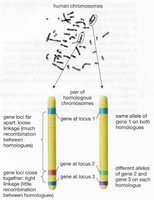
Genes exist in pairs on homologous chromosomes, one from each parent. During gamete formation, these pairs segregate so that each gamete receives only one allele from each pair.
Homologous chromosomes carry the same genes but may have different alleles.
Alleles are found at specific loci on chromosomes.
Fertilization and the Human Life Cycle
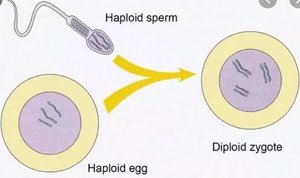
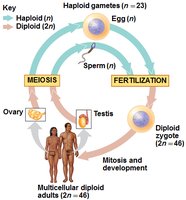
Fertilization is the union of haploid gametes (egg and sperm), resulting in a diploid zygote. The zygote divides by mitosis to form a multicellular organism.
Gametes are produced by meiosis and are haploid (n).
Somatic cells are diploid (2n), containing two sets of chromosomes.
Meiosis and Chromosome Segregation
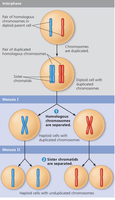
Meiosis is the process by which diploid cells produce haploid gametes, ensuring genetic diversity and maintaining chromosome number across generations.
Meiosis I: Homologous chromosomes separate, producing two haploid cells with duplicated chromosomes.
Meiosis II: Sister chromatids separate, resulting in four genetically distinct haploid gametes.
Mendel’s Experimental Approach
Mendel’s Pea Plant Experiments
Mendel used pea plants because they had easily observable traits, short generation times, and could self- or cross-pollinate. He tracked traits that occurred in two distinct forms using true-breeding plants.
True-breeding: Plants that produce offspring identical to themselves when self-fertilized.
Hybridization: Mating of two contrasting true-breeding varieties (P generation) to produce F1 hybrids.
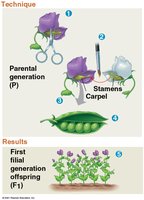
Results of Mendel’s Crosses
When Mendel crossed true-breeding purple and white flowered plants, all F1 offspring were purple. Self-pollination of F1 plants produced F2 offspring in a 3:1 ratio of purple to white flowers.
Dominant trait: Trait that appears in the F1 generation (purple flowers).
Recessive trait: Trait that is masked in the F1 but reappears in the F2 generation (white flowers).
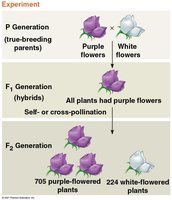
Quantitative Results of Mendel’s Crosses
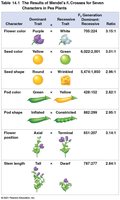
Mendel observed similar 3:1 ratios for six other pea plant characters, each with two contrasting traits.
Character | Dominant Trait | Recessive Trait | F2 Ratio |
|---|---|---|---|
Flower color | Purple | White | 3.15:1 |
Seed color | Yellow | Green | 3.01:1 |
Seed shape | Round | Wrinkled | 2.96:1 |
Pod color | Green | Yellow | 2.82:1 |
Pod shape | Inflated | Constricted | 2.95:1 |
Flower position | Axial | Terminal | 3.14:1 |
Stem length | Tall | Dwarf | 2.84:1 |
Mendel’s Model of Inheritance
Four Concepts of Mendel’s Model
Mendel’s model explains the 3:1 inheritance pattern in F2 offspring:
Alternative versions of genes (alleles) account for variations in inherited characters.
Each organism inherits two alleles for each gene, one from each parent.
If the alleles differ, the dominant allele determines the phenotype; the recessive allele has no noticeable effect.
Law of Segregation: The two alleles for a heritable character segregate during gamete formation and end up in different gametes.
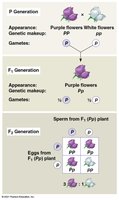
Genotype vs. Phenotype
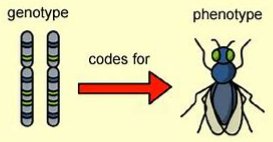
Genotype: The genetic makeup of an organism (e.g., PP, Pp, pp).
Phenotype: The observable physical or physiological traits (e.g., purple or white flowers).
Homozygous: Two identical alleles for a gene.
Heterozygous: Two different alleles for a gene.
Solving Genetics Problems
Punnett Squares and Testcrosses
Punnett squares are used to predict the probability of offspring genotypes and phenotypes. A testcross can determine if an individual with a dominant phenotype is homozygous or heterozygous. 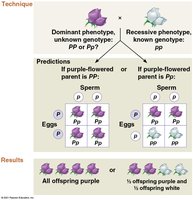
Monohybrid and Dihybrid Crosses
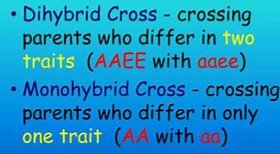
Monohybrid cross: Cross between individuals heterozygous for one character.
Dihybrid cross: Cross between individuals heterozygous for two characters, used to study the Law of Independent Assortment.
Law of Independent Assortment
Principle and Application
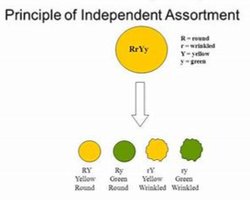
The Law of Independent Assortment states that each pair of alleles segregates independently of other pairs during gamete formation. This applies to genes on different chromosomes or far apart on the same chromosome.
Genes located close together on the same chromosome tend to be inherited together (linked genes).
Extensions of Mendelian Genetics
Incomplete Dominance and Codominance
Incomplete dominance: Heterozygotes have a phenotype intermediate between the two homozygotes (e.g., pink snapdragons from red and white parents).
Codominance: Both alleles are fully expressed in the phenotype (e.g., human ABO blood types).
Pleiotropy and Polygenic Inheritance
Pleiotropy: One gene affects multiple phenotypic traits (e.g., Marfan syndrome, sickle cell disease).
Polygenic inheritance: Multiple genes contribute additively to a single trait (e.g., human skin color, height).
Environmental Impact on Phenotype
Phenotype can be influenced by both genotype and environmental factors (multifactorial traits).
Example: Hydrangea flower color varies with soil pH.
Human Genetics and Pedigree Analysis
Pedigree Analysis
Pedigrees are family trees used to study inheritance patterns of traits in humans. They help predict the probability of genetic disorders in offspring.
Autosomal Dominant and Recessive Inheritance
Autosomal dominant: Trait appears in every generation; affected individuals have at least one affected parent.
Autosomal recessive: Trait can skip generations; affected individuals often have unaffected carrier parents.
Examples of Genetic Disorders
Albinism: Recessive disorder causing lack of pigmentation.
Sickle Cell Disease: Recessive disorder with pleiotropic effects.
Achondroplasia: Dominant disorder causing dwarfism.
Summary
Mendel’s principles of segregation and independent assortment form the basis of classical genetics. Extensions such as incomplete dominance, codominance, pleiotropy, polygenic inheritance, and environmental effects illustrate the complexity of inheritance patterns in living organisms. Additional info: This guide integrates foundational Mendelian genetics with modern understanding of gene interactions, chromosomal behavior, and human genetic analysis for comprehensive exam preparation.
