 Indietro
Mendelian Genetics: Principles and Patterns of Inheritance
Guida di studio - Note intelligenti
 Appunti personalizzati basati sui tuoi materiali, ampliati con definizioni chiave, esempi e contesto.
Mendelian Genetics
Introduction to Mendelian Genetics
Mendelian genetics explores how traits are transmitted from parents to offspring, forming the foundation of classical genetics. Gregor Mendel's experiments with garden peas led to the discovery of fundamental laws governing inheritance.
Character: A heritable feature, such as flower color.
Trait: A specific variant of a character, such as purple or white flowers.
Mendel used true-breeding plants and focused on characters with two contrasting traits.
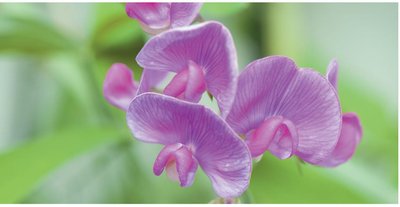
Mendel’s Experimental Approach
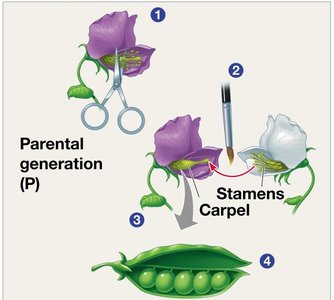
Mendel controlled pollination in pea plants to study inheritance. He removed stamens to prevent self-pollination and transferred pollen from another plant to achieve cross-pollination. This allowed him to track traits across generations.
Hybridization: Crossing two contrasting, true-breeding varieties.
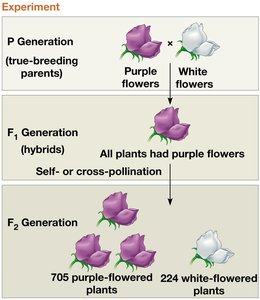
P generation: Parental generation.
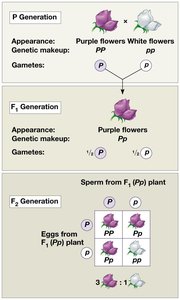
F1 generation: Offspring of the P generation; all had purple flowers.
F2 generation: Offspring produced by the F1 generation; showed a 3:1 ratio of purple to white flowers.
Results of Mendel’s Crosses
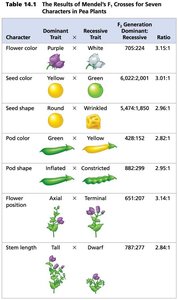
Mendel studied seven characters in pea plants, each with dominant and recessive traits. The F2 generation consistently showed a dominant:recessive ratio close to 3:1.
Character | Dominant Trait | Recessive Trait | F2 Ratio |
|---|---|---|---|
Flower color | Purple | White | 3.15:1 |
Seed color | Yellow | Green | 3.01:1 |
Seed shape | Round | Wrinkled | 2.96:1 |
Pod color | Green | Yellow | 2.82:1 |
Pod shape | Inflated | Constricted | 2.96:1 |
Flower position | Axial | Terminal | 3.14:1 |
Stem length | Tall | Dwarf | 2.84:1 |
Mendel’s Model of Inheritance
Alleles and Genes
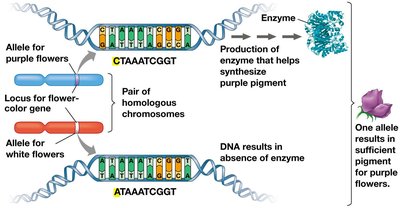
Genes exist in alternative forms called alleles. Each gene is located at a specific locus on a chromosome, and organisms inherit two alleles for each gene—one from each parent.
Homozygous: Identical alleles (e.g., AA or aa).
Heterozygous: Different alleles (e.g., Aa).
Dominance Relationships
When two alleles differ, one may determine the phenotype. The dominant allele masks the effect of the recessive allele in heterozygotes.
Dominant allele: Determines phenotype in heterozygotes.
Recessive allele: Masked in heterozygotes.
Law of Segregation
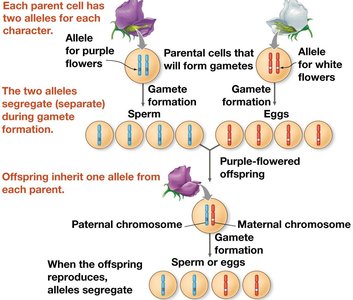
The two alleles for a gene separate during gamete formation, so each gamete receives only one allele. This corresponds to the separation of homologous chromosomes during meiosis.
Punnett Squares and Ratios
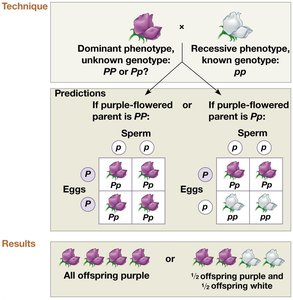
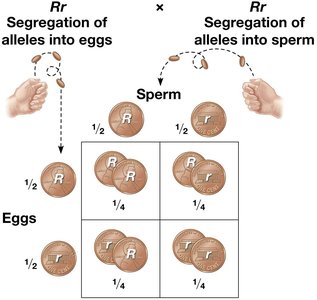
Punnett squares are used to predict possible allele combinations in offspring. Capital letters represent dominant alleles, and lowercase letters represent recessive alleles. Mendel’s model explains the 3:1 ratio observed in the F2 generation.
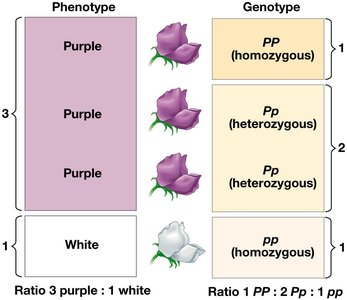
Genotype ratio: 1 PP : 2 Pp : 1 pp
Phenotype ratio: 3 purple : 1 white
Testcross
A testcross is used to determine the genotype of an individual with a dominant phenotype by crossing it with a homozygous recessive individual. If any offspring display the recessive phenotype, the mystery parent must be heterozygous.
Law of Independent Assortment
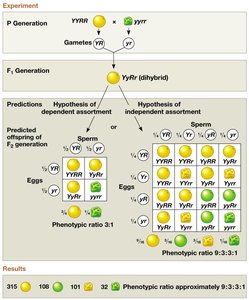
The law of independent assortment states that alleles of different genes assort independently during gamete formation. This was demonstrated by dihybrid crosses, which produced a phenotypic ratio of 9:3:3:1 in the F2 generation.
Probability in Genetics
Probability Rules
Probability laws govern Mendelian inheritance. The multiplication rule is used for independent events (AND = multiply), and the addition rule is used for mutually exclusive outcomes (OR = add).
Multiplication rule:
Addition rule:
Beyond Simple Mendelian Genetics
Degrees of Dominance
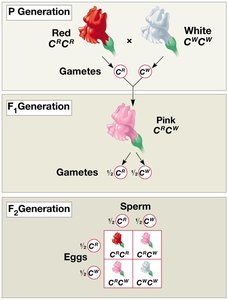
Alleles can show different dominance relationships, including complete dominance, incomplete dominance, and codominance.
Complete dominance: Heterozygote resembles one homozygote.
Incomplete dominance: Heterozygote has an intermediate phenotype.
Codominance: Both phenotypes are expressed in the heterozygote.
Multiple Alleles
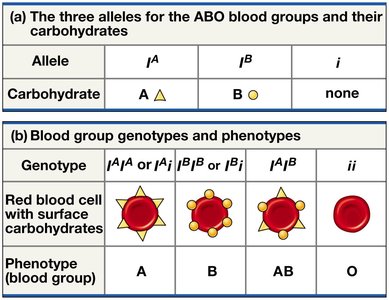
Most genes exist in populations in more than two allelic forms. The ABO blood group in humans is determined by three alleles for the enzyme that attaches A or B carbohydrates to red blood cells.
Allele | Carbohydrate |
|---|---|
IA | A |
IB | B |
i | none |
Genotype | Phenotype (Blood Group) |
|---|---|
IAIA or IAi | A |
IBIB or IBi | B |
IAIB | AB |
ii | O |
Pleiotropy
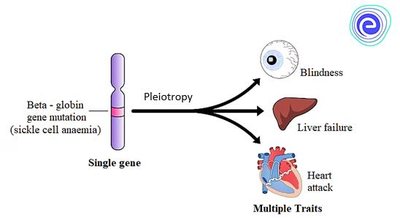
Pleiotropy occurs when one gene affects multiple traits. For example, the sickle cell anemia gene influences several symptoms, including blindness, liver failure, and heart attack.
Polygenic Inheritance
Polygenic inheritance involves multiple genes contributing to a single trait, often resulting in continuous variation. Examples include height and skin pigmentation.
Epistasis
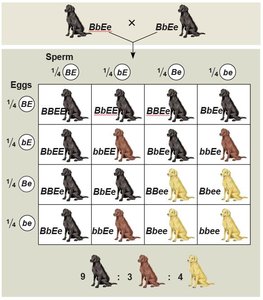
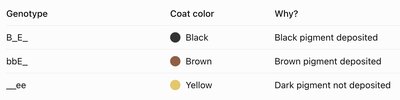
Epistasis occurs when one gene at one locus masks or modifies the phenotypic expression of another gene at a second locus. In Labrador retrievers, the E/e gene controls pigment deposition, and the B/b gene determines pigment color.
Genotype | Coat Color | Why? |
|---|---|---|
B_E_ | Black | Black pigment deposited |
bbE_ | Brown | Brown pigment deposited |
__ee | Yellow | Dark pigment not deposited |
Environmental Impact on Phenotype
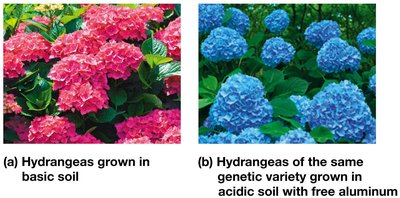
Phenotype is influenced by both genes and environment. Phenotypic plasticity describes how the same genotype can produce different phenotypes in different environments. For example, hydrangea flower color changes with soil conditions.
Human Genetics
Mendelian Patterns in Humans
Many human traits follow Mendelian patterns of inheritance. Human genetic research relies on family studies due to ethical and practical limitations.
Recessively Inherited Disorders
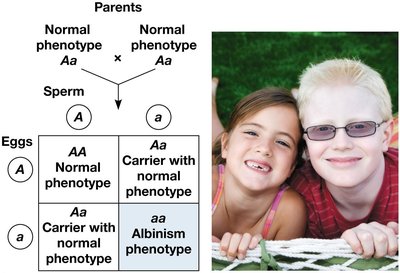
Recessive disorders require individuals to be homozygous recessive (aa). Carriers (Aa) possess the allele but usually do not show the phenotype. Two carriers have a 25% chance of producing an affected offspring. Example: albinism.
Dominantly Inherited Disorders
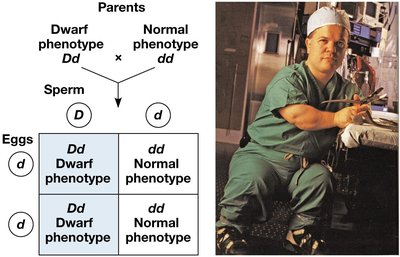
One dominant disease allele is sufficient to produce the phenotype. An affected heterozygous parent can pass the allele to 50% of offspring. Examples include achondroplasia and Huntington’s disease.
Multifactorial Disorders
Many common diseases, such as heart disease, cancer, alcoholism, and mental illnesses, have both genetic and environmental components. Genetic variation can influence risk, rather than completely determine phenotype.
Summary: Mendelian Genetics Study Map
Mendel’s Principles: Segregation, independent assortment, genotype determines phenotype.
Predicting Inheritance: Punnett squares, probability rules (AND = multiply, OR = add).
Beyond Mendelian Genetics: Incomplete dominance, codominance, multiple alleles, pleiotropy, polygenic inheritance, epistasis, environmental effects.
Human Genetics: Recessive and dominant disorders, multifactorial traits.
Big Picture: Mendelian principles are the foundation, but real inheritance can be more complex.
