 Indietro
Mendelian Genetics: Principles and Patterns of Inheritance
Guida di studio - Note intelligenti
 Appunti personalizzati basati sui tuoi materiali, ampliati con definizioni chiave, esempi e contesto.
Mendel and the Gene Idea
Introduction to Mendelian Genetics
Gregor Mendel's experiments with pea plants established the foundational principles of heredity, which explain how traits are transmitted from parents to offspring. Mendel's systematic approach and use of true-breeding varieties allowed him to deduce laws that underpin modern genetics.
Characters and Traits
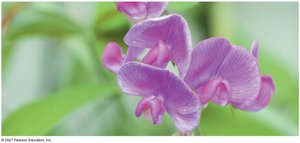
A character is a heritable feature that varies among individuals, such as flower color. Each variant for a character, like purple or white flowers, is called a trait. Mendel selected pea plants for their variety, short generation time, large offspring numbers, and controllable mating.
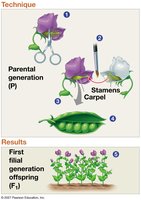
True-breeding: Plants that produce offspring of the same variety when self-pollinated.
Hybridization: Mating two contrasting, true-breeding varieties.
Mendel's Experimental Design
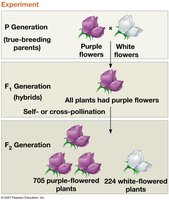
Mendel tracked characters with two distinct forms and began with true-breeding plants. He mated these to produce hybrids and observed the inheritance patterns across generations.
Results of Mendel's Crosses
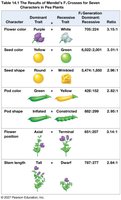
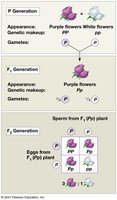
When Mendel crossed F1 hybrids, he observed a 3:1 ratio of purple to white flowers in the F2 generation. This pattern was consistent across several characters.
Character | Dominant Trait | Recessive Trait | Ratio |
|---|---|---|---|
Flower color | Purple | White | 3.15:1 |
Seed shape | Round | Wrinkled | 2.96:1 |
Seed color | Yellow | Green | 2.82:1 |
Pod shape | Inflated | Constricted | 2.84:1 |
Pod color | Green | Yellow | 2.83:1 |
Flower position | Axial | Terminal | 3.14:1 |
Stem length | Tall | Dwarf | 2.84:1 |
Mendel's Model of Inheritance
Four Key Concepts
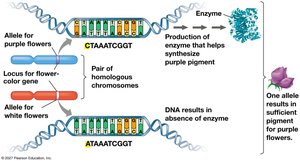
Mendel proposed a model to explain the 3:1 inheritance pattern, which can be related to modern understanding of genes and chromosomes:
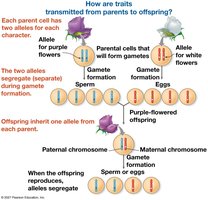
Alternative versions of genes (alleles) account for variations in inherited characters. Each gene resides at a specific locus on a chromosome.
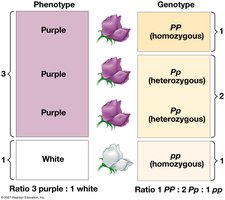
Each organism inherits two alleles, one from each parent. Alleles may be identical (homozygous) or different (heterozygous).
If the two alleles differ, the dominant allele determines the phenotype. The recessive allele has no noticeable effect.
Law of Segregation: The two alleles for a character separate during gamete formation, so each gamete carries only one allele.
Punnett Square and Law of Segregation
The Punnett square is a tool to visualize allele combinations in offspring. Mendel's law of segregation explains the 3:1 ratio observed in the F2 generation.
Phenotype vs. Genotype
Phenotype is the physical appearance, while genotype is the genetic makeup. Individuals with the same phenotype may have different genotypes.
Testcross
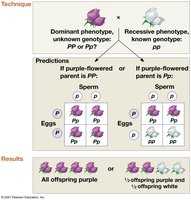
A testcross determines the genotype of an individual with a dominant phenotype by crossing it with a homozygous recessive individual.
Monohybrid and Dihybrid Crosses
Monohybrid Cross
A monohybrid cross involves heterozygotes for a single character. Mendel derived the law of segregation from such crosses.
Dihybrid Cross and Law of Independent Assortment
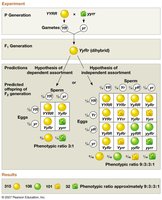
A dihybrid cross involves heterozygotes for two characters. Mendel's law of independent assortment states that alleles of different genes segregate independently during gamete formation, applying to genes on different chromosomes or far apart on the same chromosome.
Extensions of Mendelian Genetics
Complete, Incomplete, and Codominance
Inheritance patterns may deviate from simple Mendelian rules:
Complete dominance: Heterozygote and dominant homozygote have identical phenotypes.
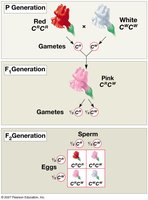
Incomplete dominance: Heterozygote phenotype is intermediate between parental phenotypes.
Codominance: Both alleles affect the phenotype in distinct ways.
Multiple Alleles and ABO Blood Groups
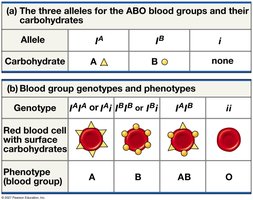
Many genes exist in more than two allelic forms. The ABO blood group in humans is determined by three alleles, resulting in four phenotypes.
Allele | Carbohydrate |
|---|---|
IA | A |
IB | B |
i | none |
Genotype | Phenotype (Blood Group) |
|---|---|
IAIA or IAi | A |
IBIB or IBi | B |
IAIB | AB |
ii | O |
Pleiotropy
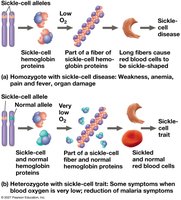
Pleiotropy occurs when one gene affects multiple phenotypic traits. Examples include cystic fibrosis and sickle-cell disease.
Epistasis
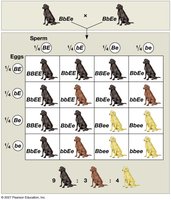
In epistasis, one gene affects the expression of another gene. For example, Labrador retriever coat color depends on two genes: one for pigment color and one for pigment deposition.
Polygenic Inheritance
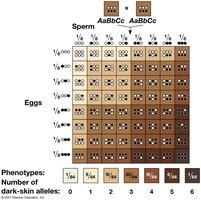
Polygenic inheritance involves multiple genes contributing to a single trait, resulting in quantitative characters that vary along a continuum, such as height and skin color.
Environmental Influence and Multifactorial Traits
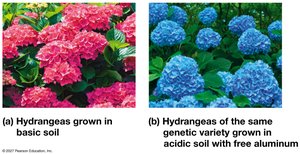
Phenotype can be influenced by both genotype and environment. Phenotypic plasticity describes the ability to produce different phenotypes under varying conditions. Multifactorial traits depend on multiple genes and environmental factors.
Human Genetics and Pedigree Analysis
Pedigrees
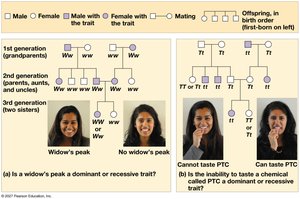
Pedigrees are family trees used to analyze the inheritance of traits across generations. They help identify dominant and recessive traits in humans.
Recessively Inherited Disorders
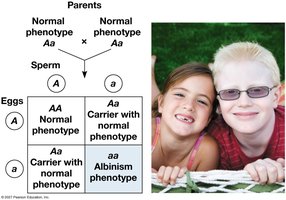
Recessive disorders appear only in individuals homozygous for the allele. Carriers are heterozygous and phenotypically normal. Examples include albinism, cystic fibrosis, and sickle-cell disease.
Dominantly Inherited Disorders
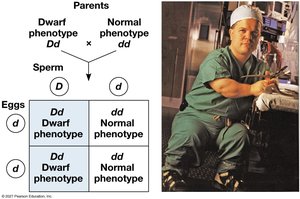
Dominant alleles causing disease are rare and often arise by mutation. Examples include achondroplasia (dwarfism) and Huntington's disease.
Genetic Testing and Counseling
Genetic counselors provide information to prospective parents about inherited diseases. Fetal and newborn testing can reveal genetic disorders, and lifestyle choices can significantly affect phenotype, even for multifactorial diseases.
