 Indietro
Mendelian Genetics: Principles, Crosses, and Probability in Heredity
Guida di studio - Note intelligenti
 Appunti personalizzati basati sui tuoi materiali, ampliati con definizioni chiave, esempi e contesto.
Mendelian Genetics
Introduction to Mendelian Genetics
Mendelian genetics is the foundation of classical genetics, describing how traits are inherited from one generation to the next through discrete units called genes. Gregor Mendel's experiments with pea plants established the principles of segregation and independent assortment, which explain the inheritance patterns of many traits.
Mendelian trait: A trait governed by a single gene with dominant and recessive alleles.
Dominant allele: The allele that masks the effect of the recessive allele in heterozygotes.
Recessive allele: The allele whose effect is masked in the presence of a dominant allele.
Mendel's Experimental Approach
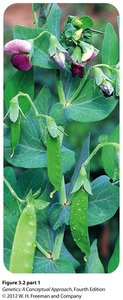
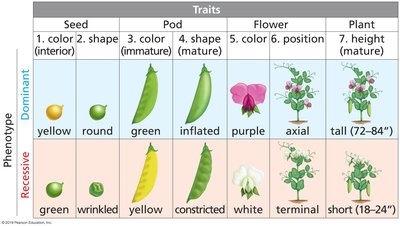
Mendel used pure-breeding pea plants to study inheritance, focusing on seven dichotomous traits. He meticulously recorded data from thousands of plants, ensuring statistical reliability.
Pisum sativum: The scientific name for the pea plant used in Mendel's experiments.
Pure-breeding (homozygous): Plants that consistently produce offspring with the same trait.
Principle of Segregation (Mendel's First Law)
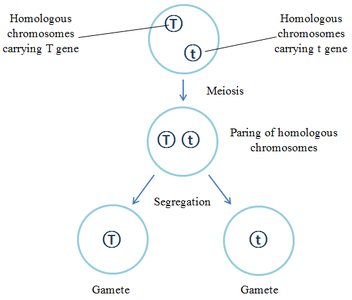
The principle of segregation states that each individual possesses two alleles for any given trait, and these alleles segregate during gamete formation, so each gamete receives only one allele.
Monohybrid cross: A cross between two parents differing in a single trait (e.g., GG x gg).
Segregation: The separation of alleles during meiosis.
Concept of Dominance
When two different alleles are present, only the dominant allele is expressed in the phenotype.
Phenotype: The observable trait (e.g., flower color).
Genotype: The genetic makeup (e.g., BB, Bb, or bb).
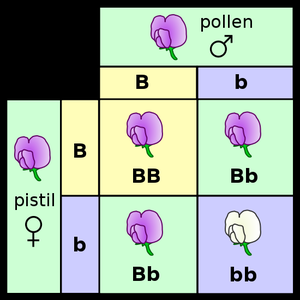
Monohybrid Crosses and Ratios
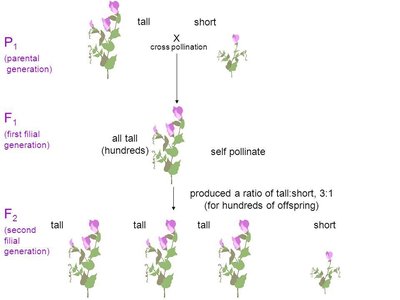
Monohybrid crosses typically yield a 3:1 phenotypic ratio in the F2 generation, with genotypic ratios of 1:2:1.
Example: Crossing two heterozygous pea plants (Bb x Bb) produces offspring with a 3:1 ratio of purple to white flowers.
Meiosis and Mendelian Genetics
Meiosis is the process by which alleles segregate into gametes, ensuring genetic diversity and the foundation for Mendelian inheritance.
Homologous chromosomes: Chromosome pairs carrying the same genes but possibly different alleles.
Gamete: A reproductive cell (sperm or egg) containing a single set of chromosomes.
Classification of Genotypes
Genotypes can be classified as homozygous dominant, homozygous recessive, or heterozygous.
Homozygous dominant: Two dominant alleles (e.g., TT).
Homozygous recessive: Two recessive alleles (e.g., tt).
Heterozygous: One dominant and one recessive allele (e.g., Tt).
Autosomal Dominant and Recessive Traits
Autosomal traits are inherited on non-sex chromosomes. Dominant traits appear in every generation, while recessive traits can skip generations.
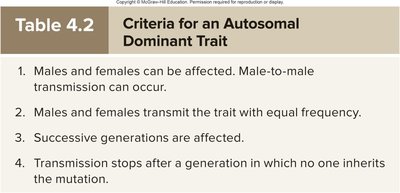
Criteria for Autosomal Dominant Trait |
|---|
Males and females can be affected. Male-to-male transmission can occur. |
Males and females transmit the trait with equal frequency. |
Successive generations are affected. |
Transmission stops after a generation in which no one inherits the mutation. |
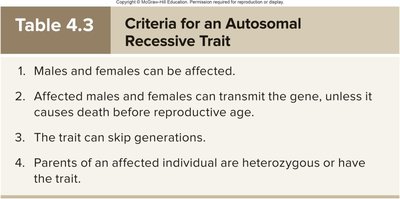
Criteria for Autosomal Recessive Trait |
|---|
Males and females can be affected. |
Affected males and females can transmit the gene, unless it causes death before reproductive age. |
The trait can skip generations. |
Parents of an affected individual are heterozygous or have the trait. |
Effects of Mutations
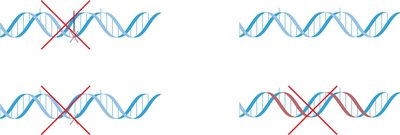
Mutations can result in loss-of-function or gain-of-function alleles, affecting the phenotype.
Loss-of-function: No protein is made, often resulting in recessive traits.
Gain-of-function: Excess or altered protein, often resulting in dominant traits.
Dihybrid Crosses and the Law of Independent Assortment
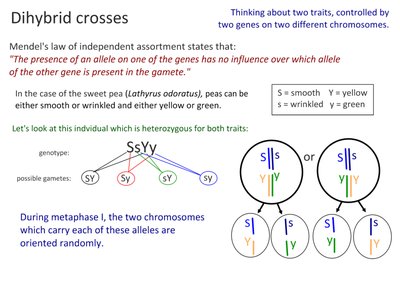
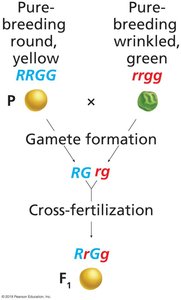
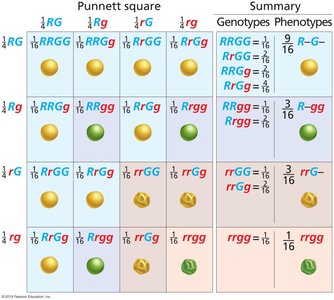
Dihybrid crosses involve two traits and demonstrate Mendel's second law: alleles of different genes assort independently during gamete formation.
Independent assortment: The presence of an allele for one gene does not affect the presence of an allele for another gene.
Phenotypic ratio: Dihybrid crosses typically yield a 9:3:3:1 ratio in the F2 generation.
Probability in Genetics
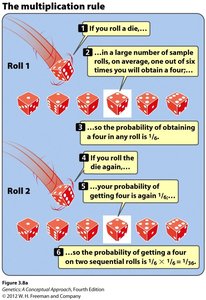
Probability rules help predict genetic outcomes.
Product rule: The probability of two independent events occurring together is the product of their individual probabilities.
Addition rule: The probability of either of two mutually exclusive events occurring is the sum of their individual probabilities.
Punnett Squares and Genotype Prediction
Punnett squares are used to visualize genetic crosses and predict genotype and phenotype frequencies.
Example: The probability of producing a yy genotype from a Yy x Yy cross is 1/4.
Forked-line diagram: A shortcut for predicting genotype frequencies in complex crosses.
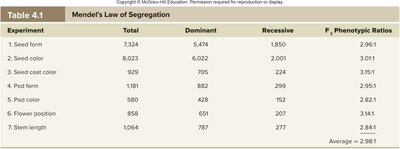
Summary Table: Mendel's Law of Segregation
Experiment | Total | Dominant | Recessive | F2 Phenotypic Ratio |
|---|---|---|---|---|
Seed form | 7,324 | 5,474 | 1,850 | 2.96:1 |
Seed color | 8,023 | 6,022 | 2,001 | 3.01:1 |
Seed coat color | 929 | 705 | 224 | 3.15:1 |
Pod form | 1,181 | 882 | 299 | 2.95:1 |
Pod color | 580 | 428 | 152 | 2.82:1 |
Flower position | 858 | 651 | 207 | 3.14:1 |
Stem length | 1,064 | 787 | 277 | 2.84:1 |
Applications and Practice Problems
Example: If two heterozygous pea plants (Bb x Bb) are crossed, the probability of producing three consecutive white-flowered offspring (bb) is .
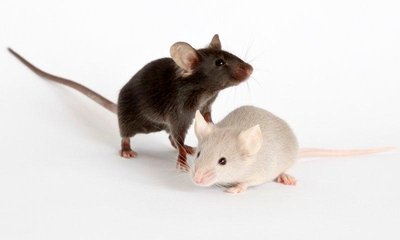
Example: In a cross between pure-breeding black and white mice, all F1 are black, and F2 shows a 3:1 ratio, indicating black is dominant and white is recessive.
Conclusion
Mendelian genetics provides a framework for understanding inheritance patterns, predicting genetic outcomes, and applying probability to biological phenomena. Mastery of these principles is essential for further study in genetics and biology. Additional info: Some diagrams and tables were expanded for clarity and completeness.
