 Indietro
Mendelian Genetics: Principles, Laws, and Applications
Guida di studio - Note intelligenti
 Appunti personalizzati basati sui tuoi materiali, ampliati con definizioni chiave, esempi e contesto.
Mendelian Genetics
Introduction to Mendelian Genetics
Mendelian genetics is the foundation of classical genetics, describing how traits are inherited from one generation to the next. Gregor Mendel's experiments with pea plants established the basic laws of inheritance, which explain the transmission of genetic information and the resulting variation in traits. 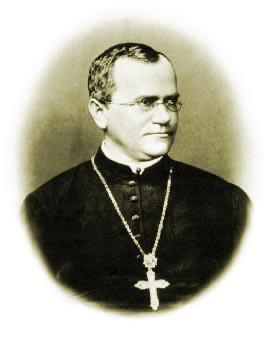
Key Terms and Concepts
- Allele: An alternative form of a gene found at a specific locus on a chromosome. - Genotype: The genetic composition of an individual, represented by the alleles present (e.g., AA, Aa, aa). - Phenotype: The observable traits or characteristics of an individual, determined by the genotype. - Homozygous: Having two identical alleles for a gene (e.g., AA or aa). - Heterozygous: Having two different alleles for a gene (e.g., Aa). - Dominant allele: The allele that masks the effect of the other in a heterozygote and determines the phenotype. - Recessive allele: The allele whose effect is masked in a heterozygote. 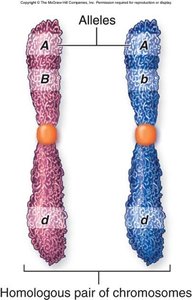
Alleles and Genes
Genes exist in multiple forms called alleles, which can lead to different traits. For example, the flower color gene in pea plants has alleles for purple and white flowers. 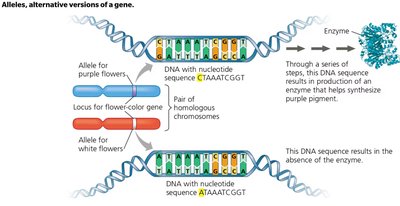
Genotype vs. Phenotype
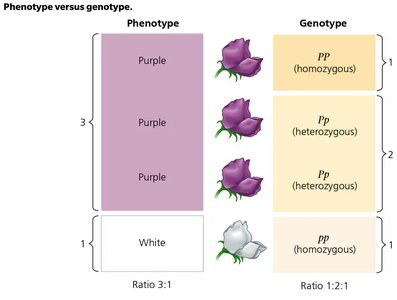
The genotype determines the phenotype, but the relationship depends on dominance. For a single gene with two alleles, the possible genotypes and phenotypes are:
Phenotype | Genotype |
|---|---|
Purple | PP (homozygous dominant) |
Purple | Pp (heterozygous) |
White | pp (homozygous recessive) |
Mendel’s Experiments and Laws
Mendel performed controlled crosses between pea plants with different traits, tracing the inheritance of traits across generations. 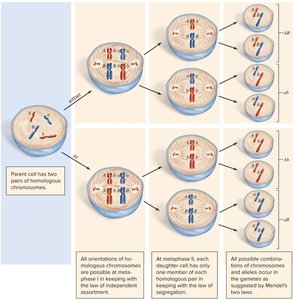
Mendel’s First Law: Principle of Segregation
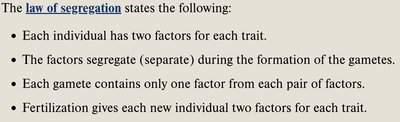
The law of segregation states that each individual has two factors (alleles) for each trait, which segregate during gamete formation. Each gamete contains only one allele from each pair, and fertilization restores the pair in offspring. 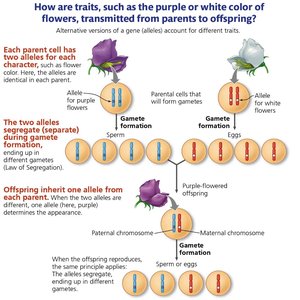
Mendel’s Second Law: Principle of Independent Assortment
The law of independent assortment states that alleles of different genes are distributed independently during gamete formation, as long as the genes are on different chromosomes. This explains the inheritance of multiple traits and the formation of new combinations. 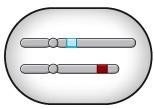
Punnett Squares and Genetic Ratios
Punnett squares are used to predict the genotypic and phenotypic ratios of offspring from genetic crosses. For a monohybrid cross (Aa x Aa): For a dihybrid cross (AaBb x AaBb):
Test Crosses
A test cross is used to determine the genotype of an individual with a dominant phenotype by crossing it with a homozygous recessive individual. - If all offspring show the dominant phenotype, the parent is homozygous dominant. - If offspring show a 1:1 ratio of dominant to recessive phenotypes, the parent is heterozygous.
Pedigrees and Autosomal Recessive Traits
Pedigrees are diagrams that trace the inheritance of traits through families. Autosomal recessive traits require two recessive alleles (e.g., bb) to be expressed.
Gene Expression and Mutation
Gene expression links genotype to phenotype. A mutation in the DNA sequence can alter the protein produced, leading to changes in phenotype. 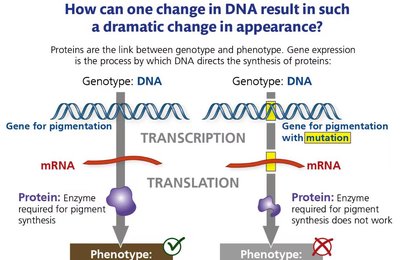
Summary Table: Key Mendelian Ratios
Cross Type | Genotype Ratio | Phenotype Ratio |
|---|---|---|
Monohybrid (Aa x Aa) | 1:2:1 | 3:1 |
Dihybrid (AaBb x AaBb) | 9:3:3:1 | 9:3:3:1 |
Applications and Practice
- Use Punnett squares to solve single and multiple trait inheritance problems. - Apply probability laws to predict outcomes of genetic crosses. - Use test crosses and pedigrees to determine genotypes and trace traits.
Examples
- Example 1: Crossing two heterozygous purple-flowered pea plants (Pp x Pp) yields a 3:1 ratio of purple to white flowers. - Example 2: A dihybrid cross (AaBb x AaBb) produces offspring with four phenotypes in a 9:3:3:1 ratio. 

Conclusion
Mendelian genetics provides the framework for understanding inheritance, genetic variation, and the relationship between genotype and phenotype. Mastery of these principles is essential for solving genetics problems and interpreting genetic data. Additional info: Mendel’s laws are foundational for modern genetics, and exceptions exist (e.g., incomplete dominance, codominance, linked genes), but classical Mendelian ratios are observed when traits are governed by single genes on separate chromosomes.
