 Indietro
Mendelian Genetics: Principles, Laws, and Applications
Guida di studio - Note intelligenti
 Appunti personalizzati basati sui tuoi materiali, ampliati con definizioni chiave, esempi e contesto.
Mendelian Genetics
Introduction to Mendelian Genetics
Mendelian genetics is the study of how traits are inherited from one generation to the next, based on the foundational work of Gregor Mendel. Mendel's experiments with pea plants revealed predictable patterns of inheritance, which are now described by his laws of segregation and independent assortment.
Basic Genetic Terminology
Genes, Alleles, and Chromosomes
Gene: A segment of DNA that encodes information for a specific trait.
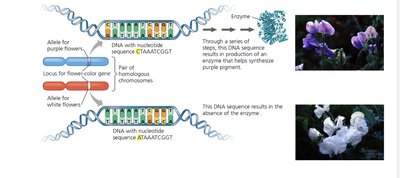
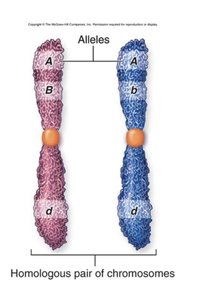
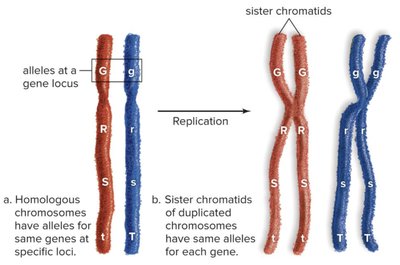
Allele: Alternate versions of a gene found at the same locus on homologous chromosomes.
Homologous Chromosomes: Chromosome pairs (one from each parent) that have genes for the same traits at the same loci, but may have different alleles.
Genotype: The genetic composition of an individual (e.g., AA, Aa, or aa).
Phenotype: The observable trait or characteristic expressed by the genotype.
Allelic Combinations
Homozygous Dominant (AA): Two dominant alleles.
Heterozygous (Aa): One dominant and one recessive allele.
Homozygous Recessive (aa): Two recessive alleles.
Gene Locus: The specific physical location of a gene on a chromosome. Allelic pairs (e.g., Tt or Gg) are found at the same locus on homologous chromosomes.
Mendel's Laws of Inheritance
Law of Segregation
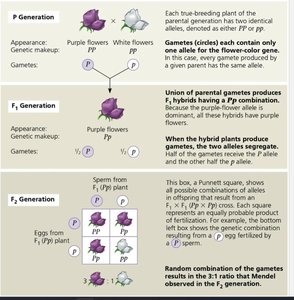
The law of segregation states that each individual has two alleles for each trait, which segregate during gamete formation so that each gamete receives only one allele. Fertilization restores the pair of alleles in the offspring.
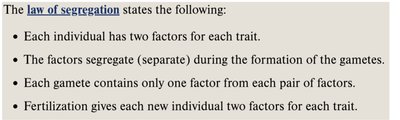
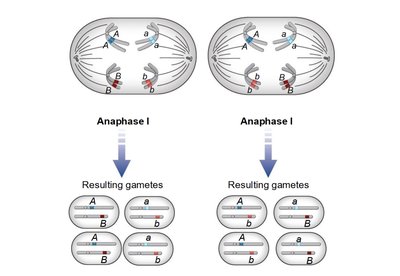
Occurs during Anaphase I of meiosis when homologous chromosomes separate.
Each gamete receives only one allele from each gene pair.
Random fertilization restores the diploid state in the zygote.
Law of Independent Assortment
The law of independent assortment states that alleles of different genes are distributed into gametes independently, provided the genes are on different chromosomes or far apart on the same chromosome. This law explains the inheritance of multiple traits.
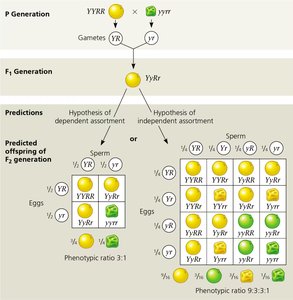
Occurs during Metaphase I of meiosis due to the random orientation of homologous chromosomes.
Genes on different chromosomes assort independently.
Genes far apart on the same chromosome can also assort independently due to crossing over.
Mendel's Experiments and Crosses
Monohybrid Cross
A monohybrid cross examines the inheritance of a single trait. Crossing two heterozygotes (Aa x Aa) yields a 1:2:1 genotypic ratio and a 3:1 phenotypic ratio.
Genotype ratio: 1 AA : 2 Aa : 1 aa
Phenotype ratio: 3 dominant : 1 recessive
Dihybrid Cross
A dihybrid cross examines the inheritance of two traits simultaneously. Crossing two individuals heterozygous for both traits (AaBb x AaBb) yields a 9:3:3:1 phenotypic ratio if the genes assort independently.
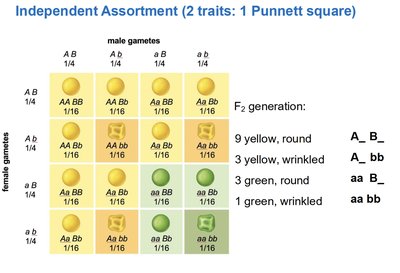
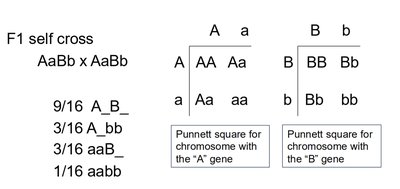
Phenotypic ratio: 9 (both dominant) : 3 (first dominant, second recessive) : 3 (first recessive, second dominant) : 1 (both recessive)
Gametes for AaBb: AB, Ab, aB, ab
Punnett Squares
Punnett squares are tools used to predict the possible genotypes and phenotypes of offspring from a genetic cross. For a monohybrid cross, a 2x2 square is used; for a dihybrid cross, a 4x4 square is used.
Each box represents a possible genotype of the offspring.
Gametes from each parent are placed on the axes.
Test Cross
A test cross is used to determine the genotype of an individual with a dominant phenotype by crossing it with a homozygous recessive individual. The offspring phenotypes reveal whether the parent is homozygous dominant or heterozygous.
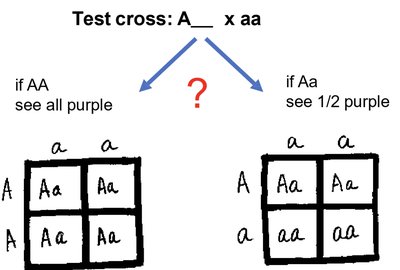
If all offspring show the dominant trait, the parent is homozygous dominant.
If offspring show a 1:1 ratio of dominant to recessive traits, the parent is heterozygous.
Pedigrees and Probability in Genetics
Pedigree Analysis
Pedigrees are diagrams that show the inheritance of traits across generations. They are used to determine the mode of inheritance (e.g., autosomal recessive, autosomal dominant) and to predict the probability of offspring inheriting certain traits.
Autosomal Recessive: Trait appears only when both alleles are recessive (e.g., bb).
Often skips generations; unaffected parents can have affected children if both are carriers.
Circles represent females, squares represent males.
Probability Calculations
Probability is often expressed as a fraction (e.g., 1/4) or percentage (e.g., 25%).
When calculating the probability of a child being a carrier, consider only the relevant genotypes (e.g., for unaffected children, only AA and Aa).
For combined probabilities (e.g., being a girl and a carrier), multiply the individual probabilities.
Summary Table: Mendelian Ratios
Cross Type | Genotypic Ratio | Phenotypic Ratio |
|---|---|---|
Monohybrid (Aa x Aa) | 1 AA : 2 Aa : 1 aa | 3 dominant : 1 recessive |
Dihybrid (AaBb x AaBb) | 9 A_B_ : 3 A_bb : 3 aaB_ : 1 aabb | 9:3:3:1 |
Key Equations
Probability of independent events:
Genotype frequency (monohybrid cross):
Phenotype frequency (monohybrid cross):
Additional info: Mendel's laws form the basis for classical genetics, but exceptions exist (e.g., linked genes, incomplete dominance, codominance) that are explored in advanced genetics.
