 Indietro
Mendelian Genetics: Principles, Patterns, and Applications
Guida di studio - Note intelligenti
 Appunti personalizzati basati sui tuoi materiali, ampliati con definizioni chiave, esempi e contesto.
Mendelian Genetics
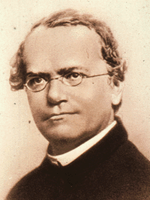
Gregor Mendel: The Father of Genetics
Gregor Mendel is recognized as the founder of modern genetics due to his pioneering experiments with garden peas. His work established the basic principles of heredity, which are fundamental to understanding genetic inheritance in all organisms.
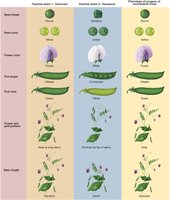
The Seven Traits Studied by Mendel
Mendel selected seven distinct traits in garden peas, each with two contrasting phenotypes. These traits allowed him to observe clear patterns of inheritance and formulate his laws.
Seed shape: Round vs. wrinkled
Seed color: Yellow vs. green
Flower color: Purple vs. white
Pod shape: Inflated vs. constricted
Pod color: Green vs. yellow
Flower position: Axial vs. terminal
Stem length: Tall vs. dwarf
Mendelian Terminology
Understanding Mendel's experiments requires familiarity with key genetic terms:
True-breeding: Organisms that consistently produce offspring with the same phenotype when self-crossed, due to homozygosity.
Hybrid: Offspring resulting from a cross between parents with different traits; typically heterozygous.
P (Parental) Generation: The initial generation in a genetic cross.
F1 Generation: The first filial generation, offspring of the parental generation.
F2 Generation: The second filial generation, offspring of the F1 generation.
Molecular Basis of Mendelian Traits
Wrinkled Seed Mutation in Peas
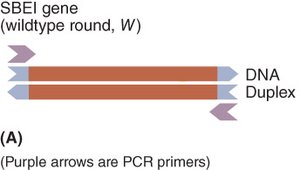
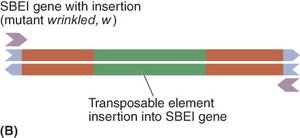
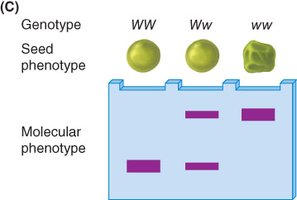
The molecular basis of the wrinkled seed phenotype is a mutation in the SBEI gene. The wildtype allele (W) produces a functional starch branching enzyme, resulting in round seeds. The mutant allele (w) contains an insertion of foreign DNA, rendering the enzyme inactive and producing wrinkled seeds.
Genotype WW or Ww: Round seeds (dominant phenotype)
Genotype ww: Wrinkled seeds (recessive phenotype)
Principles of Mendelian Inheritance
Monohybrid Crosses and Segregation of Alleles
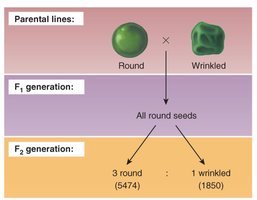
Monohybrid crosses involve one trait and reveal the segregation of alleles. When true-breeding parents are crossed, all F1 progeny display the dominant phenotype. Self-crossing F1 individuals produces an F2 generation with a 3:1 ratio of dominant to recessive phenotypes.
Dominant trait: Expressed in F1 and 75% of F2
Recessive trait: Reappears in 25% of F2
Genetic Crosses and Punnett Squares
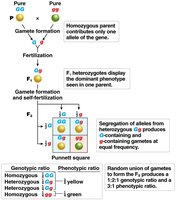
Punnett squares are used to predict the outcome of genetic crosses. They illustrate the random union of gametes and the resulting genotypic and phenotypic ratios.
Genotypic ratio: 1 homozygous dominant : 2 heterozygous : 1 homozygous recessive
Phenotypic ratio: 3 dominant : 1 recessive
Testcrosses
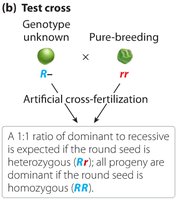
A testcross is used to determine the genotype of an individual with a dominant phenotype by crossing it with a homozygous recessive individual. The resulting offspring ratios reveal whether the unknown is homozygous or heterozygous.
All dominant phenotype: Unknown is homozygous dominant
1:1 ratio: Unknown is heterozygous
Mendel's Laws
Law of Segregation
Mendel's first law states that during gamete formation, the two alleles for a gene segregate so that each gamete receives only one allele. This explains the 3:1 ratio observed in the F2 generation of monohybrid crosses.
Each cell: Contains two alleles for each gene
Each gamete: Contains one allele
Union of gametes: Restores the pair
Law of Independent Assortment
Mendel's second law states that alleles of different genes assort independently during gamete formation. This law is observed in dihybrid crosses, where the F2 generation exhibits a 9:3:3:1 phenotypic ratio.
Dihybrid cross: AaBb x AaBb
F2 ratio: 9 dominant for both traits : 3 dominant for first, recessive for second : 3 recessive for first, dominant for second : 1 recessive for both
Probability in Genetics
Product Rule and Sum Rule
Probability theory is essential for predicting genetic outcomes. The product rule is used for independent events, while the sum rule is used for mutually exclusive events.
Product rule:
Sum rule:
Branch Method for Multi-Locus Problems
The branch method is a systematic approach to solving complex genetic problems involving multiple loci. Each branch represents a possible genotype or phenotype, and probabilities are multiplied along each path.
Statistical Analysis in Genetics
Chi-Square Test
The chi-square () test is used to evaluate whether observed genetic ratios fit expected Mendelian ratios. The test compares observed and expected values and calculates a statistic to assess goodness of fit.
Formula:
Degrees of freedom:
Interpretation: Larger indicates poor fit; larger p-value indicates better fit
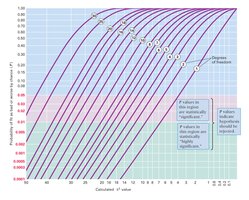
df | 0.05 | 0.01 |
|---|---|---|
1 | 3.84 | 6.64 |
2 | 5.99 | 9.21 |
3 | 7.81 | 11.34 |
4 | 9.49 | 13.28 |
5 | 11.07 | 15.09 |
6 | 12.59 | 16.81 |
7 | 14.07 | 18.48 |
8 | 15.51 | 20.09 |
9 | 16.92 | 21.67 |
10 | 18.31 | 23.21 |
Modes and Mechanisms of Inheritance
Autosomal Dominant and Recessive Inheritance
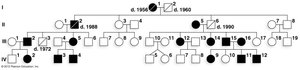
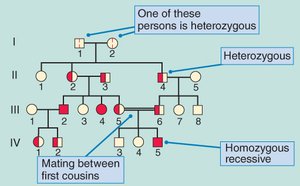
Autosomal dominant inheritance is characterized by the presence of affected individuals in every generation, with males and females equally affected. Autosomal recessive inheritance often skips generations, and affected individuals usually have unaffected parents.
Autosomal dominant: Each affected individual has at least one affected parent; 50% of offspring affected if one parent is heterozygous
Autosomal recessive: Most affected individuals have unaffected parents; 25% of siblings affected if both parents are carriers
Non-Mendelian Inheritance Patterns
Incomplete Dominance
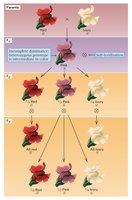
Incomplete dominance occurs when heterozygotes display a phenotype intermediate between the two homozygous types. The F2 generation of a monohybrid cross shows a 1:2:1 genotypic and phenotypic ratio.
Codominance
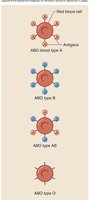
Codominance is observed when heterozygotes express phenotypes characteristic of both alleles. The classic example is the ABO blood group system, where IA and IB alleles are codominant.
Genotypes: IAIA or IAi (Type A), IBIB or IBi (Type B), IAIB (Type AB), ii (Type O)
Gene-Environment Interactions and Epistasis
Gene-Environment Interactions
The expression of genetic traits can be influenced by environmental factors. For example, phenylketonuria (PKU) can be managed by dietary modification, preventing the expression of the disease phenotype.
Epistasis
Epistasis occurs when the alleles of one gene modify or prevent the expression of alleles at another gene. This interaction can alter expected Mendelian ratios, such as the 9:3:3:1 ratio in dihybrid crosses.
Example: In maize, the CI allele masks the phenotype at the R locus, and homozygosity for the r allele masks the wild type genotype at the C locus.
Recessive epistasis: 9:3:4 ratio, as seen in Labrador retrievers
Probability and Statistical Methods in Genetics
Binomial Probability and Pascal's Triangle
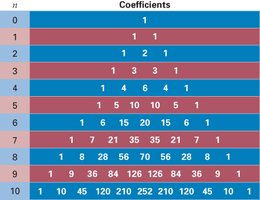
Binomial probability is used to calculate the likelihood of a specific combination of outcomes in genetic crosses. Pascal's Triangle provides the numerical coefficients for binomial expansion.
Formula:
Coefficients: Determined by Pascal's Triangle
Conditional Probability and Bayes' Theorem
Conditional probability is used when prior information is available, such as family history or phenotype. Bayes' Theorem allows for updating probabilities based on new data.
Bayes' Theorem:
Summary Table: Key Mendelian Concepts
Concept | Definition | Example |
|---|---|---|
Law of Segregation | Alleles separate during gamete formation | Monohybrid cross (3:1 ratio) |
Law of Independent Assortment | Alleles of different genes assort independently | Dihybrid cross (9:3:3:1 ratio) |
Dominance | One allele masks the effect of another | Round vs. wrinkled peas |
Incomplete Dominance | Heterozygote is intermediate | Pink flowers in snapdragons |
Codominance | Both alleles are expressed | ABO blood groups |
Epistasis | One gene affects expression of another | Coat color in Labrador retrievers |
Additional info: These notes expand on Mendelian genetics by including molecular mechanisms, probability theory, and statistical analysis, providing a comprehensive overview suitable for college-level General Biology students.
