 Indietro
Mendelian Patterns of Inheritance: Study Notes CH11
Guida di studio - Note intelligenti
 Appunti personalizzati basati sui tuoi materiali, ampliati con definizioni chiave, esempi e contesto.
Mendelian Patterns of Inheritance
Gregor Mendel and the Foundations of Genetics
Gregor Mendel, an Austrian monk, is recognized as the father of modern genetics. His experiments with the garden pea (Pisum sativum) in the 1860s led to the formulation of fundamental laws of heredity, which contradicted the then-popular blending concept of inheritance. Instead, Mendel proposed the particulate theory of inheritance, emphasizing the reshuffling of genes from generation to generation.
Blending Concept: Suggested offspring are a blend of parental traits, leading to decreased variation over time.
Particulate Theory: Traits are inherited as discrete units (genes), maintaining variation.
Mendel’s Laws: Law of Segregation and Law of Independent Assortment.
Mendel’s Experimental System: The Garden Pea
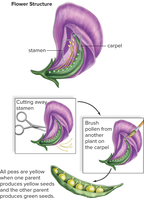
The garden pea was ideal for Mendel’s experiments due to its ease of cultivation, short generation time, self-pollination, and availability of true-breeding varieties with simple, observable traits. Mendel performed controlled cross-pollination by transferring pollen from the anther of one plant to the stigma of another.
Self-pollination: Peas naturally fertilize themselves.
Cross-pollination: Mendel manually transferred pollen to study inheritance patterns.
Mendel’s Laws
Law of Segregation
The Law of Segregation states that each individual has two alleles for each trait, which segregate during gamete formation so that each gamete contains only one allele. Fertilization restores the pair in the offspring.
Allele: Alternate form of a gene.
Homozygous: Identical alleles for a trait (e.g., TT or tt).
Heterozygous: Different alleles for a trait (e.g., Tt).
Genotype: The genetic makeup (allele combination) of an individual.
Phenotype: The observable physical or physiological trait.

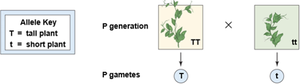
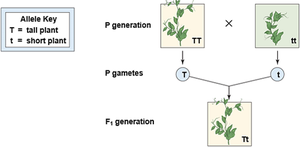
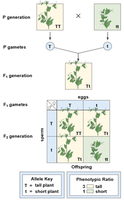
Relationship Between Genotype and Phenotype
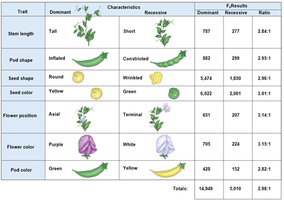
Dominant alleles mask the expression of recessive alleles. The classic Mendelian monohybrid cross results in a 3:1 phenotypic ratio in the F2 generation.
Trait | Dominant | Recessive | F2 Results (Dominant) | F2 Results (Recessive) | Ratio |
|---|---|---|---|---|---|
Stem length | Tall | Short | 787 | 277 | 2.84:1 |
Pod shape | Inflated | Constricted | 882 | 299 | 2.95:1 |
Seed shape | Round | Wrinkled | 5474 | 1850 | 2.96:1 |
Seed color | Yellow | Green | 6022 | 2001 | 3.01:1 |
Flower position | Axial | Terminal | 651 | 207 | 3.14:1 |
Flower color | Purple | White | 705 | 224 | 3.15:1 |
Pod color | Green | Yellow | 428 | 152 | 2.82:1 |
Totals | 14,949 | 5,010 | 2.98:1 |
Chromosomal Basis of Inheritance
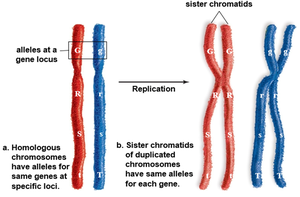
Genes are located on homologous chromosomes. During meiosis, homologous chromosomes (and thus alleles) segregate, explaining Mendel’s law of segregation.
Homologous chromosomes: Chromosome pairs with genes for the same traits at the same loci.
Sister chromatids: Identical copies formed during DNA replication.
Law of Independent Assortment
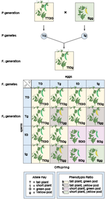
The Law of Independent Assortment states that alleles of different genes assort independently of one another during gamete formation. This law applies to genes on different chromosomes or those far apart on the same chromosome.
Dihybrid cross: Cross involving two traits, resulting in a 9:3:3:1 phenotypic ratio in the F2 generation if genes assort independently.
Chromosome Behavior During Meiosis
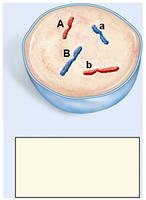
During meiosis, homologous chromosomes align and separate independently, leading to genetic variation in gametes. This process underlies Mendel’s laws.
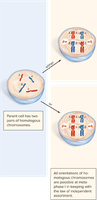
Genotype, Phenotype, and Probability
Punnett Squares
Punnett squares are tools used to predict the probability of genotypes and phenotypes in offspring from a genetic cross. They list all possible gamete combinations and their resulting zygotes.
Sum rule: Add probabilities of genotypes that produce the same phenotype.
Testcrosses
A testcross is used to determine the genotype of an individual with a dominant phenotype by crossing it with a homozygous recessive individual. The offspring phenotypes reveal the unknown genotype.
Summary of Key Terms and Concepts
Allele: Variant form of a gene.
Homozygous: Two identical alleles for a trait.
Heterozygous: Two different alleles for a trait.
Genotype: Genetic constitution of an organism.
Phenotype: Observable characteristics.
Law of Segregation: Alleles separate during gamete formation.
Law of Independent Assortment: Genes for different traits assort independently.
Example Equation:
The probability of two independent events both occurring is the product of their individual probabilities:
Additional info: These principles form the foundation for understanding inheritance patterns, genetic disorders, and the molecular basis of heredity in all living organisms.
