 Indietro
Metabolic Pathways, Activation Energy, and Electron Transport Chain Study Guide
Guida di studio - Note intelligenti
 Appunti personalizzati basati sui tuoi materiali, ampliati con definizioni chiave, esempi e contesto.
Q1. Which of the following is a true statement about catabolic and anabolic pathways?
Background
Topic: Metabolic Pathways (Catabolism vs. Anabolism)
This question tests your understanding of the differences between catabolic and anabolic pathways, including whether they build or break down molecules, their energy requirements, and whether they are exergonic or endergonic.
Key Terms:
Catabolic pathways: Metabolic processes that break down complex molecules into simpler ones, often releasing energy.
Anabolic pathways: Metabolic processes that build complex molecules from simpler ones, usually requiring energy input.
Exergonic: Reactions that release free energy (ΔG < 0).
Endergonic: Reactions that require an input of energy (ΔG > 0).
Step-by-Step Guidance
Recall that catabolic pathways are responsible for breaking down molecules (e.g., cellular respiration breaks down glucose).
Consider whether catabolic pathways release or require energy. Think about what happens to energy during the breakdown of molecules.
Recall that anabolic pathways build larger molecules from smaller ones (e.g., protein synthesis from amino acids).
Consider whether anabolic pathways release or require energy, and whether they are exergonic or endergonic.
Match these characteristics to the answer choices, eliminating those that do not fit the definitions above.
Try solving on your own before revealing the answer!
Final Answer: Anabolic pathways build molecules, require energy, and are endergonic.
Catabolic pathways break down molecules and release energy (exergonic), while anabolic pathways build molecules and require energy input (endergonic).
Q2. Which statement best explains why a solution of starch at room temperature does not readily decompose to form a solution of glucose?
Background
Topic: Enzyme Catalysis and Activation Energy
This question is about why some spontaneous reactions (negative ΔG) do not occur quickly without an enzyme, focusing on the concept of activation energy.
Key Terms:
Activation energy (Ea): The minimum energy required to start a chemical reaction.
Spontaneous reaction: A reaction that can occur without input of additional energy (ΔG < 0), but may still be slow if activation energy is high.
Step-by-Step Guidance
Recall that even if a reaction is spontaneous (negative ΔG), it may not proceed quickly if the activation energy barrier is high.
Consider what happens to starch in the absence of enzymes at room temperature—does it break down rapidly or slowly?
Think about the role of enzymes in lowering activation energy and speeding up reactions.
Review the answer choices and identify which one refers to the concept of activation energy as a barrier to reaction progress.
Try solving on your own before revealing the answer!
Final Answer: A certain amount of activation energy is required for the reaction to proceed.
Even though the hydrolysis of starch to glucose is spontaneous, the reaction is slow at room temperature because the activation energy barrier is too high without an enzyme.
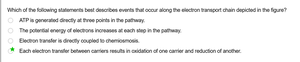
Q3. Which of the following statements best describes events that occur along the electron transport chain?
Background
Topic: Electron Transport Chain (ETC) in Cellular Respiration
This question tests your understanding of redox reactions and the transfer of electrons through the electron transport chain, which is crucial for ATP production in mitochondria.
Key Terms:
Electron transport chain (ETC): A series of protein complexes that transfer electrons via redox reactions, coupled with the transfer of protons across a membrane.
Oxidation: Loss of electrons.
Reduction: Gain of electrons.
Redox reaction: A chemical reaction involving the transfer of electrons between two species.
Step-by-Step Guidance
Recall that the ETC involves a series of redox reactions, where electrons are passed from one carrier to another.
Consider what happens to each carrier as it receives or donates electrons—does it become oxidized or reduced?
Review the answer choices and identify which one correctly describes the redox events occurring at each step in the chain.
Think about whether ATP is generated directly at each step, or if the main function is electron transfer and proton pumping.
Try solving on your own before revealing the answer!
Final Answer: Each electron transfer between carriers results in oxidation of one carrier and reduction of another.
As electrons move through the ETC, each carrier is reduced when it gains an electron and oxidized when it passes the electron to the next carrier.
