 Indietro
AP Biology Chapter 8 : Metabolism
Guida di studio - Note intelligenti
 Appunti personalizzati basati sui tuoi materiali, ampliati con definizioni chiave, esempi e contesto.
Metabolism and Bioenergetics
Introduction to Metabolism
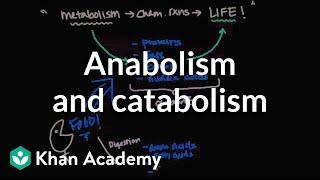
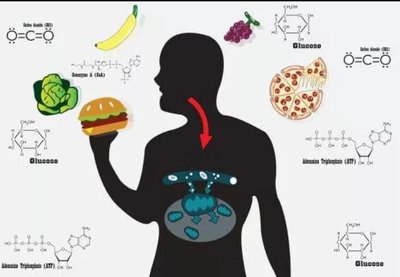
Metabolism encompasses all chemical reactions occurring within an organism, managing both material and energy resources. It is divided into two main types of pathways: catabolic (degradative, energy-releasing) and anabolic (building, energy-consuming).
Catabolic pathways: Break down complex molecules into simpler ones, releasing energy (e.g., cellular respiration).
Anabolic pathways: Build complex molecules from simpler ones, requiring energy input (e.g., protein synthesis, photosynthesis).
Metabolism: The sum of all chemical reactions in the cell.
Energy: Forms and Concepts
Energy is the capacity to cause change or rearrange matter. It exists in two primary forms: kinetic energy (energy of motion) and potential energy (energy due to position or structure).
Kinetic energy: Includes heat (thermal energy), movement.
Potential energy: Includes chemical energy stored in bonds.


Thermodynamics in Biology
Basic Laws of Thermodynamics
Thermodynamics is the study of energy transformations. Biological systems obey two fundamental laws:
First Law (Conservation of Energy): Energy can neither be created nor destroyed, only transferred or transformed.
Second Law: Every energy transfer increases the entropy (disorder) of the universe.
Entropy: A measure of disorder or randomness; biological systems often release energy as heat, which increases entropy.



Free Energy and Spontaneity
Gibbs Free Energy
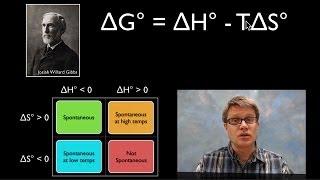
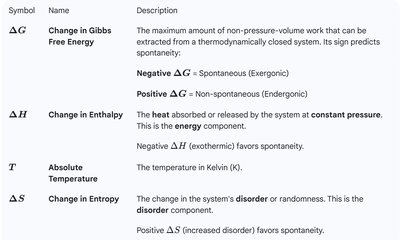
The change in free energy (ΔG) determines whether a reaction is spontaneous. It is calculated using the equation:
ΔG = ΔH - TΔS
ΔH: Change in enthalpy (total energy, often heat).
T: Absolute temperature (Kelvin).
ΔS: Change in entropy (disorder).
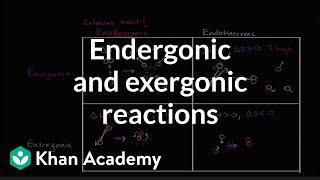
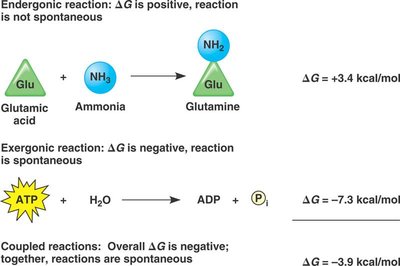
Negative ΔG: Spontaneous (exergonic) reaction.
Positive ΔG: Nonspontaneous (endergonic) reaction.

Exergonic vs. Endergonic Reactions
Reactions are classified based on their energy changes:
Exergonic: Net release of free energy; spontaneous.
Endergonic: Absorbs free energy; nonspontaneous.
ATP and Energy Coupling
Structure and Function of ATP
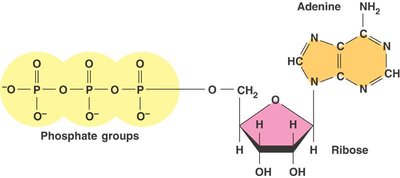
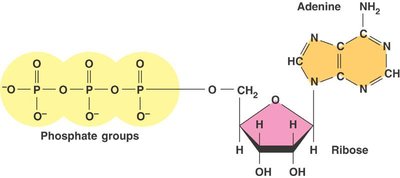
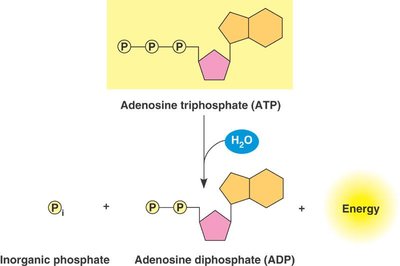
Adenosine triphosphate (ATP) is the primary energy currency of the cell. Its structure consists of adenine, ribose, and three phosphate groups. The high-energy bonds between phosphates are key to its function.
ATP hydrolysis: Releases energy by breaking the terminal phosphate bond.
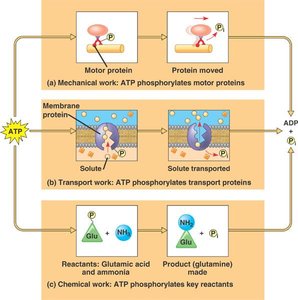
Phosphorylation: Transfer of a phosphate group to another molecule, making it more reactive.
Energy Coupling in Cells
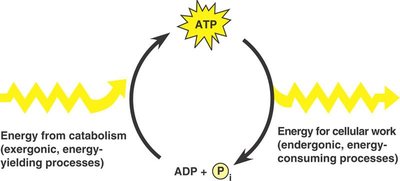
Cells couple exergonic and endergonic reactions using ATP. Energy released from catabolic (exergonic) processes is used to drive anabolic (endergonic) processes.
ATP cycle: ATP is continuously regenerated from ADP and inorganic phosphate.
Phosphorylated intermediates: Molecules with added phosphate groups are more reactive.


Enzymes and Catalysis
Enzyme Function and Specificity
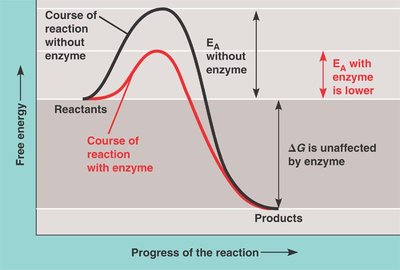
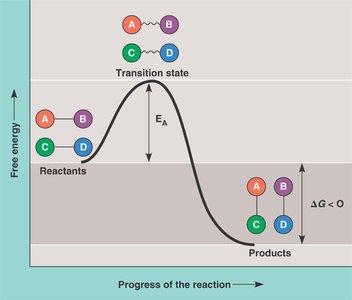
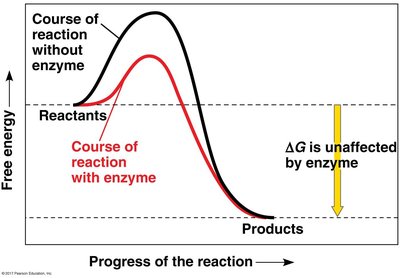
Enzymes are biological catalysts that speed up chemical reactions by lowering the activation energy (EA) required. They are highly specific for their substrates and are not consumed in the reaction.
Active site: The region on the enzyme where the substrate binds.
Induced fit model: The enzyme changes shape to fit the substrate.
Substrate: The reactant acted upon by the enzyme.
Enzyme Kinetics and Activation Energy
Enzymes lower the activation energy barrier, allowing reactions to proceed faster. The overall free energy change (ΔG) is unaffected by the enzyme.
Activation energy (EA): The energy required to initiate a reaction.
Enzyme-catalyzed reactions: Lower EA, same ΔG.
Enzyme Regulation
Enzyme activity can be regulated by inhibitors and environmental factors.
Competitive inhibitors: Compete for the active site; can be overcome by increasing substrate concentration.
Noncompetitive inhibitors: Bind to allosteric sites, changing enzyme shape and function.
Irreversible inhibitors: Bind covalently, permanently disabling the enzyme.
Allosteric regulation: Regulation by binding to a site other than the active site.
Factors Affecting Enzyme Activity
Enzyme activity is influenced by temperature, pH, and the presence of cofactors and coenzymes.
Temperature: High temperatures can denature enzymes.
pH: Extreme pH values can denature enzymes.
Cofactors: Inorganic helpers (e.g., zinc, iron, copper).
Coenzymes: Organic helpers (e.g., vitamins).
