 Indietro
Metabolism and Energy in Cells: General Biology Study Notes
Guida di studio - Note intelligenti
 Appunti personalizzati basati sui tuoi materiali, ampliati con definizioni chiave, esempi e contesto.
Metabolism: The Foundation of Cellular Life
Introduction to Metabolism
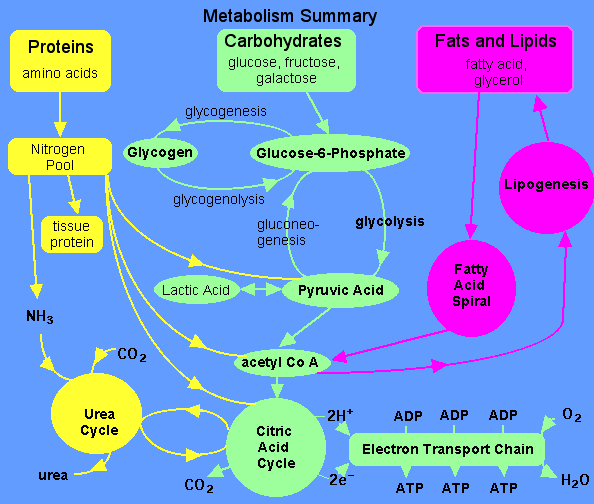
Metabolism encompasses all chemical reactions occurring within living cells, enabling them to reuse, rearrange, and rebuild molecules. These reactions are essential for the breakdown and synthesis of carbohydrates, lipids, proteins, and nucleic acids, as well as for the production of ATP, the cell’s energy currency.
Metabolism: The sum of all chemical reactions in a living system.
Includes both catabolic (breakdown) and anabolic (synthesis) reactions.
Maintains cellular structure and function by recycling and managing matter.
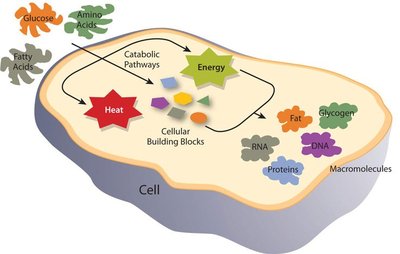
Metabolism Manages Matter
Cells must manage matter to maintain function and prevent waste buildup. Metabolic processes break down nutrients, rearrange molecules, build larger structures, and recycle cellular components.
Cellular parts wear out or become damaged and must be replaced.
Useful building blocks are reused for growth and repair.
Waste buildup can interfere with cell function.
Energy in Biological Systems
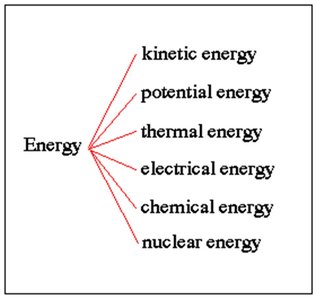
Forms of Energy
Energy is the capacity to cause change or perform work. Cells utilize various forms of energy to power biological processes.
Potential energy: Stored energy, such as an ion gradient or water behind a dam.
Chemical energy: Potential energy stored in molecular bonds (e.g., glucose).
Kinetic energy: Energy of motion (e.g., vesicle transport, muscle contraction).
Thermal energy: Kinetic energy from random movement of atoms and molecules; heat is the transfer of thermal energy.
Metabolism Manages Energy
Cells require energy to build, transport, move, and maintain order. Metabolism captures energy from sunlight or food, transfers it into usable molecules like ATP, and releases some energy as heat.
Energy is captured and transferred into ATP.
ATP powers cellular work.
Some energy is lost as heat, increasing entropy.

Thermodynamics in Biology
First Law of Thermodynamics
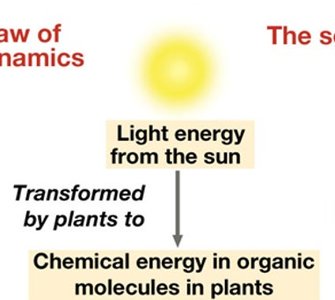
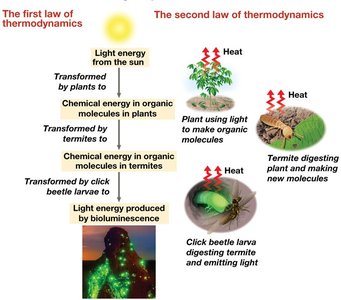
The first law states that energy cannot be created or destroyed, only transferred or transformed. In living systems, photosynthesis transforms light energy into chemical energy, and cellular respiration transfers chemical energy from food into ATP.
Cells transform energy; they do not create energy.
Energy flows through biological systems via metabolic pathways.
Second Law of Thermodynamics
Every energy transfer increases the entropy (disorder) of the universe. Energy transformations are never 100% efficient; some energy is dispersed as heat.
Cells use energy to create and maintain order.
Each transformation releases heat, increasing entropy.
A cell can become more organized as long as the total entropy of the universe increases.
Metabolic Pathways and Reactions
Metabolic Pathways
A metabolic pathway is a series of chemical reactions occurring in a specific sequence, each step controlled by a specific enzyme. The product of one reaction becomes the reactant for the next.
Pathways are essential for efficient energy and matter management.
Enzymes ensure specificity and regulation.

Types of Metabolic Reactions: Anabolism and Catabolism
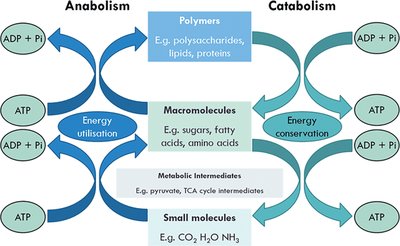
Metabolic reactions are classified as anabolic (building up) or catabolic (breaking down).
Anabolism: Builds larger molecules; requires energy input (e.g., protein synthesis).
Catabolism: Breaks larger molecules; releases usable energy (e.g., glucose breakdown).
Review of Chemical Reactions
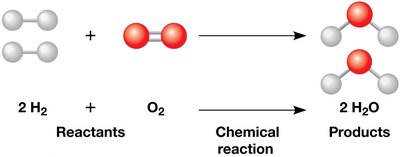
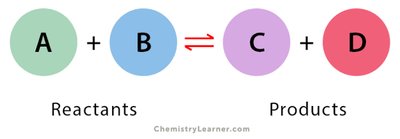
In chemical reactions, reactants are transformed into products by breaking and forming chemical bonds. Breaking bonds requires energy, while forming bonds releases energy. Reactions are energetically favorable when products have lower free energy and greater stability than reactants.
Many cellular reactions are reversible.
The direction depends on concentrations and free energies.
Free Energy and Reaction Types
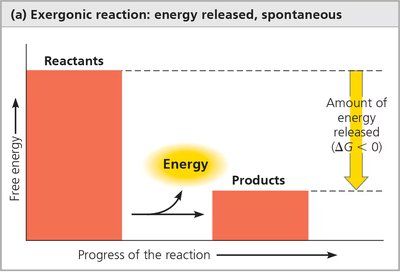
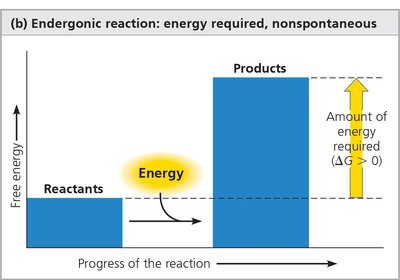
Free energy (G) is the energy available to perform work. Reactions move toward lower free energy and greater stability.
Negative : energetically favorable (exergonic).
Positive : requires energy input (endergonic).
: equilibrium.
Chemical Equilibrium
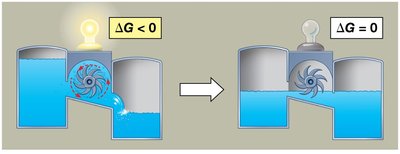
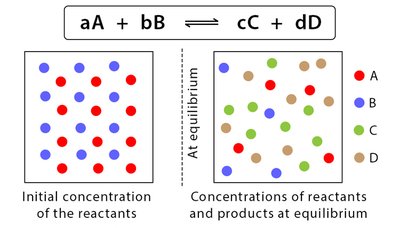
A reversible reaction reaches equilibrium when forward and reverse reactions occur at the same rate. At equilibrium, reactant and product concentrations remain constant, equals zero, and no net change occurs.
Equilibrium reactions cannot provide energy for cellular work.
Equilibrium and Cellular Metabolism
Living cells remain away from equilibrium by continuously taking in nutrients and energy, moving products into other reactions, and maintaining a flow of matter through connected metabolic pathways.
Continuous flow keeps reactions active and supports life.
Energy Coupling and ATP
Energy Coupling Reactions
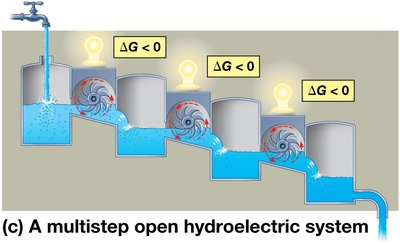
Cells power endergonic reactions by coupling them to exergonic energy sources. Exergonic reactions release free energy that can drive cellular work.
Common energy sources: ATP hydrolysis, ion gradients, electron carriers.
ATP Powers Cellular Work
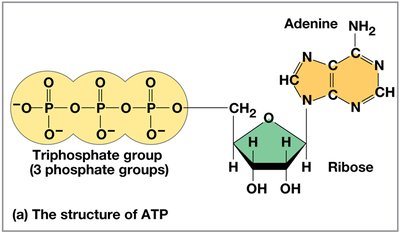
ATP (adenosine triphosphate) is composed of adenine, ribose, and three phosphate groups. It is the cell’s primary immediate source of energy for transport, mechanical, and chemical work.
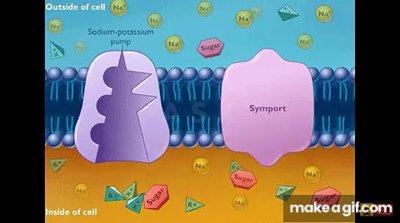
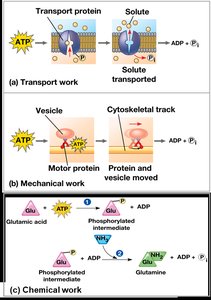
Transport work: powering pumps that move ions and molecules.
Mechanical work: enabling movement (motor proteins, muscle contraction).
Chemical work: supplying energy to build complex molecules.
ATP Hydrolysis and the ATP Cycle
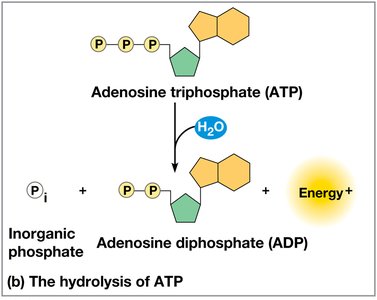
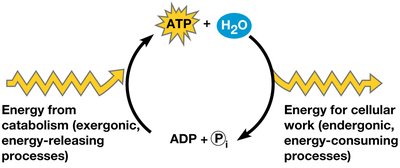
ATP hydrolysis converts ATP into ADP and inorganic phosphate, releasing usable energy. ATP is constantly regenerated from ADP and Pi using energy from catabolism.
ATP is reused to power cellular work.
Energy from catabolic reactions rebuilds ATP.
Enzymes: Biological Catalysts
Enzymes: The Cell’s Catalysts
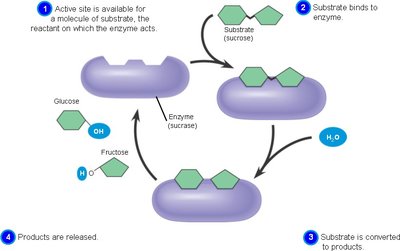
Enzymes are proteins that act as catalysts, speeding up chemical reactions without being consumed. They allow reactions to occur rapidly under normal conditions.
Example: sucrase breaks down sucrose into glucose and fructose.
Activation Energy
Every chemical reaction requires an initial input of energy called activation energy to begin. Enzymes lower activation energy, allowing reactions to proceed faster and more easily.
Without enzymes, activation energy barriers are too high for most reactions.
How Enzymes Lower Activation Energy
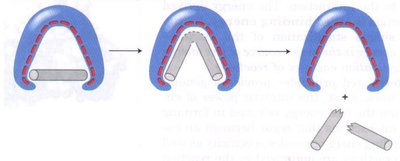
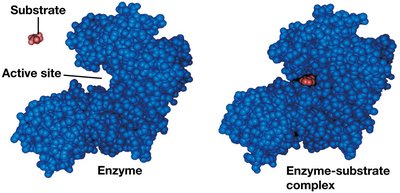
Enzymes lower activation energy by bringing substrates together, positioning them correctly, straining bonds, creating a supportive environment, and temporarily forming bonds with substrates. Enzymes do not change the free-energy difference or supply energy to the reaction.
Enzyme specificity is due to the unique shape of the active site.
Each enzyme usually catalyzes one type of reaction for a specific substrate.
Enzyme Kinetics: Reaction Rates
The rate of an enzyme-catalyzed reaction depends on substrate concentration. At low substrate levels, increasing substrate increases the rate; at high levels, the enzyme becomes saturated and the rate levels off (Vmax).
Enzyme activity is influenced by temperature and pH.
Temperature and Enzyme Activity
As temperature increases, reaction rates rise due to faster molecular movement. If temperature is too high, enzymes denature and lose activity. Low temperatures reduce enzyme activity.
Enzymes function best within a specific temperature range.
pH and Enzyme Activity
Each enzyme has an optimal pH range. Extreme pH disrupts hydrogen and ionic bonds, causing denaturation. Different enzymes are adapted to different environments (e.g., pepsin in stomach, trypsin in intestine).
Enzyme activity is highest at optimal pH.
Inhibitors of Enzymes
Enzyme inhibitors reduce enzyme activity. Competitive inhibitors bind to the active site and compete with the substrate. Non-competitive inhibitors bind elsewhere, reducing catalytic activity without competing for the active site.
Competitive inhibition reduces substrate binding.
Non-competitive inhibition reduces product formation.
Allosteric Regulation
Cells regulate enzymes through allosteric regulation. A regulatory molecule binds to an allosteric site, changing the enzyme’s shape and activity. Allosteric activators stabilize the active form; inhibitors stabilize the inactive form.
Allosteric regulation allows fine control of metabolic pathways.
Type of Reaction | ΔG | Energy Flow | Example |
|---|---|---|---|
Exergonic | Negative | Energy released | Glucose breakdown |
Endergonic | Positive | Energy required | Protein synthesis |
Equilibrium | Zero | No net energy change | Reversible reactions at equilibrium |
Additional info: These notes expand on the original content by providing definitions, examples, and academic context for each topic, ensuring completeness and clarity for General Biology students.
