 Indietro
Metabolism and Energy Principles in Biology
Guida di studio - Note intelligenti
 Appunti personalizzati basati sui tuoi materiali, ampliati con definizioni chiave, esempi e contesto.
Metabolism: The Chemical Reactions of Life
Definition and Overview
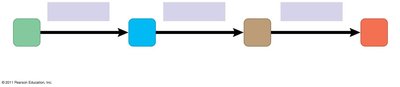
Metabolism encompasses all the chemical reactions occurring within an organism, enabling it to grow, reproduce, maintain its structures, and respond to environmental changes. These reactions are organized into metabolic pathways, which begin with a specific molecule and end with a product, often through a series of enzyme-catalyzed steps.
Catabolic pathways: Break down complex molecules into simpler ones, releasing energy (e.g., cellular respiration).
Anabolic pathways: Build complex molecules from simpler ones, consuming energy (e.g., photosynthesis).
Energy in Biological Systems
Types of Energy
Energy is the capacity to do work or cause change. Biological systems utilize different forms of energy:
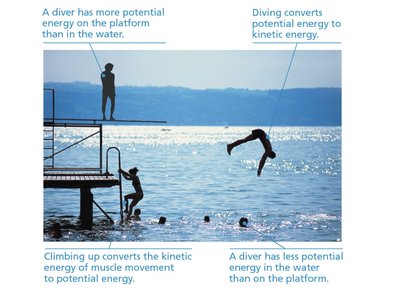
Kinetic energy: Energy of motion, including thermal energy (heat), which is the random movement of atoms and molecules.
Potential energy: Stored energy due to an object's position or structure, such as chemical energy in molecular bonds.

Thermodynamics in Biology
The First Law of Thermodynamics
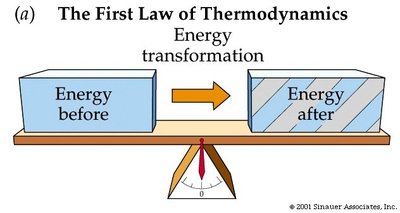
The first law states that energy can be transferred and transformed, but cannot be created or destroyed. This is known as the principle of conservation of energy. Living organisms, as open systems, constantly exchange energy with their surroundings.
The Second Law of Thermodynamics
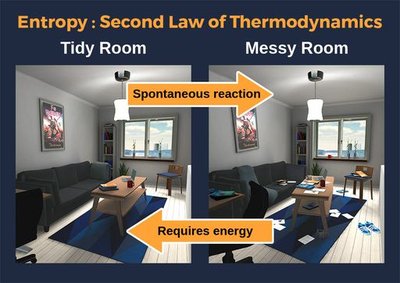
The second law states that every energy transfer or transformation increases the entropy (disorder) of the universe. While local order can increase (e.g., in cells), the overall entropy of the universe always increases, often due to heat generation.
Entropy: A measure of disorder; spontaneous processes increase entropy.
Heat is a form of molecular disorder and becomes unavailable for useful work.
Free Energy and Chemical Reactions
Free Energy (G) and ΔG
Free energy (G) is the energy available to do work in a system. The change in free energy, ΔG, determines whether a reaction is spontaneous:
Exergonic reactions: Release free energy; spontaneous (ΔG < 0).
Endergonic reactions: Absorb free energy; nonspontaneous (ΔG > 0).
Equation for free energy change:
Energy Coupling and ATP
ATP: The Energy Currency of the Cell
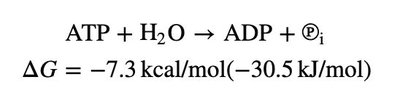
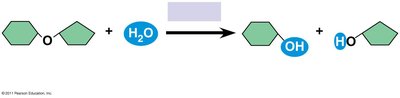
Adenosine triphosphate (ATP) is the primary molecule used by cells to couple exergonic and endergonic reactions. ATP hydrolysis releases energy, which can drive otherwise nonspontaneous processes.
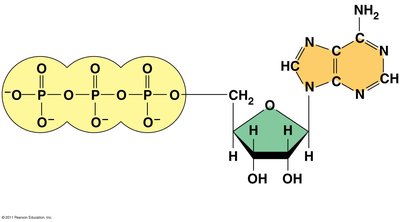
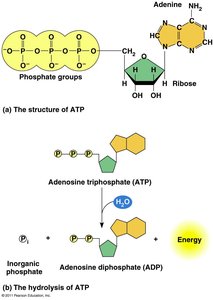
ATP hydrolysis reaction:
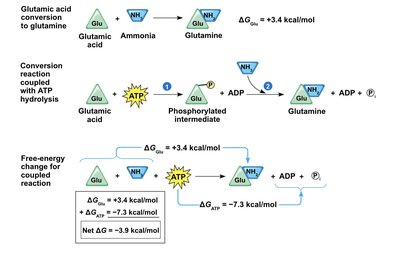
Energy Coupling Example
Cells use ATP to couple exergonic and endergonic reactions, such as the synthesis of glutamine from glutamic acid and ammonia. The overall free energy change becomes negative, allowing the reaction to proceed.
ATP in Cellular Work
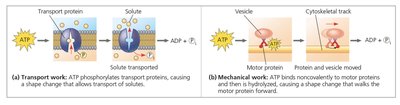
ATP powers transport and mechanical work in cells by phosphorylating proteins or binding to motor proteins, causing conformational changes.
Enzymes: Biological Catalysts
Enzyme Function and Activation Energy
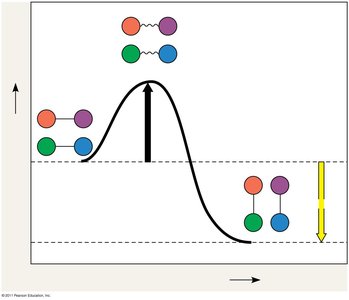
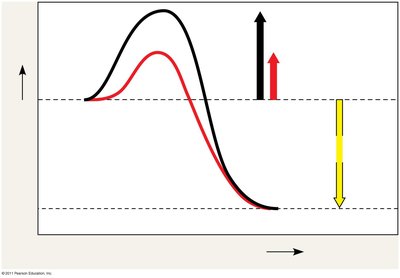
All chemical reactions require an initial input of energy, called activation energy (Ea). Enzymes are protein catalysts that lower Ea, speeding up reactions without being consumed.
Enzyme Mechanism
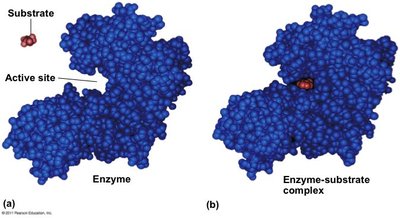
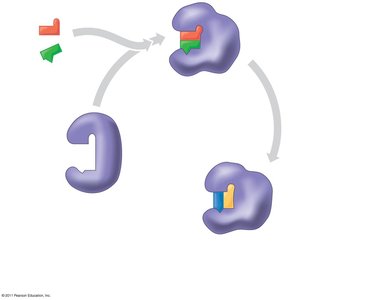
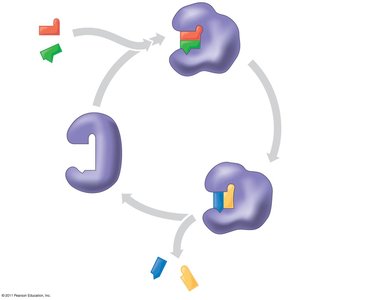
Enzymes bind substrates at their active site, forming an enzyme-substrate complex. This induces a fit that catalyzes the reaction, converting substrates to products and releasing them.
Regulation of Enzyme Activity
Allosteric Regulation
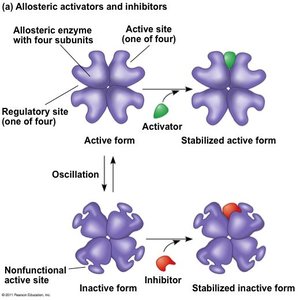
Enzyme activity can be regulated by molecules binding to sites other than the active site (allosteric regulation). These molecules can act as activators or inhibitors, altering enzyme function.
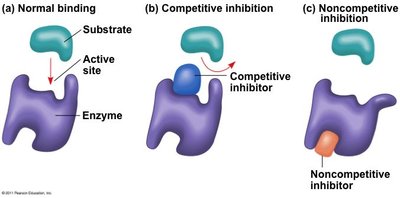
Enzyme Inhibition
Competitive inhibitors: Bind to the active site, blocking substrate access.
Noncompetitive (allosteric) inhibitors: Bind elsewhere, changing the enzyme's shape and reducing activity.
Summary
Metabolism is governed by the principles of energy transformation and thermodynamics. Cells use ATP to couple energy-releasing and energy-consuming reactions, and enzymes to catalyze and regulate metabolic pathways efficiently.
