 Indietro
Metabolism and Enzyme Regulation: Study Notes for General Biology
Guida di studio - Note intelligenti
 Appunti personalizzati basati sui tuoi materiali, ampliati con definizioni chiave, esempi e contesto.
An Introduction to Metabolism
Metabolism: Transforming Matter and Energy
Metabolism encompasses all chemical reactions occurring within an organism, enabling the transformation of matter and energy necessary for life. These reactions occur when atoms, ions, or molecules interact to form new substances.
Metabolic Pathways: A series of chemical reactions starting with a specific molecule and ending with a product, each step catalyzed by a unique enzyme.
Enzymes: Biological catalysts that accelerate reactions without being consumed.
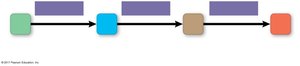
Example: Glycolysis is a metabolic pathway that breaks down glucose into pyruvate, involving multiple enzymes.
Forms of Energy
Types and Conversion of Energy
Energy is the capacity to cause change and exists in several forms, each capable of performing work. Organisms convert energy from one form to another to sustain life.
Kinetic Energy: Energy of motion (e.g., muscle movement).
Thermal Energy: Energy associated with heat.
Potential Energy: Stored energy due to position or structure.
Chemical Energy: Energy stored in molecular bonds.

Example: Climbing a platform increases potential energy; diving converts it to kinetic energy.
Thermodynamics in Biological Systems
The Laws of Thermodynamics
Biological processes obey the laws of thermodynamics, governing energy transfer and transformation.
First Law: Energy can be transferred and transformed, but not created or destroyed (conservation of energy).
Second Law: Every energy transfer increases the entropy (disorder) of the universe; some energy is lost as heat.
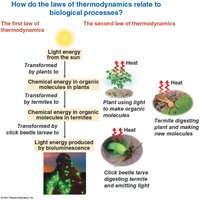
Example: Plants convert sunlight to chemical energy, but some energy is lost as heat.
Free Energy and Chemical Reactions
Free Energy (G) and Spontaneity
Free energy is the portion of a system's energy available to perform work. The change in free energy (ΔG) determines whether a reaction is spontaneous.
Spontaneous Reactions: Release free energy (exergonic, ΔG < 0).
Non-Spontaneous Reactions: Require free energy input (endergonic, ΔG > 0).
Equation:
G: Free energy
H: Enthalpy (total energy)
T: Temperature (Kelvin)
S: Entropy (disorder)
Free Energy Change:
If , reaction is endergonic (nonspontaneous, ΔG positive).
If , reaction is exergonic (spontaneous, ΔG negative).
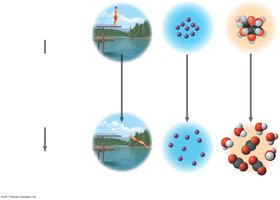
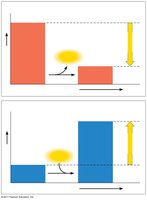
Example: Diffusion and chemical reactions can be spontaneous or nonspontaneous depending on ΔG.
ATP and Cellular Work
ATP: Structure and Function
ATP (adenosine triphosphate) is the primary energy currency of the cell, composed of ribose, adenine, and three phosphate groups. Hydrolysis of ATP releases energy used to drive cellular work.
Chemical Work: Driving endergonic reactions.
Transport Work: Moving substances across membranes.
Mechanical Work: Movement of cellular structures.
Energy Coupling: Using exergonic processes to drive endergonic ones, mediated by ATP.
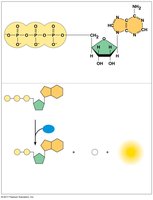
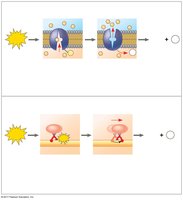
Example: ATP hydrolysis powers muscle contraction and active transport.
Enzymes and Metabolic Reactions
Enzyme Function and Catalysis
Enzymes are catalytic proteins that speed up metabolic reactions by lowering the activation energy (EA) barrier. They do not alter the ΔG of a reaction but make reactions occur faster.
Catalyst: A substance that increases reaction rate without being consumed.
Activation Energy (EA): The energy required to initiate a reaction.
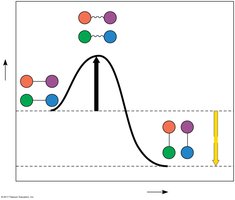
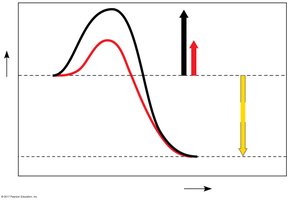
Example: Sucrase catalyzes the hydrolysis of sucrose into glucose and fructose.
How Enzymes Lower Activation Energy
The active site of an enzyme facilitates reactions by:
Orienting substrates correctly
Straining substrate bonds
Providing a favorable microenvironment
Covalently bonding to the substrate
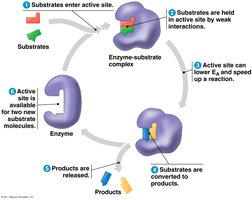
Example: The induced fit model describes how enzymes change shape to accommodate substrates.
Regulation of Enzyme Activity
Allosteric Regulation and Inhibition
Enzyme activity is regulated to control metabolism. Allosteric regulation involves binding of regulatory molecules at sites other than the active site, affecting enzyme function.
Allosteric Inhibition: Regulatory molecule inhibits enzyme activity.
Allosteric Activation: Regulatory molecule enhances enzyme activity.
Competitive Inhibitors: Bind to the active site, competing with the substrate.
Noncompetitive Inhibitors: Bind elsewhere, altering enzyme shape and reducing effectiveness.
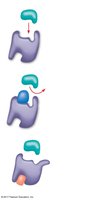
Example: Drugs and toxins often act as enzyme inhibitors.
Feedback Inhibition
Feedback inhibition is a regulatory mechanism where the end product of a metabolic pathway inhibits an earlier step, preventing overproduction.
Ensures efficient use of resources
Maintains metabolic balance
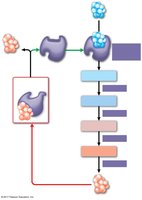
Example: Isoleucine inhibits threonine deaminase in its biosynthetic pathway.
Type of Regulation | Mechanism | Effect |
|---|---|---|
Allosteric Inhibition | Inhibitor binds to allosteric site | Decreases enzyme activity |
Allosteric Activation | Activator binds to allosteric site | Increases enzyme activity |
Competitive Inhibition | Inhibitor binds to active site | Blocks substrate binding |
Noncompetitive Inhibition | Inhibitor binds elsewhere | Alters enzyme shape |
Feedback Inhibition | End product inhibits pathway | Halts pathway when product accumulates |
