 Indietro
Metabolism and Enzymes: Direction, Currency, Speed, and Control
Guida di studio - Note intelligenti
 Appunti personalizzati basati sui tuoi materiali, ampliati con definizioni chiave, esempi e contesto.
Metabolism: The Chemical Reactions of Life
Overview of Metabolic Pathways
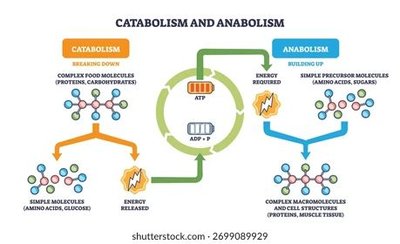
Metabolism encompasses all chemical reactions within an organism, organized into pathways that either break down molecules (catabolic) or build them up (anabolic). These pathways are essential for maintaining life and cellular function.
Catabolic pathways: Break down complex molecules, releasing energy (e.g., glucose → CO2 + H2O).
Anabolic pathways: Build complex molecules from simpler ones, requiring energy input (e.g., amino acids → proteins).
ATP: Links catabolic and anabolic pathways, acting as the cell's energy currency.
Direction of Reactions: Free Energy and ΔG
Free Energy and Spontaneity
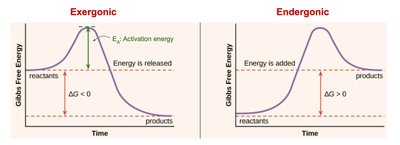
The direction and extent of a chemical reaction are determined by the change in free energy (ΔG).
Free energy (G): The portion of a system's energy available to do work.
ΔG = G(products) − G(reactants): Negative ΔG (exergonic) means the reaction is spontaneous and releases energy; positive ΔG (endergonic) means energy is required.
Equilibrium: When ΔG = 0, no net change occurs; a cell at equilibrium is dead.
ATP: The Energy Currency of the Cell
Structure and Hydrolysis of ATP
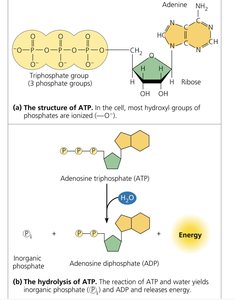
ATP (adenosine triphosphate) is a nucleotide consisting of adenine, ribose, and three phosphate groups. Hydrolysis of ATP releases energy because the products (ADP and inorganic phosphate) are more stable and better solvated.
Hydrolysis reaction: ATP + H2O → ADP + Pi + energy
ΔG of hydrolysis: Approximately −7.3 kcal/mol (standard conditions), about −13 kcal/mol in cells.
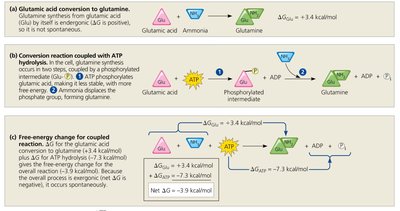
Energy coupling: ATP hydrolysis drives endergonic reactions by transferring a phosphate group to a substrate, making it less stable and enabling a downhill step.
Enzymes: Speeding Up Reactions
Activation Energy and Catalysis
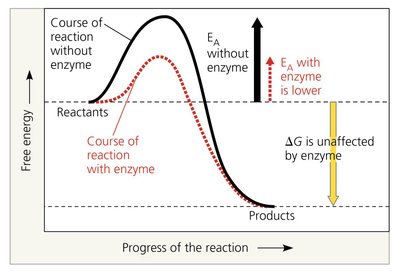
Enzymes are protein catalysts that lower the activation energy (Ea) required for reactions, allowing them to proceed rapidly at biological temperatures.
Activation energy (Ea): The energy needed to reach the transition state.
Enzyme action: Enzymes do not change ΔG or the equilibrium; they only increase the rate at which equilibrium is reached.
Active site: The pocket on the enzyme where the substrate binds and the reaction occurs.
Induced fit: Binding of the substrate changes the enzyme's shape for tighter binding and transition state stabilization.
Regulation of Enzyme Activity
Inhibitors and Allosteric Regulation
Enzyme activity is controlled by inhibitors and allosteric regulators, ensuring metabolic pathways respond to cellular needs.
Competitive inhibitors: Bind the active site, blocking substrate access; excess substrate can overcome inhibition.
Noncompetitive inhibitors: Bind elsewhere, changing the active site shape; substrate addition does not restore activity.
Allosteric regulation: Molecules bind a site other than the active site, stabilizing the enzyme's active or inactive form.
Feedback inhibition: The end product of a pathway inhibits an early enzyme, matching supply to demand.
Membrane Transport: Passive and Active Mechanisms
Facilitated Diffusion and Active Transport
Cells move substances across membranes using various mechanisms, depending on energy requirements and direction relative to concentration gradients.
Facilitated diffusion: Passive transport through protein channels or carriers; no energy required.
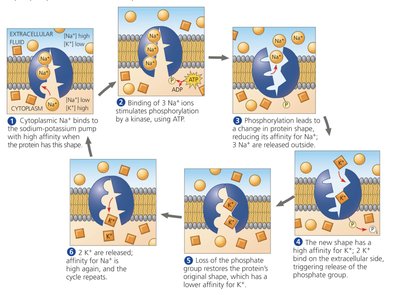
Active transport: Uses ATP to move substances against their gradient (e.g., Na+/K+ pump).
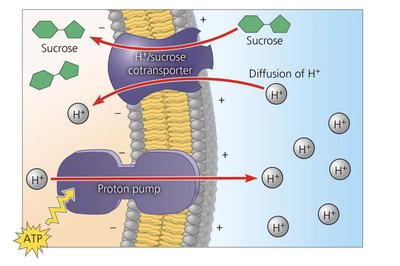
Cotransport: Couples the downhill movement of one solute to the uphill movement of another, using gradients built by ATP.
Bulk Transport: Moving Large Quantities
Exocytosis and Endocytosis
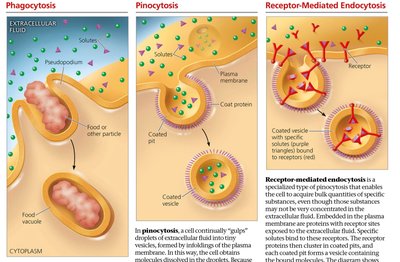
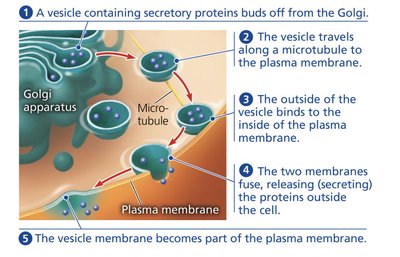
Bulk transport moves large molecules or quantities via vesicles, requiring energy.
Exocytosis: Vesicles fuse with the plasma membrane, releasing contents outside the cell.
Endocytosis: The membrane engulfs material, forming a vesicle inside the cell. Includes phagocytosis (particles), pinocytosis (fluids), and receptor-mediated endocytosis (specific cargo).
Key Terms and Definitions
Metabolism and Energy
Metabolism: All chemical reactions in an organism.
Catabolic pathway: Breaks down molecules, releases energy.
Anabolic pathway: Builds molecules, requires energy.
Free energy (G): Usable energy in a system.
Exergonic: ΔG < 0, spontaneous, releases energy.
Endergonic: ΔG > 0, requires energy input.
ATP: Energy currency of the cell.
Energy coupling: Using exergonic reactions to drive endergonic ones.
Enzymes and Control
Activation energy (Ea): Energy needed to start a reaction.
Enzyme: Protein catalyst.
Substrate: Molecule acted on by an enzyme.
Active site: Enzyme pocket for substrate binding.
Induced fit: Shape change upon substrate binding.
Cofactor/coenzyme: Non-protein helpers for enzymes.
Competitive inhibitor: Blocks active site.
Noncompetitive inhibitor: Alters active site shape.
Allosteric regulation: Regulation via a site other than the active site.
Feedback inhibition: End product inhibits pathway's first enzyme.
Practice Questions
A reaction has ΔG = −10 kcal/mol, but nothing happens for a week. Why? How can you make it go?
Rewrite: “ATP has a high-energy bond that releases energy when broken.”
An inhibitor stops an enzyme. Adding ten times more substrate restores activity. Where does the inhibitor bind?
Summary Table: Membrane Transport Mechanisms
Route | Protein? | Direction | Energy | Examples |
|---|---|---|---|---|
Simple diffusion | No | Down gradient | None | O2, CO2 |
Osmosis | No (or aquaporin) | Water toward solute | None | Red cell in fresh water |
Facilitated diffusion | Channel/carrier | Down gradient | None | Aquaporin, ion channels, GLUT |
Active transport | Pump (carrier) | Against gradient | ATP | Na+/K+ pump, H+ pumps |
Cotransport | Cotransporter | One down, one up | Gradient built by ATP | Na+/glucose, H+/sucrose |
Bulk transport | Vesicles | Either | ATP | Exocytosis, endocytosis |
Summary: Five Key Ideas
ΔG sets direction and distance, not speed.
Energy is released when electrons fall toward oxygen.
ATP is currency; hydrolysis is exergonic due to product stability.
Enzymes lower activation energy, affecting speed only.
Enzymes are controlled by inhibitors, allosteric sites, feedback, and environmental conditions.
