 Indietro
Metabolism and Thermodynamics in Biological Systems
Guida di studio - Note intelligenti
 Appunti personalizzati basati sui tuoi materiali, ampliati con definizioni chiave, esempi e contesto.
Metabolism and Thermodynamics
Overview of Metabolism
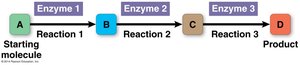
Metabolism refers to the totality of an organism’s chemical reactions, which manage the material and energy resources of the cell. It is an emergent property of life, arising from orderly interactions between molecules. Metabolic pathways consist of a series of steps, each catalyzed by a specific enzyme, transforming a starting molecule into a product through defined intermediates.
Catabolic pathways: Break down complex molecules into simpler ones, releasing energy (e.g., cellular respiration).
Anabolic pathways: Build complex molecules from simpler ones, consuming energy (e.g., synthesis of glycogen from glucose).
Forms of Energy in Biology
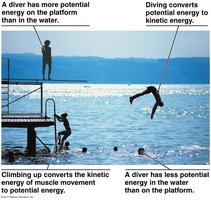
Energy is the capacity to cause change. In biological systems, energy exists in several forms:
Kinetic energy: Energy of motion.
Heat (thermal energy): Kinetic energy associated with random movement of atoms or molecules.
Potential energy: Energy due to location or structure.
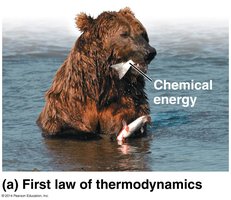
Chemical energy: Potential energy available for release in a chemical reaction.
Thermodynamics in Biological Systems
Thermodynamics is the study of energy transformations. Two fundamental laws govern energy flow in biological systems:
First Law of Thermodynamics
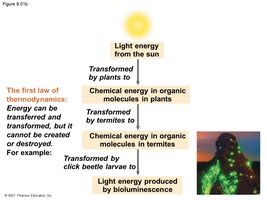
Energy can be transferred and transformed, but it cannot be created or destroyed.
Biological example: Light energy from the sun is transformed into chemical energy by plants, which is then transferred through food chains.
Second Law of Thermodynamics
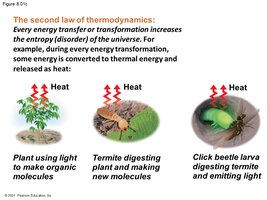
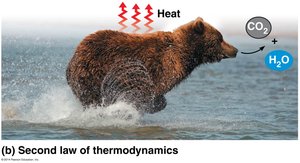
Every energy transfer or transformation increases the entropy (disorder) of the universe.
Some energy is always lost as heat during these processes.
Entropy and Spontaneous Processes
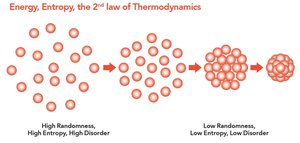
Entropy (S) is a measure of molecular disorder or randomness. Spontaneous processes increase the entropy of a system and do not require energy input.
High entropy: High disorder, more random arrangement of molecules.
Low entropy: Low disorder, more ordered arrangement.
Free Energy and Biological Work
Gibbs Free Energy (G)
Gibbs free energy is the portion of a system’s energy that can perform work when temperature and pressure are uniform. The change in free energy (ΔG) determines whether a process is spontaneous.
ΔG = ΔH - TΔS
ΔH: Change in enthalpy (total energy)
T: Absolute temperature in Kelvin
ΔS: Change in entropy
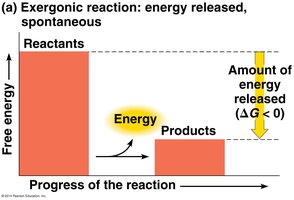
Only reactions with a negative ΔG (ΔG < 0) are spontaneous.
Free Energy, Stability, and Equilibrium
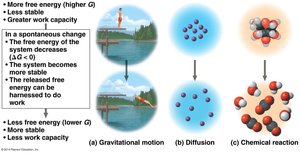
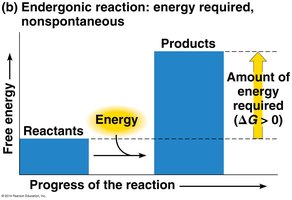
Unstable systems have higher free energy and tend to change to become more stable (lower free energy). As a system approaches equilibrium, its free energy decreases. At equilibrium, the system is stable and can no longer do work spontaneously.
Exergonic and Endergonic Reactions
Exergonic reaction: Proceeds with a net release of free energy (ΔG < 0); spontaneous.
Endergonic reaction: Absorbs free energy from its surroundings (ΔG > 0); not spontaneous.
ATP and Energy Coupling
Role of ATP in Cellular Work
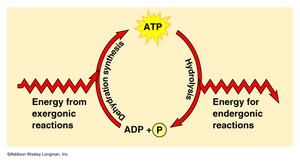
Adenosine triphosphate (ATP) is the cell’s main energy currency. It powers cellular work by coupling exergonic reactions (which release energy) to endergonic reactions (which require energy).
Chemical work: Driving endergonic reactions (e.g., polymerization).
Transport work: Pumping substances across membranes.
Mechanical work: Muscle contraction, movement of cilia/flagella.
ATP Structure and Hydrolysis
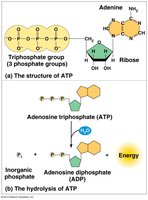
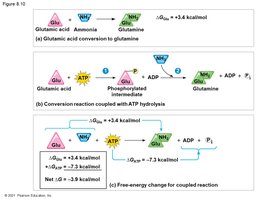
ATP consists of adenine, ribose, and three phosphate groups. Hydrolysis of ATP releases energy (ΔG = -7.3 kcal/mol), which can be used to drive endergonic reactions.
Energy Coupling Example: Glutamine Synthesis
The synthesis of glutamine from glutamic acid and ammonia is endergonic. When coupled with ATP hydrolysis, the overall reaction becomes exergonic and can proceed spontaneously.
Enzymes and Biological Catalysis
Role of Enzymes
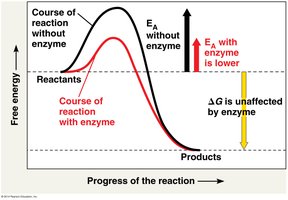
Enzymes are catalytic proteins that speed up chemical reactions by lowering the activation energy (EA) barrier, without being consumed in the reaction. They do not change the free energy (ΔG) of the reaction, only the rate at which equilibrium is reached.
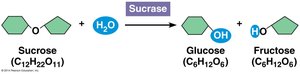
Catalyst: A chemical agent that accelerates a reaction without being consumed.
Example: Sucrase catalyzes the hydrolysis of sucrose into glucose and fructose.
Enzyme Mechanism
Enzymes lower the activation energy required for a reaction, making it proceed faster. The overall change in free energy (ΔG) remains unchanged by the enzyme.
Additional info: These notes provide a comprehensive overview of the relationship between metabolism, thermodynamics, free energy, ATP, and enzymes in biological systems, as covered in a typical General Biology curriculum.
