 Indietro
Metabolism, Cellular Respiration, and Photosynthesis: Study Guide for General Biology
Guida di studio - Note intelligenti
 Appunti personalizzati basati sui tuoi materiali, ampliati con definizioni chiave, esempi e contesto.
Metabolism and Energy Transformation
Metabolism and Metabolic Pathways
Metabolism refers to all chemical reactions that occur within living organisms to sustain life. These reactions are organized into metabolic pathways, where the product of one reaction serves as the substrate for the next. - Catabolic pathways break down molecules and release energy. - Anabolic pathways build complex molecules and require energy input. - Example: Cellular respiration is catabolic; photosynthesis is anabolic.
Forms of Energy
Energy exists in several forms relevant to biology: - Kinetic energy: Energy of motion. - Thermal energy: Energy associated with random movement of atoms/molecules. - Potential energy: Stored energy due to position or structure. - Chemical energy: Potential energy stored in chemical bonds.
Free Energy and Thermodynamics
The change in free energy () determines whether a reaction is spontaneous. - First Law of Thermodynamics: Energy cannot be created or destroyed, only transformed. - Second Law of Thermodynamics: Every energy transfer increases entropy (disorder) in the universe. - Entropy: Measure of disorder; increases in spontaneous processes. - Free energy: Energy available to do work.
Exergonic and Endergonic Reactions
- Exergonic reactions: Release energy; (spontaneous). - Endergonic reactions: Require energy input; (non-spontaneous).
ATP and Energy Coupling
ATP (adenosine triphosphate) is the cell's energy currency. Energy coupling uses exergonic reactions to drive endergonic ones, often via ATP hydrolysis. - Phosphorylated intermediate: A molecule with a phosphate group attached, making it more reactive. - Phosphorylation: Transfer of a phosphate group, often from ATP to another molecule.
Enzymes and Catalysis
Enzymes are biological catalysts that speed up reactions by lowering activation energy. - Active site: Region on enzyme where substrate binds. - Induced fit: Enzyme changes shape to fit substrate. - Inhibitors: Molecules that decrease enzyme activity (competitive or noncompetitive). - Feedback inhibition: End product inhibits pathway to regulate activity. - Ideal conditions: Enzymes function best at specific pH and temperature.
Cellular Respiration
Overview and Equation
Cellular respiration is the process by which cells extract energy from glucose. Equation:
Redox Reactions
- Oxidation: Loss of electrons. - Reduction: Gain of electrons. - NAD+: Oxidized form; accepts electrons. - NADH: Reduced form; carries electrons.
Stages of Cellular Respiration
Glycolysis: Occurs in cytosol; glucose is split into pyruvate. Produces 2 ATP (substrate-level phosphorylation).
Pyruvate Oxidation: Pyruvate is converted to Acetyl CoA in mitochondria.
Citric Acid Cycle: Acetyl CoA enters cycle; CO2 is released, NADH and FADH2 are produced.
Oxidative Phosphorylation: Includes electron transport chain and chemiosmosis; most ATP is produced here.
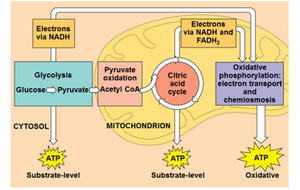
Electron Transport Chain and Chemiosmosis
The electron transport chain (ETC) is located in the inner mitochondrial membrane. Electrons from NADH and FADH2 are transferred through protein complexes, creating a proton gradient. Oxygen is the final electron acceptor, forming water. ATP synthase uses the proton gradient to synthesize ATP. 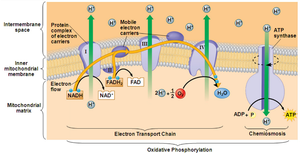
Fermentation
Fermentation occurs when oxygen is absent. Glycolysis continues, and pyruvate is converted to lactate or ethanol. - ATP yield: 2 ATP per glucose (much less than aerobic respiration). - Lactate: Can be transported to the liver for conversion back to pyruvate.
Photosynthesis
Light Reactions
Light reactions occur in the thylakoid membranes of chloroplasts. - Photon: A particle of light energy. - Photosystem: Complex of proteins and pigments that absorb light. - Photosystem II and I: Work together to transfer electrons and produce ATP and NADPH. - Reaction-center complex: Contains special chlorophyll molecules and primary electron acceptor.
Calvin Cycle (Dark Reactions)
The Calvin cycle occurs in the stroma of chloroplasts. - Carbon fixation: CO2 is incorporated into organic molecules. - Products from light reactions: ATP and NADPH are used in the Calvin cycle. - "Dark reaction": Does not require light directly, but depends on products of light reactions.
Pigments and Wavelengths
- Chlorophyll a and b: Main pigments for photosynthesis. - Accessory pigments: Absorb additional wavelengths. - Wavelengths: Photosynthesis is driven by visible light, especially blue and red wavelengths.
Photosystem Function
Light energy excites electrons in chlorophyll, which are transferred to the primary electron acceptor. Electrons flow through the electron transport chain, generating ATP and NADPH. 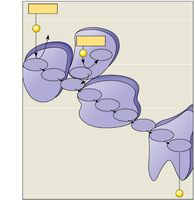
Additional info:
- Substrate-level phosphorylation: Direct transfer of phosphate to ADP to form ATP. - Oxidative phosphorylation: ATP formation via electron transport chain and chemiosmosis. - Enzyme conditions: Pepsin (stomach) works in acidic pH; trypsin (intestine) works in basic pH. ----------------------------------------
