 Indietro
Metabolism, Energy, and Enzyme Function: Guided Study for Biology 1001
Guida di studio - Note intelligenti
 Appunti personalizzati basati sui tuoi materiali, ampliati con definizioni chiave, esempi e contesto.
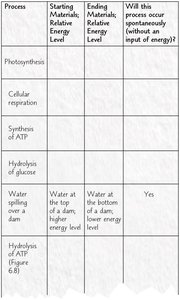
Q1. What are the two types of metabolic pathways, and how do they differ in terms of energy and molecule transformation?
Background
Topic: Metabolic Pathways (Anabolic vs. Catabolic)
This question tests your understanding of how organisms manage energy and matter through metabolic pathways, specifically distinguishing between anabolic (building up) and catabolic (breaking down) reactions.
Key Terms:
Anabolic pathway: Builds larger molecules from smaller ones; usually requires energy input.
Catabolic pathway: Breaks down larger molecules into smaller ones; usually releases energy.
Metabolism: The sum of all chemical reactions in an organism.
Step-by-Step Guidance
Identify which reactions release energy (catabolic) and which consume energy (anabolic).
Determine which reactions build up larger molecules (anabolic) and which break down molecules (catabolic).
Consider which reactions are "uphill" (require energy input) and which are "downhill" (release energy).
Classify photosynthesis and cellular respiration as anabolic or catabolic pathways.
Think about the role of enzymes in catalyzing these reactions.
Try solving on your own before revealing the answer!
Final Answer:
Catabolic reactions release energy and break down molecules (e.g., cellular respiration).
Anabolic reactions consume energy and build up larger molecules (e.g., photosynthesis).
"Uphill" reactions are anabolic and require energy input; "downhill" reactions are catabolic and release energy.
Photosynthesis is an anabolic pathway; cellular respiration is a catabolic pathway.
All metabolic reactions require enzymes to catalyze them.
Catabolic pathways are exergonic, while anabolic pathways are endergonic.
Q2. What is the difference between kinetic and potential energy, and can you give examples of each?
Background
Topic: Types of Energy
This question tests your understanding of the basic forms of energy relevant to biological systems.
Key Terms:
Kinetic energy: Energy associated with motion.
Potential energy: Energy stored due to position or structure.
Step-by-Step Guidance
Define kinetic energy and think of examples (e.g., moving water, muscle contraction).
Define potential energy and think of examples (e.g., water at the top of a dam, chemical bonds).
Relate these concepts to biological processes (e.g., ATP, glucose).
Try solving on your own before revealing the answer!
Final Answer:
Kinetic energy is energy of motion (e.g., water flowing over a dam, muscle movement).
Potential energy is stored energy (e.g., water at the top of a dam, energy in chemical bonds).
Biological systems use both forms: ATP stores potential energy, which is released as kinetic energy during cellular work.
Q3. What is the First and Second Law of Thermodynamics, and how do they apply to biological systems?
Background
Topic: Thermodynamics in Biology
This question tests your understanding of fundamental physical laws governing energy transformations in living organisms.
Key Terms and Formulas:
First Law: Energy cannot be created or destroyed, only transformed.
Second Law: Every energy transfer increases the entropy (disorder) of the universe.
Entropy: Measure of disorder or randomness.
Step-by-Step Guidance
State the First Law and relate it to energy flow in cells (e.g., ATP hydrolysis).
State the Second Law and relate it to the increase in entropy during metabolic reactions.
Consider how living systems maintain order by increasing entropy elsewhere.
Try solving on your own before revealing the answer!
Final Answer:
First Law: Energy is conserved; cells transform energy from one form to another (e.g., chemical to mechanical).
Second Law: Energy transformations increase entropy; cells maintain order by releasing heat and increasing disorder in their surroundings.
These laws explain why cells need a constant input of energy and why metabolic processes are not 100% efficient.
Q4. What is free energy (G), and how does its change (ΔG) predict whether a reaction is spontaneous?
Background
Topic: Free Energy and Spontaneity
This question tests your ability to use the concept of free energy to predict reaction spontaneity.
Key Terms and Formulas:
Free energy (G): Energy available to do work.
ΔG: Change in free energy during a reaction.
Formula:
Step-by-Step Guidance
Define free energy and its symbol (G).
Explain how ΔG is calculated and what it means for a reaction.
Determine whether ΔG is negative (spontaneous) or positive (non-spontaneous).
Relate ΔG to cellular respiration and photosynthesis.
Try solving on your own before revealing the answer!
Final Answer:
Free energy (G) is the energy available to do work in a system.
ΔG is negative for spontaneous reactions (exergonic), positive for non-spontaneous (endergonic).
Cellular respiration is exergonic (ΔG negative); photosynthesis is endergonic (ΔG positive).
ΔG helps predict whether a reaction will occur without an input of energy.
Q5. How does ATP power cellular work, and what is energy coupling?
Background
Topic: ATP and Energy Coupling
This question tests your understanding of how cells use ATP to drive endergonic reactions by coupling them with exergonic reactions.
Key Terms and Formulas:
ATP (Adenosine Triphosphate): Main energy currency of the cell.
Energy coupling: Using energy released from exergonic reactions to drive endergonic reactions.
ATP hydrolysis:
Step-by-Step Guidance
List the three main kinds of work cells do (mechanical, transport, chemical).
Describe how ATP is used to power these types of work.
Explain the concept of energy coupling and why it is important for cells.
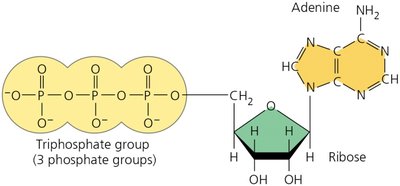
Identify the components of ATP and which bond is most likely to break during hydrolysis.
Try solving on your own before revealing the answer!
Final Answer:
ATP powers cellular work by transferring a phosphate group to other molecules, making them more reactive.
Energy coupling allows cells to use energy released from ATP hydrolysis (exergonic) to drive endergonic reactions.
The terminal phosphate bond is most likely to break, releasing energy.
ATP is composed of adenine, ribose, and three phosphate groups.
Q6. How do enzymes speed up metabolic reactions, and what is activation energy?
Background
Topic: Enzyme Function and Activation Energy
This question tests your understanding of how enzymes lower the activation energy barrier to speed up reactions.
Key Terms and Formulas:
Enzyme: Protein that acts as a catalyst.
Catalyst: Substance that speeds up a reaction without being consumed.
Activation energy (EA): Energy required to start a reaction.
Step-by-Step Guidance
Define catalyst and activation energy.
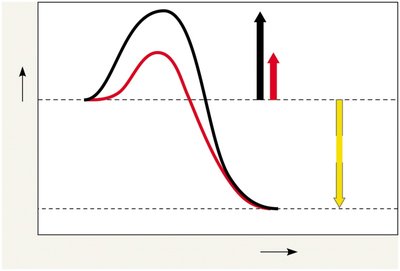
Label the axes of a reaction progress graph (x-axis: Progress of Reaction, y-axis: Free Energy).
Identify the activation energy with and without an enzyme on the graph.
Discuss how enzymes affect EA and ΔG.
Try solving on your own before revealing the answer!
Final Answer:
Enzymes lower the activation energy barrier, making reactions proceed faster.
They do not change the ΔG of the reaction.
On the graph, EA is lower with an enzyme (red curve) than without (black curve).
Enzymes are essential for regulating metabolic pathways efficiently.
Q7. What is meant by induced fit, and how do enzymes interact with substrates?
Background
Topic: Enzyme-Substrate Interaction
This question tests your understanding of how enzymes bind to substrates and change shape to facilitate reactions.
Key Terms:
Induced fit: Enzyme changes shape to better fit the substrate.
Active site: Region of enzyme where substrate binds.
Substrate: Reactant acted upon by enzyme.
Product: Result of the enzyme-catalyzed reaction.
Step-by-Step Guidance
Define enzyme, substrate, active site, and product.
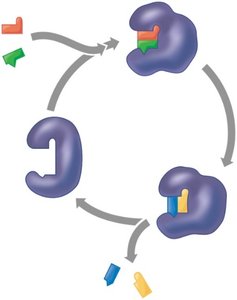
Describe the process of substrate binding and induced fit.
Label the steps in the enzyme-substrate complex diagram.
Try solving on your own before revealing the answer!
Final Answer:
Induced fit refers to the enzyme changing shape to snugly fit the substrate, enhancing catalysis.
The substrate binds to the active site, the enzyme changes shape, and the reaction produces products.
This mechanism increases the specificity and efficiency of enzyme action.
