 Indietro
Metabolism, Energy, and Enzymes: Study Guide for General Biology
Guida di studio - Note intelligenti
 Appunti personalizzati basati sui tuoi materiali, ampliati con definizioni chiave, esempi e contesto.
Metabolism and Energy in Biological Systems
Introduction to Metabolism
Metabolism encompasses all chemical reactions occurring within an organism, enabling the management of cellular material and energy resources. These reactions are organized into pathways that either build or break down molecules.
Anabolic Pathways: Consume energy to build complex molecules from simpler ones (e.g., assembling monomers into polymers).
Catabolic Pathways: Release energy by breaking down complex molecules into simpler ones (e.g., glucose breakdown during respiration).
Energy Coupling: Energy released from catabolic pathways is used to drive anabolic pathways.
Types of Energy
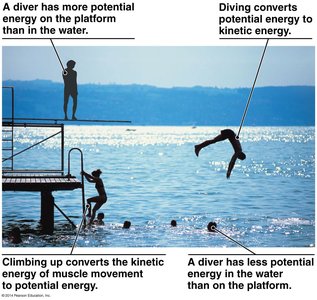
Energy is the capacity to do work and exists in various forms within biological systems.
Kinetic Energy: Energy of motion, including heat (thermal energy) and light (movement of photons).
Potential Energy: Stored energy due to position or structure, such as chemical energy in bonds.
Thermodynamics: The study of energy transformations within a system and its surroundings.
The Laws of Thermodynamics
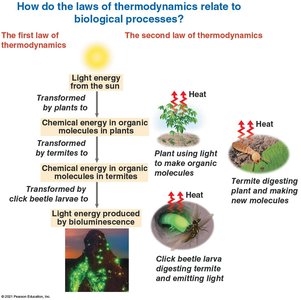
Biological processes obey the fundamental laws of thermodynamics, which govern energy transformations.
First Law (Conservation of Energy): Energy cannot be created or destroyed, only transferred or transformed.
Second Law: Every energy transformation releases some energy as heat, increasing entropy (disorder/randomness).
Entropy: The measure of disorder; heat is the most disorganized form of energy.
Free Energy and Chemical Reactions
Gibbs Free Energy (G)
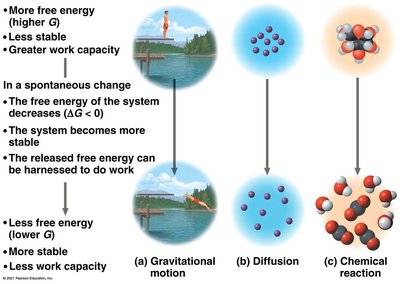
Free energy is the portion of a system's energy available to perform work. Changes in free energy (ΔG) determine whether a reaction is spontaneous or requires energy input.
ΔG = G(final) – G(initial)
Negative ΔG: Free energy is released; reaction is spontaneous and favorable.
Positive ΔG: Free energy is absorbed; reaction is non-spontaneous and requires energy.
Classifying Reactions: Exergonic vs. Endergonic
Reactions are classified based on their free energy changes and their role in metabolism.
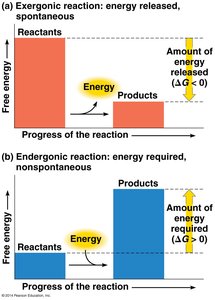
Exergonic Reactions: Negative ΔG, spontaneous, energy released, associated with catabolic pathways.
Endergonic Reactions: Positive ΔG, non-spontaneous, energy consumed, associated with anabolic pathways.
Energy Coupling: Endergonic reactions must be coupled to exergonic reactions to proceed.
Equilibrium and Free Energy
Systems tend toward equilibrium, the state of lowest free energy and maximum stability. In biological systems, equilibrium is rarely reached, as ongoing reactions and material movement prevent it.
At Equilibrium: ΔG = 0; no work can be performed.
Biological Systems: Continuous reactions prevent equilibrium, enabling ongoing work and life.
ΔG in Cellular Metabolism
Key metabolic reactions illustrate the principles of free energy change.
Cellular Respiration: ; ΔG = -686 kcal/mol (exergonic, spontaneous).
Photosynthesis: ; ΔG = +686 kcal/mol (endergonic, non-spontaneous).
ATP: The Energy Currency of the Cell
Structure and Function of ATP
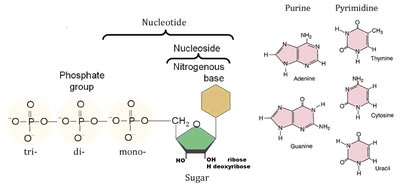
ATP (Adenosine Triphosphate) is the primary energy carrier in cells, mediating energy coupling for cellular work.
Structure: Adenine base, ribose sugar, three phosphate groups.
Cellular Work: Mechanical, transport, and chemical processes—all endergonic and require ATP.
ATP Hydrolysis: Releases energy by breaking the bond between phosphate groups.

ATP Hydrolysis and Energy Coupling
Hydrolysis of ATP is highly exergonic and is used to drive endergonic reactions via phosphorylation.
ΔG for ATP Hydrolysis: kcal/mol (standard conditions).
Phosphorylation: Transfer of phosphate group to a protein or substrate, causing a change in shape and function.
Energy Coupling Example: Conversion of glucose to glucose-6-phosphate is endergonic, but coupled to ATP hydrolysis, the net reaction is exergonic.

Effects of Phosphorylation
Phosphorylation alters the charge and shape of proteins, acting as a molecular switch to turn proteins on or off.
Protein Kinases: Enzymes that add phosphate groups.
Protein Phosphatases: Enzymes that remove phosphate groups.

Enzymes and Catalysis
Role of Enzymes
Enzymes are biological catalysts that increase the rate of chemical reactions without being consumed. They lower the activation energy (Ea) required for reactions to proceed.
Catalyst: Substance that increases reaction rate without altering ΔG.
Enzyme: Protein (or RNA) catalyst in biological systems.
Substrate: The reactant acted upon by an enzyme.
Active Site: Region of enzyme where substrate binds.
Induced Fit Model: Active site changes shape to accommodate substrate, stabilizing the transition state.
Activation Energy and Reaction Rate
Activation energy is the energy required to break bonds in reactants. Enzymes lower Ea, allowing reactions to occur more rapidly.
Transition State: Unstable intermediate with highest free energy.
Enzyme Mechanisms: Align substrates, stress bonds, provide favorable microenvironment, participate in reaction.
Enzyme Activity and Regulation
Enzyme activity is influenced by environmental conditions and regulatory molecules.
Optimal Conditions: Each enzyme works best at specific temperature, pH, and salt concentration.
Cofactors/Coenzymes: Non-protein helpers required for enzyme function.
Inhibitors: Molecules that decrease enzyme activity.
Competitive Inhibitors: Bind to active site, competing with substrate.
Noncompetitive Inhibitors: Bind elsewhere, changing enzyme shape (allosteric regulation).
Feedback Inhibition: End product of pathway inhibits earlier steps, regulating metabolic pathways.
Summary Table: Exergonic vs. Endergonic Reactions
Property | Exergonic | Endergonic |
|---|---|---|
Pathway Type | Catabolic | Anabolic |
ΔG | Negative | Positive |
Energy | Released | Consumed |
Spontaneity | Spontaneous | Non-spontaneous |
Entropy | Increases | Decreases |
Key Vocabulary
Anabolic vs. Catabolic
Kinetic Energy (Heat, Light)
Potential Energy (Chemical)
Entropy
Free Energy (G)
Exergonic vs. Endergonic
Energy Coupling
Equilibrium
ATP vs. ADP
Phosphorylation (Kinase, Phosphatase)
Catalyst
Substrate
Active Site
Induced Fit Model
Activation Energy (Ea)
Transition State
Inhibitors (Competitive, Non-competitive, Allosteric)
Feedback Inhibition
