 Indietro
Metabolism, Enzymes, and Thermodynamics: Study Notes for General Biology
Guida di studio - Note intelligenti
 Appunti personalizzati basati sui tuoi materiali, ampliati con definizioni chiave, esempi e contesto.
Metabolism and Energy Transformations
Forms of Energy in Biological Systems
All living cells require energy to survive, and they utilize various sources and forms of energy. Metabolism refers to the sum of all chemical reactions in a cell, including the conversion of one form of energy to another.
Energy Sources: Light, chemical, and kinetic energy are common sources for living organisms.
Energy Transformations: Cells can convert light to chemical energy (photosynthesis), chemical to kinetic energy (muscle contraction), chemical to light (bioluminescence), and kinetic to chemical energy.
Covalent Bonds: These represent potential energy, which can be stored or released by making or breaking bonds.
Example: Bioluminescent organisms convert chemical energy into light, as seen in glowing beaches.

ATP: The Energy Currency of the Cell
ATP (adenosine triphosphate) is the primary molecule used by cells to store and transfer energy for cellular processes.
Structure: ATP consists of ribose (a sugar), adenine (a nitrogenous base), and three phosphate groups.
Functions: ATP is used for building cell parts, moving materials within the cell, muscle contraction, and breaking down cellular materials.
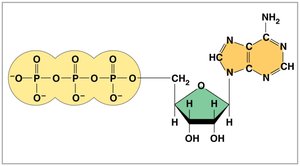
ATP Hydrolysis
ATP is hydrolyzed to ADP (adenosine diphosphate) and inorganic phosphate, releasing energy for cellular work.
Reaction: ATP + H2O → ADP + Pi + energy
Importance: This reaction is central to energy transfer in cells.
Thermodynamics in Biology
Laws of Thermodynamics
The laws of thermodynamics explain how energy is transformed and conserved in biological systems.
First Law (Conservation of Energy): Energy cannot be created or destroyed, only transformed.
Second Law (Entropy): Entropy (disorder) increases in a system, and some energy is lost as heat during transformations.

Metabolic Pathways
Catabolic and Anabolic Pathways
Metabolism is divided into two main types of pathways:
Catabolic Pathways: Break down large molecules into smaller ones, releasing energy.
Anabolic Pathways: Build large, complex molecules from smaller building blocks, consuming energy.
Exergonic and Endergonic Reactions
Reactions in metabolism can be classified based on their energy changes:
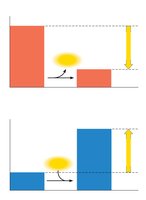
Exergonic Reactions: Release free energy and are spontaneous.
Endergonic Reactions: Absorb free energy and are nonspontaneous.
Gibbs Free Energy (G): The portion of a system’s energy available to do work at constant temperature and pressure.
Enzymes and Activation Energy
Role of Enzymes
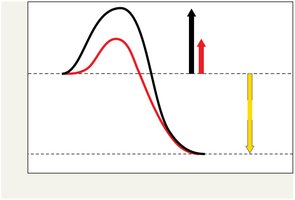
Enzymes are catalytic proteins (and some RNAs) that speed up chemical reactions by lowering the activation energy required.
Activation Energy (EA): The energy required to start a reaction.
Enzyme Properties: Enzymes are not consumed in the reaction and can be reused.
Enzyme-Substrate Interaction
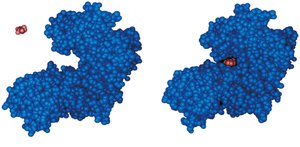
Enzymes interact specifically with their substrates, forming an enzyme-substrate complex that facilitates the reaction.
Specificity: The active site of the enzyme binds only to specific substrates.
Mechanism: Enzymes bring chemical groups into the correct position, reducing activation energy.
Coupling Reactions with ATP Hydrolysis
Many metabolic reactions are coupled with ATP hydrolysis to make them exergonic, allowing cells to drive nonspontaneous processes.
Example: The conversion of glutamic acid to glutamine is coupled with ATP hydrolysis, resulting in a net negative .
Regulation of Metabolic Pathways
Pathway Organization and Regulation
Cellular metabolism is organized into pathways, with each step catalyzed by a specific enzyme. Regulation ensures efficient and controlled metabolic flow.
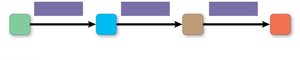
Pathways: The product of one reaction becomes the substrate for the next.
Cofactors: Some enzymes require cofactors (e.g., NAD+) for activity.
Enzyme Inhibition
Enzyme activity can be regulated by inhibitors:
Competitive Inhibition: A molecule similar to the substrate binds to the active site, blocking substrate access.
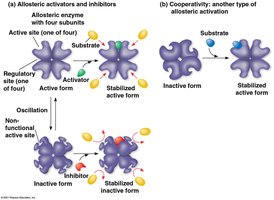
Noncompetitive Inhibition: A molecule binds elsewhere on the enzyme, changing its shape and reducing activity. Allosteric inhibition is a type of noncompetitive inhibition.
Allosteric Regulation
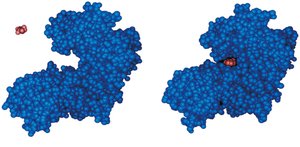
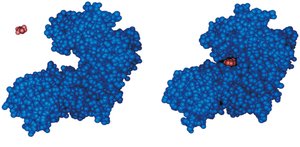
Allosteric regulation is a common mechanism for controlling metabolic pathways. The final product of a pathway can bind to the first enzyme, altering its shape and stopping the pathway.
Feedback Inhibition: Prevents overproduction of products and maintains homeostasis.
Summary Table: Types of Metabolic Reactions
Type | Energy Change | Spontaneity | Example |
|---|---|---|---|
Catabolic | Release energy | Spontaneous (exergonic) | Cellular respiration |
Anabolic | Consume energy | Nonspontaneous (endergonic) | Protein synthesis |
Additional info: Enzyme regulation is essential for maintaining cellular homeostasis and responding to environmental changes. Allosteric regulation and feedback inhibition are key mechanisms in metabolic control.
