 Indietro
Metabolism, Glycolysis, and Cellular Respiration: Study Notes for General Biology
Guida di studio - Note intelligenti
 Appunti personalizzati basati sui tuoi materiali, ampliati con definizioni chiave, esempi e contesto.
Metabolism and Cellular Respiration
Enzymes and Activation Energy
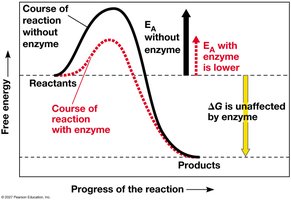
Enzymes are biological catalysts that accelerate chemical reactions by lowering the activation energy required for the reaction to proceed. This allows cells to carry out metabolic processes efficiently and at lower temperatures than would otherwise be possible.
Activation Energy (EA): The minimum energy required to initiate a chemical reaction.
Enzyme Function: Enzymes reduce EA, but do not affect the overall change in free energy (ΔG) of the reaction.
Example: Digestive enzymes break down food molecules rapidly in the body.
Cellular Work and ATP
Cells perform various types of work, including anabolic metabolism (building molecules), membrane transport, and movement. All these processes require energy, which is supplied by ATP.
Anabolic Metabolism: Synthesis of complex molecules from simpler ones.
Membrane Transport: Movement of substances against concentration gradients.
ATP: The universal energy currency of the cell.
Source of Cellular Energy
ATP is ultimately derived from the energy stored in glucose, which is produced by phototrophs (producers) through photosynthesis. This energy is then transferred through the food web.
Producers (Phototrophs): Convert solar energy into chemical energy (glucose).
Consumers (Heterotrophs): Obtain energy by consuming other organisms.
Decomposers: Break down dead organic matter, releasing energy.


Redox Reactions in Metabolism
Oxidation and Reduction
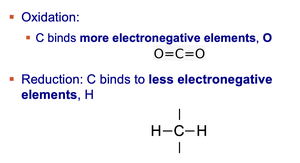
Metabolic processes often involve redox reactions, where electrons are transferred between molecules. Oxidation is the loss of electrons, while reduction is the gain of electrons.
Oxidation: Carbon binds to more electronegative elements (e.g., oxygen).
Reduction: Carbon binds to less electronegative elements (e.g., hydrogen).
Energy Release: Oxidation of hydrocarbons releases energy.
Energy from Hydrocarbons
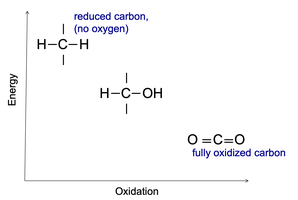
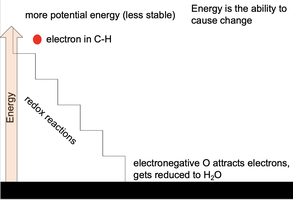
Hydrogen atoms in C-H bonds are sources of high-energy electrons. When these electrons are transferred to oxygen (a highly electronegative atom), energy is released and can be harnessed by the cell.
Example: Burning marshmallows or wood releases energy through oxidation.


Energy and Oxidation Levels
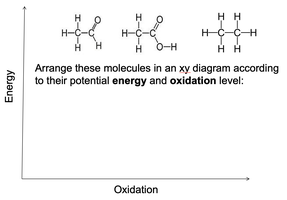
The energy content of organic molecules depends on their oxidation state. Reduced carbon (more C-H bonds) has higher energy, while fully oxidized carbon (more C-O bonds) has lower energy.
Reduced Carbon: High energy, less stable.
Oxidized Carbon: Low energy, more stable.

Stages of Cellular Respiration
Overview of Cellular Respiration
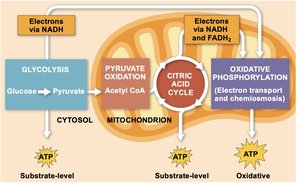
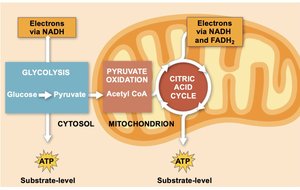
Cellular respiration is the process by which cells harvest energy from glucose. It consists of four main stages: glycolysis, pyruvate oxidation, the citric acid cycle, and oxidative phosphorylation.
Glycolysis: Breakdown of glucose to pyruvate in the cytoplasm.
Pyruvate Oxidation: Conversion of pyruvate to acetyl CoA.
Citric Acid Cycle: Complete oxidation of acetyl CoA to CO2.
Oxidative Phosphorylation: ATP synthesis using high-energy electrons.
Glycolysis
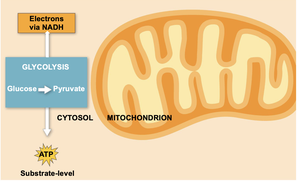
Glycolysis is the first stage of cellular respiration, occurring in the cytoplasm of all organisms. It breaks down one molecule of glucose (C6) into two molecules of pyruvate (C3), producing ATP and NADH.
Location: Cytoplasm
Products: 2 ATP (via substrate-level phosphorylation), 2 NADH
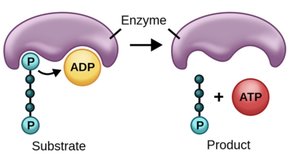
Substrate-Level Phosphorylation: Direct transfer of phosphate group to ADP to form ATP.
NADH and FADH2
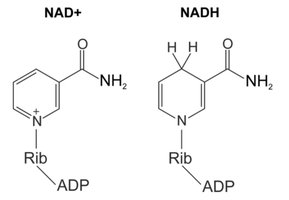
NADH and FADH2 are electron carriers that store high-energy electrons generated during glycolysis and the citric acid cycle. These electrons are used in oxidative phosphorylation to produce ATP.
NADH: Formed from NAD+ by accepting electrons.
FADH2: Formed from FAD by accepting electrons.
Pyruvate Oxidation
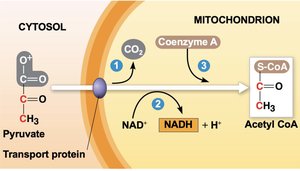
Pyruvate produced in glycolysis is transported into the mitochondrion, where it is oxidized to acetyl CoA. This process also generates NADH and releases CO2.
Location: Mitochondrion
Products: Acetyl CoA, NADH, CO2
Citric Acid Cycle (Krebs Cycle, TCA Cycle)
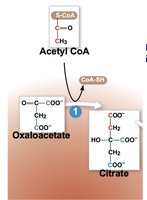
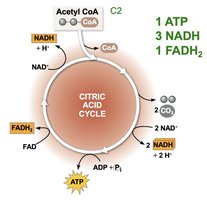
The citric acid cycle completes the oxidation of acetyl CoA, producing ATP, NADH, FADH2, and CO2. Each turn of the cycle generates 1 ATP, 3 NADH, and 1 FADH2.
Location: Mitochondrion
Products per turn: 1 ATP, 3 NADH, 1 FADH2, 2 CO2
Electron Carriers: NADH and FADH2 relay electrons to the electron transport chain.
Oxidative Phosphorylation
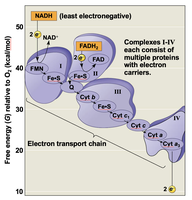
Oxidative phosphorylation is the final stage of cellular respiration, where high-energy electrons from NADH and FADH2 are transferred through the electron transport chain to oxygen, the final electron acceptor. This process generates most of the cell's ATP.
Electron Transport Chain: Series of protein complexes that transfer electrons and pump protons.
ATP Synthesis: Driven by chemiosmosis (proton gradient).
Oxygen: Serves as the final electron acceptor, forming water.
Summary Table: Stages of Cellular Respiration
Stage | Location | Main Products |
|---|---|---|
Glycolysis | Cytoplasm | 2 ATP, 2 NADH, 2 Pyruvate |
Pyruvate Oxidation | Mitochondrion | 2 NADH, 2 Acetyl CoA, 2 CO2 |
Citric Acid Cycle | Mitochondrion | 2 ATP, 6 NADH, 2 FADH2, 4 CO2 |
Oxidative Phosphorylation | Mitochondrion | ~28 ATP, H2O |
Key Equations
The overall equation for cellular respiration is:
Additional info:
All organisms, including producers, consumers, and decomposers, utilize glycolysis to break down glucose and obtain energy.
Substrate-level phosphorylation occurs in glycolysis and the citric acid cycle, while oxidative phosphorylation occurs in the electron transport chain.
