 Indietro
Mini-Textbook Study Guide: Structure and Function of Large Biological Molecules, Cell Structure, and Membrane Function
Guida di studio - Note intelligenti
 Appunti personalizzati basati sui tuoi materiali, ampliati con definizioni chiave, esempi e contesto.
Chapter 5: The Structure and Function of Large Biological Molecules
Organic Molecules and Biomolecules
Organic molecules are fundamental to life, composed primarily of carbon and hydrogen. Living organisms utilize four main types of biomolecules: carbohydrates, lipids, proteins, and nucleic acids. Many of these are macromolecules, formed by linking smaller units called monomers into polymers.
Carbohydrates: Monomer is glucose; function as energy sources and structural components.
Proteins: Monomer is amino acid; function in catalysis, structure, transport, defense, and more.
Nucleic Acids: Monomer is nucleotide; function in genetic information storage and transfer.
Triglycerides: Made of glycerol and three fatty acids; serve as energy storage.
Carbohydrates
Carbohydrates are classified by their complexity:
Monosaccharides: Simple sugars (e.g., glucose, fructose, galactose). Classified by carbonyl group location (aldose or ketose) and number of carbons (triose, pentose, hexose).
Disaccharides: Two monosaccharides joined by dehydration synthesis (glycosidic linkage). Examples: maltose, sucrose, lactose.
Polysaccharides: Long chains of monosaccharides. Examples: starch (plant storage), glycogen (animal storage), cellulose (plant cell wall), chitin (exoskeletons).
Lipids
Lipids are hydrophobic molecules serving as energy storage, membrane structure, and signaling.
Fats (Triglycerides): Glycerol + 3 fatty acids. Saturated fats (solid, single bonds), unsaturated fats (liquid, double bonds).
Phospholipids: Amphipathic molecules with hydrophilic head and hydrophobic tails; form cell membranes.
Steroids: Four fused carbon rings; function as hormones (e.g., cholesterol, testosterone).
Proteins
Proteins are polymers of amino acids, performing diverse functions:
Enzymes: Catalyze reactions.
Transport: Hemoglobin carries oxygen.
Structure: Keratin in skin, hair, nails.
Hormones: Insulin, thyroxine.
Defense: Antibodies.
Contractile: Actin, myosin in muscles.
Storage: Egg white proteins.
Protein structure is hierarchical:
Primary: Sequence of amino acids.
Secondary: Coils and folds (α-helix, β-sheet).
Tertiary: 3D shape from R group interactions.
Quaternary: Multiple polypeptide chains.
Protein function depends on structure; denaturation disrupts function. Diseases like sickle-cell anemia and Alzheimer's are linked to misfolded proteins.
Nucleic Acids
Nucleic acids (DNA and RNA) store and transmit genetic information.
DNA: Double-stranded, deoxyribose sugar, bases A, T, C, G. Structure: two antiparallel sugar-phosphate backbones, nitrogenous bases paired by hydrogen bonds (A-T, C-G).
RNA: Single-stranded, ribose sugar, bases A, U, C, G.
Chapter 6: A Tour of the Cell
Cell Theory and Cell Types
Cell theory states that all living things are composed of cells, the basic unit of life, and new cells arise from existing cells. Cells are classified as prokaryotic (no membrane-bound organelles, e.g., bacteria) or eukaryotic (membrane-bound organelles, e.g., plants, animals).
Common Cellular Structures
DNA: Genetic information.
Ribosomes: Protein synthesis.
Cytoplasm: Site of metabolic reactions.
Cell membrane: Regulates entry/exit of substances.
Eukaryotic Organelles and Their Functions
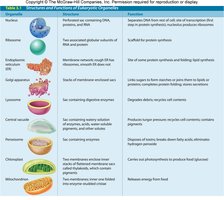
Eukaryotic cells contain specialized organelles, each with distinct functions:
Organelle | Structure | Function |
|---|---|---|
Nucleus | Membrane-enclosed, contains DNA | Controls cell activities, stores genetic material |
Ribosomes | Small, composed of rRNA and proteins | Protein synthesis |
Endoplasmic Reticulum (Rough/Smooth) | Membrane network; rough ER has ribosomes | Protein (rough) and lipid (smooth) synthesis |
Golgi Apparatus | Stacked membranes | Modifies, packages, ships proteins/lipids |
Lysosomes | Vesicles with digestive enzymes | Break down food/waste |
Vacuoles | Large sacs | Storage of nutrients, water, waste |
Mitochondria | Double membrane | ATP production (cellular respiration) |
Chloroplasts | Oval, double membrane | Photosynthesis (plants) |
Peroxisomes | Small vesicles | Break down fatty acids, detoxify |
Comparison of Cell Types
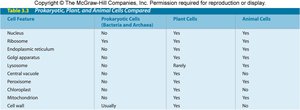
Prokaryotic, plant, and animal cells differ in their organelle composition:
Cell Feature | Prokaryotic | Plant | Animal |
|---|---|---|---|
Nucleus | No | Yes | Yes |
Ribosome | Yes | Yes | Yes |
Endoplasmic Reticulum | No | Yes | Yes |
Golgi Apparatus | No | Yes | Yes |
Lysosome | No | Rarely | Yes |
Central Vacuole | No | Yes | No |
Chloroplast | No | Yes | No |
Mitochondrion | Usually | Yes | Yes |
Cell Wall | Yes | Yes | No |
Chapter 7: Membrane Structure and Function
Plasma Membrane Structure
The plasma membrane is a fluid mosaic of phospholipids, proteins, cholesterol, and carbohydrates. Its amphipathic phospholipids form a bilayer, with hydrophilic heads facing outward and hydrophobic tails inward. Membrane proteins (integral and peripheral) perform transport, signaling, and structural functions.
Transport Across Membranes
Cell membranes regulate transport via passive and active mechanisms:
Passive Transport: No energy required. Includes diffusion, osmosis, and facilitated diffusion.
Diffusion: Movement from high to low concentration.
Osmosis: Water movement across a semi-permeable membrane. Direction depends on solute concentration (tonicity).
Facilitated Diffusion: Uses transport proteins; no ATP required.
Active Transport: Requires ATP to move substances against concentration gradient (e.g., Na+/K+ pump).
Bulk Transport: Endocytosis (phagocytosis, pinocytosis, receptor-mediated) and exocytosis.
Osmosis and Tonicity
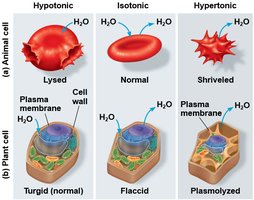
Osmosis affects cell shape depending on the external solution:
Hypotonic: Water enters cell; animal cells may lyse, plant cells become turgid.
Isotonic: No net water movement; cells remain normal.
Hypertonic: Water leaves cell; animal cells shrivel (crenation), plant cells plasmolyze.
Membrane Proteins and Fluidity
Integral proteins: Span the membrane, involved in transport.
Peripheral proteins: Attached to membrane surface.
Cholesterol: Buffers membrane fluidity.
Transport Mechanisms: Summary Table
Type | Energy Required? | Direction | Protein Needed? | Example |
|---|---|---|---|---|
Simple Diffusion | No | High to low | No | O2, CO2 |
Facilitated Diffusion | No | High to low | Yes | Glucose, amino acids |
Osmosis | No | High to low (water) | Sometimes (aquaporins) | Water |
Active Transport | Yes (ATP) | Low to high | Yes | Na+/K+ pump |
Bulk Transport | Yes (ATP) | Variable | Yes | Endocytosis, exocytosis |
Key Terms and Concepts
Dehydration Synthesis: Joins monomers by removing water.
Hydrolysis: Breaks polymers by adding water.
Amphipathic: Molecule with both hydrophilic and hydrophobic regions (e.g., phospholipids).
Glycosidic Linkage: Covalent bond between monosaccharides.
Tonicity: Relative concentration of solutes; determines water movement.
Aquaporins: Channel proteins for water transport.
Important Equations
Diffusion Rate:
Osmosis: (Water potential difference drives osmosis)
Additional info: Some details about cell structure and transport mechanisms were expanded for clarity and completeness.
