 Indietro
Mitosis and the Eukaryotic Cell Cycle: Structure, Regulation, and Chromosome Dynamics
Guida di studio - Note intelligenti
 Appunti personalizzati basati sui tuoi materiali, ampliati con definizioni chiave, esempi e contesto.
Mitosis and the Cell Cycle
Overview of the Cell Cycle
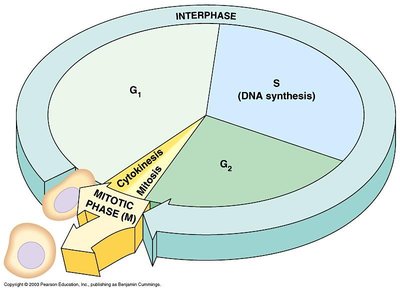
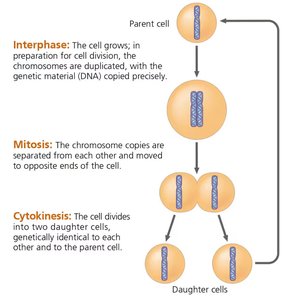
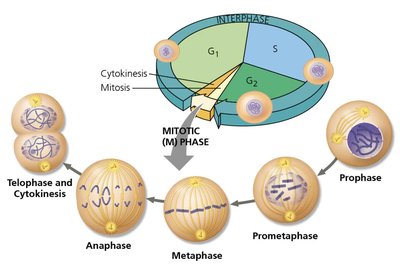
The eukaryotic cell cycle is a series of events that cells go through as they grow and divide. It consists of interphase (G1, S, G2) and the mitotic (M) phase, which includes mitosis and cytokinesis.
G1 phase: Cell growth and normal metabolic roles.
S phase: DNA synthesis (replication) occurs, resulting in duplicated chromosomes.
G2 phase: Further growth and preparation for division.
M phase: Mitosis (nuclear division) and cytokinesis (cytoplasmic division).
Cell Cycle Checkpoints
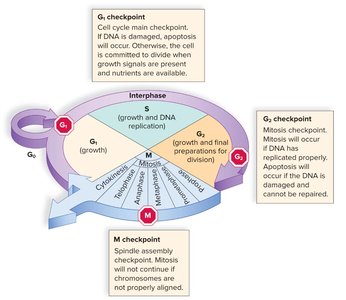
Checkpoints are control mechanisms that ensure the fidelity of cell division. They prevent the progression of the cell cycle if certain conditions are not met, thus maintaining genomic integrity.
G1 checkpoint: Checks for DNA damage before DNA replication. If damage is detected, the cell may undergo apoptosis.
G2 checkpoint: Ensures DNA has been replicated properly and checks for DNA damage before mitosis.
M checkpoint (Spindle Assembly Checkpoint): Ensures all chromosomes are properly attached to the spindle before anaphase proceeds.
DNA Replication and Chromosome Structure
DNA Replication
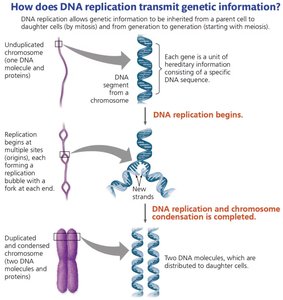
DNA replication is the process by which a cell duplicates its DNA, ensuring that each daughter cell receives an identical set of genetic instructions. Replication occurs during the S phase of interphase and is semiconservative, meaning each new DNA molecule consists of one old and one new strand.
Origins of replication: Specific sequences where DNA replication begins.
Replication forks: Y-shaped regions where the DNA is split into two strands for copying.
Chromosome Structure and Replication
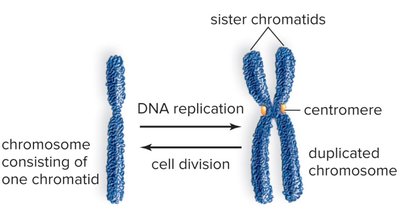
Chromosomes are long, linear DNA molecules wrapped around proteins called histones. After replication, each chromosome consists of two identical sister chromatids joined at a centromere.
Sister chromatids: Identical copies of a chromosome, connected by a centromere, produced during DNA replication.
Centromere: The region where sister chromatids are joined and where spindle fibers attach during mitosis.
Transmission of Genetic Information
DNA replication ensures that genetic information is faithfully transmitted from parent to daughter cells during cell division. Each gene is a unit of hereditary information, and accurate replication is essential for maintaining genetic continuity.
Mitosis: Process and Phases
Purpose and Outcomes of Mitosis
Mitosis is the process by which a eukaryotic cell separates its duplicated chromosomes into two identical nuclei. This process is essential for growth, repair, and asexual reproduction in multicellular organisms.
Produces two genetically identical daughter cells (same chromosome number and genetic content as the parent cell).
Maintains diploid chromosome number in somatic cells.
Phases of Mitosis
Mitosis is divided into several distinct phases:
Prophase: Chromosomes condense, spindle apparatus forms, nuclear envelope breaks down.
Prometaphase: Spindle fibers attach to kinetochores on chromosomes.
Metaphase: Chromosomes align at the metaphase plate (center of the cell).
Anaphase: Sister chromatids separate and move toward opposite poles.
Telophase: Nuclear envelopes reform around the two sets of chromosomes, which decondense.
Cytokinesis: Division of the cytoplasm, resulting in two separate daughter cells.
Microscopic View of Mitosis
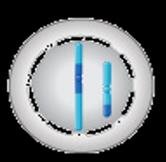
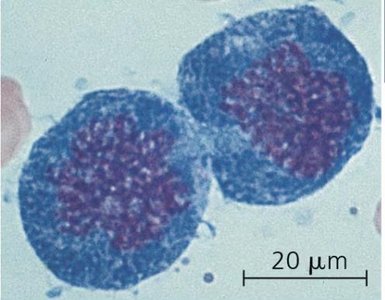
Under the microscope, dividing cells can be observed at various stages of mitosis, with chromosomes visible as condensed structures during division.
Chromosome Organization and Ploidy
Chromosome Number and Ploidy
The genome is the complete set of genetic material in an organism. In humans, somatic cells are diploid (2n), containing two sets of chromosomes (one from each parent). The human karyotype consists of 23 pairs of chromosomes (46 total).
Homologous chromosomes: Chromosome pairs with the same genes in the same order, but possibly different alleles.
Sister chromatids: Identical copies of a chromosome, produced during DNA replication.
Term | Definition |
|---|---|
Homologous chromosomes | Chromosomes of the same size and shape, with the same genes at the same loci, but possibly different alleles |
Sister chromatids | Identical copies of a chromosome, joined at the centromere, produced during S phase |
Ploidy (n) | Number of unique sets of chromosomes in a cell |
Summary Table: Cell Cycle Phases and Key Events
Phase | Main Events |
|---|---|
G1 | Cell growth, normal function, checkpoint for DNA damage |
S | DNA replication (synthesis), chromosome duplication |
G2 | Preparation for mitosis, checkpoint for DNA replication errors |
Mitosis | Division of the nucleus (prophase, prometaphase, metaphase, anaphase, telophase) |
Cytokinesis | Division of the cytoplasm, formation of two daughter cells |
Key Concepts and Equations
Semiconservative replication: Each new DNA molecule consists of one parental and one new strand.
Equation for DNA content after replication:
Equation for chromosome number in diploid cells:
Additional info:
Errors in cell cycle regulation can lead to uncontrolled cell division and cancer.
Cell differentiation is controlled by transcription factors, not by changes in DNA sequence.
