Indietro
Modes of Nutrition and Domain Characteristics in Prokaryotes and Eukaryotes
Guida di studio - Note intelligenti
 Appunti personalizzati basati sui tuoi materiali, ampliati con definizioni chiave, esempi e contesto.
Modes of Nutrition in Prokaryotes and Eukaryotes
Autotrophs and Heterotrophs
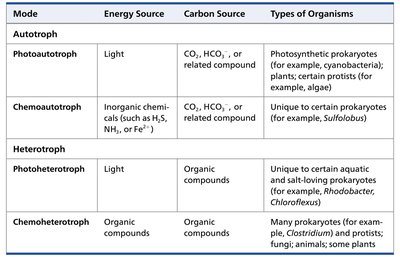
Organisms are classified based on how they obtain energy and carbon for growth. These nutritional modes are fundamental to understanding metabolic diversity in biology.
Autotrophs: Organisms that use inorganic carbon (such as CO2) as their carbon source.
Heterotrophs: Organisms that require organic compounds as their carbon source.
Types of Autotrophs
Photoautotrophs: Use light as an energy source and CO2 or related compounds as a carbon source. Examples include photosynthetic prokaryotes (cyanobacteria), plants, and certain protists (e.g., algae).
Chemoautotrophs: Use inorganic chemicals (such as H2S, NH3, or Fe2+) as an energy source and CO2 or related compounds as a carbon source. Unique to certain prokaryotes (e.g., Sulfolobus).
Types of Heterotrophs
Photoheterotrophs: Use light as an energy source and organic compounds as a carbon source. Found in certain aquatic and salt-loving prokaryotes (e.g., Rhodobacter, Chloroflexus).
Chemoheterotrophs: Use organic compounds for both energy and carbon. Includes many prokaryotes (e.g., Clostridium), protists, fungi, animals, and some plants.
Example: Plants are photoautotrophs, while humans are chemoheterotrophs.
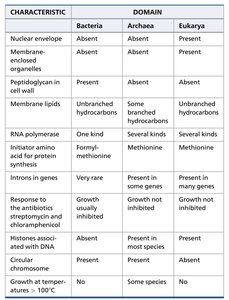
Characteristics of the Three Domains of Life
Bacteria, Archaea, and Eukarya
The three domains of life—Bacteria, Archaea, and Eukarya—are distinguished by several cellular and molecular characteristics. Understanding these differences is essential for studying phylogeny and evolutionary biology.
Bacteria: Prokaryotic cells lacking a nuclear envelope and membrane-enclosed organelles. Cell walls contain peptidoglycan. Membrane lipids are unbranched hydrocarbons. RNA polymerase is of one kind. Growth is usually inhibited by antibiotics.
Archaea: Prokaryotic cells without a nuclear envelope or membrane-enclosed organelles. Cell walls lack peptidoglycan. Membrane lipids may be branched hydrocarbons. RNA polymerase is of several kinds. Growth is not inhibited by antibiotics. Some species can grow at temperatures above 100°C.
Eukarya: Eukaryotic cells with a nuclear envelope and membrane-enclosed organelles. Cell walls (if present) lack peptidoglycan. Membrane lipids are unbranched hydrocarbons. RNA polymerase is of several kinds. Growth is not inhibited by antibiotics. Histones are associated with DNA. Chromosomes are linear.
Example: Humans belong to the domain Eukarya, while most bacteria found in soil belong to the domain Bacteria.
Characteristic | Bacteria | Archaea | Eukarya |
|---|---|---|---|
Nuclear envelope | Absent | Absent | Present |
Membrane-enclosed organelles | Absent | Absent | Present |
Peptidoglycan in cell wall | Present | Absent | Absent |
Membrane lipids | Unbranched hydrocarbons | Some branched hydrocarbons | Unbranched hydrocarbons |
RNA polymerase | One kind | Several kinds | Several kinds |
Initiator amino acid for protein synthesis | Formyl-methionine | Methionine | Methionine |
Introns in genes | Very rare | Present in some genes | Present |
Response to antibiotics | Growth usually inhibited | Growth not inhibited | Growth not inhibited |
Histones associated with DNA | Absent | Present in some species | Present |
Circular chromosome | Present | Present | Absent |
Growth at temperatures > 100°C | Not present | Some species | Not present |