 Indietro
Molecular Basis of Inheritance – DNA Structure, Replication, and Genetic Information
Guida di studio - Note intelligenti
 Appunti personalizzati basati sui tuoi materiali, ampliati con definizioni chiave, esempi e contesto.
Q2. Describe how DNA replication transmits genetic information to the next generation in a species.
Background
Topic: DNA Replication and Heredity
This question tests your understanding of how the process of DNA replication ensures that genetic information is accurately passed from parent cells to daughter cells, and from one generation to the next in a species.
Key Terms and Concepts:
DNA Replication: The process by which a cell makes an exact copy of its DNA before cell division.
Genetic Information: The sequence of nucleotides in DNA that encodes instructions for building proteins and functioning of the organism.
Base Pairing: Adenine (A) pairs with Thymine (T), and Cytosine (C) pairs with Guanine (G).
Semiconservative Replication: Each new DNA molecule consists of one old (parental) strand and one newly synthesized strand.
Step-by-Step Guidance
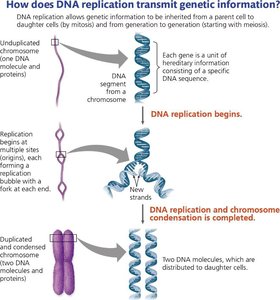
Recall that before a cell divides, its DNA must be replicated so that each daughter cell receives a complete set of genetic instructions.
During replication, the double-stranded DNA molecule unwinds, and each strand serves as a template for the synthesis of a new complementary strand.
Base pairing rules ensure that the new strands are accurate copies: A pairs with T, and C pairs with G. This preserves the genetic code.
After replication, each daughter cell inherits a DNA molecule with one original (parental) strand and one new strand, maintaining genetic continuity.
Think about how this process allows genetic information to be passed not only during cell division (mitosis) but also from parent to offspring (meiosis and fertilization).
Try solving on your own before revealing the answer!
Final Answer:
DNA replication transmits genetic information to the next generation by making an exact copy of the DNA molecule before cell division. Each new cell receives a DNA molecule with one parental strand and one new strand, ensuring that the genetic code is preserved and passed on. This process allows hereditary information to be inherited from parent to offspring, maintaining the continuity of genetic traits in a species.
The accuracy of base pairing during replication ensures that the sequence of nucleotides (and thus the genetic information) is faithfully transmitted.
