 Indietro
Moles, Organic Compounds, and Alkanes: Study Notes for General Biology
Guida di studio - Note intelligenti
 Appunti personalizzati basati sui tuoi materiali, ampliati con definizioni chiave, esempi e contesto.
Chapter 3.5: The Mole and Mole Conversions
Definition and Importance of the Mole
The mole is a fundamental unit in chemistry used to count large numbers of particles, such as atoms or molecules. It is analogous to other counting units like a dozen (12) or a gross (144), but much larger. The mole allows scientists to relate microscopic particles to macroscopic quantities.
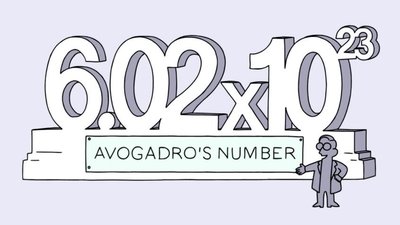
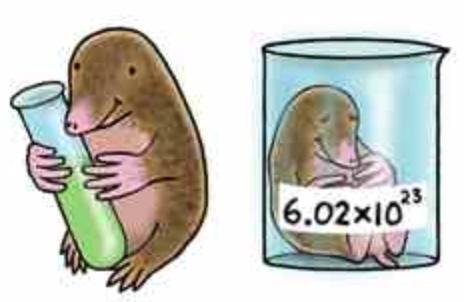
Avogadro’s Number: One mole contains particles (atoms, molecules, etc.).
Examples: 1 mole of marbles = marbles; 1 mole of sand grains = $6.02 \times 10^{23}$ sand grains.
Mole Conversions: Atoms to Moles and Vice Versa
Converting between moles and atoms is similar to converting between dozens and individual items. The conversion factor is Avogadro’s number.
Conversion Factor:
Example Calculation:
Number of copper atoms in 2.45 mol:
Number of moles in silver atoms:
Molecular Weight and Moles of Glucose
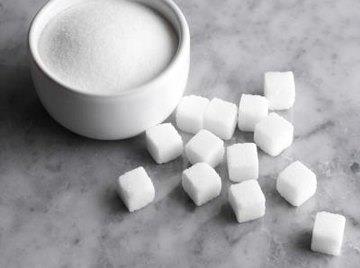
The molecular weight (MW) of a compound is the sum of the atomic masses of its constituent atoms. For glucose (C6H12O6):
Calculation:
Example: Number of moles in 100g of glucose:
Chapter 4: Introduction to Organic Compounds
Overview of Organic Chemistry
Organic chemistry is the study of organic compounds, which are covalent compounds containing carbon. These compounds are essential to life and include molecules composed of carbon, hydrogen, oxygen, nitrogen, and other elements.
Key Elements: Carbon, Hydrogen, Oxygen, Nitrogen, etc.
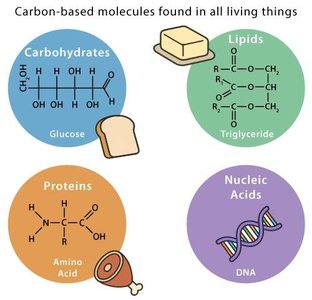
Biological Relevance: Organic compounds form the basis of biomolecules such as carbohydrates, lipids, proteins, and nucleic acids.
Valence Electrons and Bonding
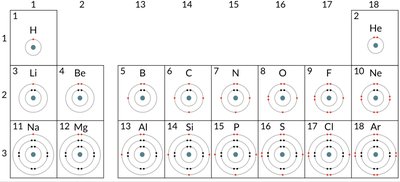
Valence electrons are the outermost electrons of an atom and are responsible for forming chemical bonds. The periodic table can be used to determine the number of valence electrons for each element.
Bond Formation: Atoms form bonds to achieve a stable electron configuration, often an octet (8 electrons).
Carbon: Has 4 valence electrons and forms four bonds (single, double, or triple).

Lewis Dot Structures
Lewis structures show the arrangement of atoms and valence electrons in a molecule. They help visualize bonding and electron distribution.
Steps for Drawing Lewis Structures:
Count total valence electrons.
Determine the central atom (usually least electronegative).
Connect atoms with single bonds.
Add remaining electrons to satisfy the octet rule.
Form multiple bonds if necessary.
Examples: Methane (CH4), Carbon dioxide (CO2), Hydrogen cyanide (HCN).
Practice: Drawing Lewis Structures
Examples: HCl, C2H4, H2O
Single, double, and triple bonds are illustrated in these molecules.
Chapter 4.1: Structural Representations of Organic Molecules
Condensed and Skeletal Structures
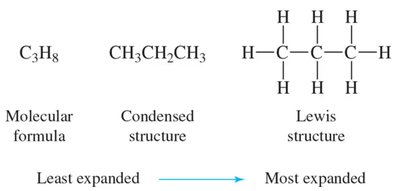
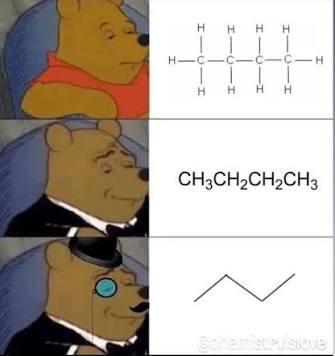
Organic molecules can be represented in several ways, each providing different levels of detail:
Molecular Formula: Shows the number of each atom (e.g., C3H8).
Condensed Structure: Shows atoms adjacent to each other but not all bonds.
Lewis Structure: Shows all atoms and bonds.
Skeletal Structure: Simplifies the molecule to lines representing carbon-carbon bonds.

Chapter 4.2: Alkanes and Cycloalkanes
Alkanes: Structure and Properties
Alkanes are the simplest group of organic molecules, consisting only of single-bonded carbon and hydrogen atoms. They are referred to as saturated hydrocarbons because they are bonded to the maximum number of hydrogen atoms.
Straight-Chain Alkanes: Continuous, unbranched chains of carbon atoms.
General Formula:
Examples: Methane (CH4), Ethane (C2H6), Propane (C3H8), Butane (C4H10), etc.

Naming Alkanes
The names of alkanes are based on the number of carbon atoms in the chain, using specific prefixes.
Number of Carbon Atoms | Prefix | Name | Molecular Formula | Condensed Structure | Skeletal Structure |
|---|---|---|---|---|---|
1 | Meth- | Methane | CH4 | CH4 | |
2 | Eth- | Ethane | C2H6 | CH3CH3 | |
3 | Prop- | Propane | C3H8 | CH3CH2CH3 | Zigzag 3 chain |
4 | But- | Butane | C4H10 | CH3CH2CH2CH3 | Zigzag 4 chain |
5 | Pent- | Pentane | C5H12 | CH3CH2CH2CH2CH3 | Zigzag 5 chain |
6 | Hex- | Hexane | C6H14 | CH3CH2CH2CH2CH2CH3 | Zigzag 6 chain |
7 | Hept- | Heptane | C7H16 | CH3CH2CH2CH2CH2CH2CH3 | Zigzag 7 chain |
8 | Oct- | Octane | C8H18 | CH3CH2CH2CH2CH2CH2CH2CH3 | Zigzag 8 chain |
9 | Non- | Nonane | C9H20 | CH3CH2CH2CH2CH2CH2CH2CH2CH3 | Zigzag 9 chain |
10 | Dec- | Decane | C10H22 | CH3CH2CH2CH2CH2CH2CH2CH2CH2CH3 | Zigzag 10 chain |

Cycloalkanes: Structure and Naming
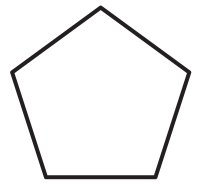
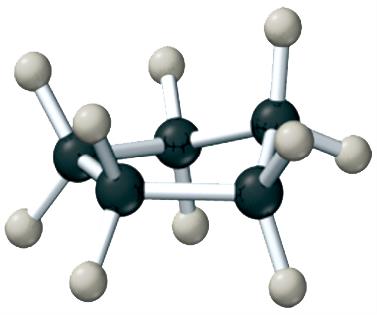
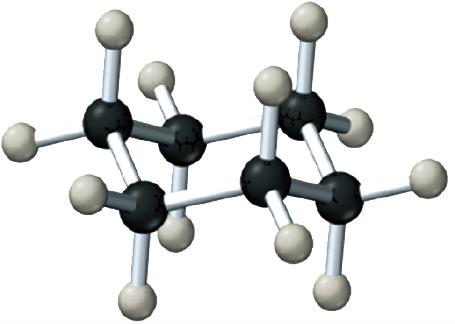
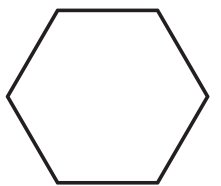
Cycloalkanes are alkanes in which carbon atoms form rings. The names are formed by adding the prefix cyclo- to the alkane name. Rings of five and six carbon atoms are most common in nature.
| |||
Name | Molecular Formula | Ball-and-Stick Model | Skeletal Structure |
|---|---|---|---|
Cyclopropane | C3H6 |
| |
Cyclobutane | C4H8 |
|
|
Cyclopentane | C5H10 |
|
|
Cyclohexane | C6H12 |
|
|




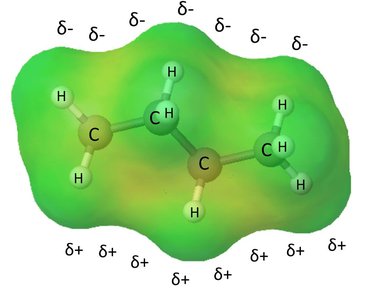
Alkanes are Nonpolar
The electronegativities of carbon and hydrogen are very similar, so the covalent bonds between them are nonpolar. This means electrons are shared equally, and alkanes do not mix well with polar substances like water.
Summary
The mole is a counting unit essential for relating microscopic and macroscopic quantities in chemistry.
Organic compounds are carbon-based and form the foundation of biological molecules.
Alkanes are saturated hydrocarbons with only single bonds; cycloalkanes are ring structures.
Structural representations (molecular, condensed, Lewis, skeletal) provide different levels of detail for organic molecules.
Alkanes are nonpolar due to similar electronegativities of carbon and hydrogen.
Additional info: Some images and examples were inferred for clarity and completeness. The notes cover foundational chemistry and organic chemistry concepts relevant to General Biology.
