 Indietro
Movement of Molecules Across Biological Membranes: Diffusion, Osmosis, and Tonicity
Guida di studio - Note intelligenti
 Appunti personalizzati basati sui tuoi materiali, ampliati con definizioni chiave, esempi e contesto.
How Molecules Move Across Membranes
Introduction to Membrane Transport
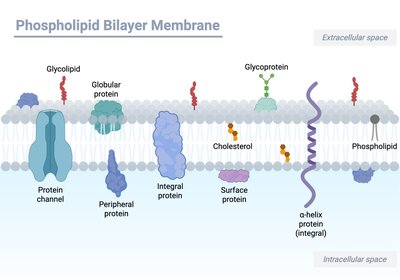
Biological membranes are essential for maintaining cellular homeostasis by regulating the movement of molecules between the cell's internal and external environments. The plasma membrane is selectively permeable, allowing certain substances to pass while restricting others.
External environment: The water solution surrounding cells contains nutrients, wastes, gases, salts, and other substances.
Plasma membrane: Controls what enters and leaves the cell, maintaining internal conditions.
Types of Molecules in Solution
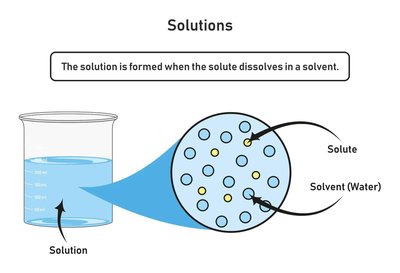
Cells interact with a variety of solutes and solvents in their environment.
Solutes: Ions (Mg2+, Ca2+, K+, Na+, H+), molecules (glucose, sucrose, amino acids, lipids, steroids, vitamins), metabolic products (urea, lactic acid), dissolved gases (O2, CO2).
Solvent: Water is the primary solvent in biological systems.
Passive Transport Across Membranes
Definition and Types of Passive Transport
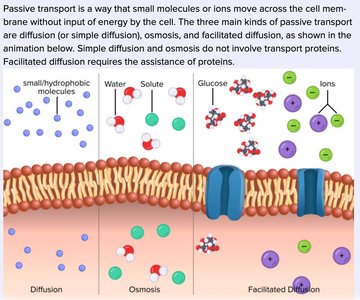
Passive transport is the movement of molecules across membranes without the expenditure of cellular energy (ATP).
Diffusion: Movement of solutes down their concentration gradient.
Osmosis: Diffusion of water across a selectively permeable membrane.
Facilitated diffusion: Movement of molecules with the help of membrane proteins.
Selective Permeability of the Plasma Membrane
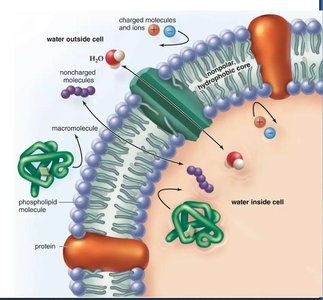
The plasma membrane allows free passage of some molecules while restricting others.
Freely diffusing molecules: Small, nonpolar molecules (e.g., O2, CO2).
Restricted molecules: Large, polar, or charged molecules require transport proteins.
Diffusion
Mechanism and Properties
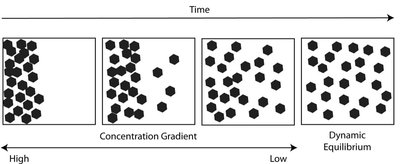
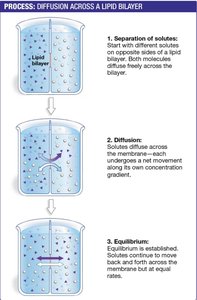
Diffusion is the net movement of solute molecules from an area of higher concentration to an area of lower concentration, driven by the concentration gradient.
Spontaneous process: Does not require energy input.
Dynamic equilibrium: At equilibrium, molecules continue to move but there is no net change in concentration.
Mathematical Representation
The rate of diffusion can be described by Fick's Law:
Where:
J = flux (amount of substance per unit area per unit time)
D = diffusion coefficient
\frac{dC}{dx} = concentration gradient
Osmosis
Definition and Mechanism
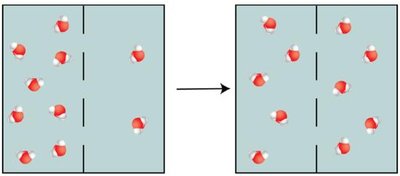
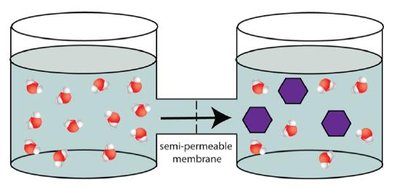
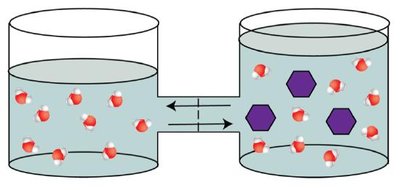
Osmosis is the movement of water across a selectively permeable membrane from an area of higher water concentration (lower solute concentration) to an area of lower water concentration (higher solute concentration).
Occurs only when: The membrane is permeable to water but not to solute.
Results in: Changes in volume on either side of the membrane.
Tonicity: Hypertonic, Isotonic, and Hypotonic Solutions
Definitions and Effects on Cells
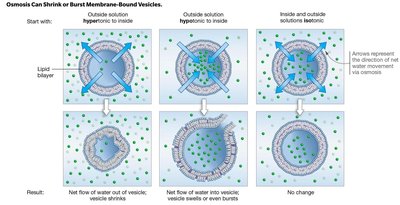
Tonicity describes the effect of a solution on the movement of water into or out of a cell.
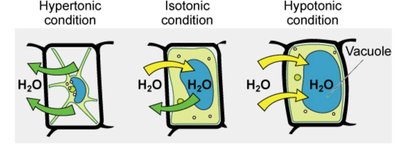
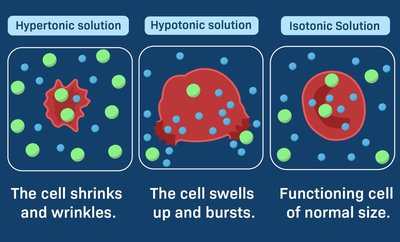
Hypertonic: Higher solute concentration outside the cell; cell loses water and shrinks.
Isotonic: Equal solute concentration inside and outside; cell retains its shape.
Hypotonic: Lower solute concentration outside; cell gains water and expands.

Type of Solution | Concentration of Solute | Concentration of Water | Effect on Cell |
|---|---|---|---|
Hypertonic | Higher outside of cell | Lower outside of cell | Cell loses water, shrinks |
Isotonic | Same inside and outside | Same inside and outside | Cell loses and gains water, retains shape |
Hypotonic | Lower outside of cell | Higher outside of cell | Cell gains water, expands |
Adaptations to Tonicity
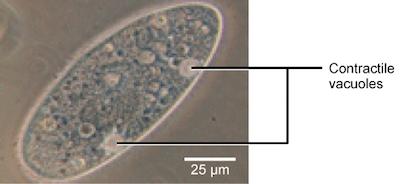
Contractile Vacuoles in Protists
Organisms without rigid cell walls, such as paramecia and amoebas, use specialized structures called contractile vacuoles to manage water balance in hypotonic environments.
Contractile vacuole: Collects excess water and pumps it out to prevent cell lysis.
Summary
Biological membranes regulate the movement of molecules to maintain cellular homeostasis.
Passive transport includes diffusion, osmosis, and facilitated diffusion, all driven by concentration gradients.
Tonicity affects cell volume and shape, with adaptations such as contractile vacuoles helping cells survive in challenging environments.
Additional info: Facilitated diffusion is a form of passive transport that requires membrane proteins but does not require energy. Plant cells are protected from bursting in hypotonic solutions by their rigid cell walls, while animal cells are more vulnerable to osmotic changes.
