 Indietro
Neuronal Signaling: Structure, Function, and Mechanisms
Guida di studio - Note intelligenti
 Appunti personalizzati basati sui tuoi materiali, ampliati con definizioni chiave, esempi e contesto.
Neuronal Signaling
Introduction to Neuronal Signaling
Neuronal signaling is the process by which neurons communicate information throughout the nervous system. This process underlies all higher-order brain functions, including consciousness, learning, and memory. Neurons transmit information as electrical signals, which are rapidly conducted from one part of the cell to another and relayed to other cells.
Principles of Electrical Signaling
Types of Nervous Systems
Nerve Net: A diffuse arrangement of cells, found in simple animals like cnidarians and ctenophores.
Central Nervous System (CNS): A system with large numbers of neurons aggregated into clusters called ganglia, found in more complex animals.
The CNS Integrates Sensory Information
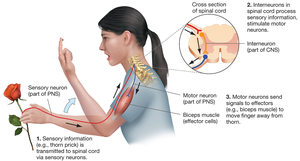
The CNS receives sensory input, processes it, and sends signals to effector cells (such as muscles) to produce a response. This integration is essential for coordinated movement and behavior.
The Anatomy of a Neuron
Neuron Structure
Cell Body (Soma): Contains the nucleus and organelles.
Dendrites: Highly branched projections that receive signals from other neurons.
Axon: Long projection that transmits signals to other neurons or effector cells.
Information flows from dendrites to the cell body, then along the axon to the next cell.
Membrane Potentials and Resting Potential
Membrane Potential
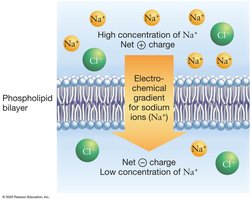
The membrane potential is the electrical potential difference across the plasma membrane, resulting from unequal distribution of ions. It is measured in millivolts (mV), with the outside defined as 0 mV. Typically, the inside of a neuron is more negative than the outside.
Electrochemical Gradients
Ions move across membranes in response to both concentration and electrical gradients, collectively called the electrochemical gradient.
Resting Membrane Potential
The resting potential is the membrane potential of a neuron not actively sending a signal. It is typically around -65 mV. This potential is maintained by differences in ion concentrations and selective permeability of the membrane.
Role of the Na+/K+ ATPase Pump
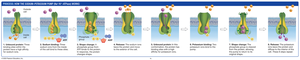
The Na+/K+ ATPase pump actively transports 3 Na+ ions out of the cell and 2 K+ ions into the cell, using ATP. This creates and maintains the concentration gradients of Na+ and K+ across the membrane, which are essential for the resting potential.
K+ Leak Channels and Equilibrium Potential
K+ leak channels allow potassium ions to diffuse out of the cell, making the inside more negative. The equilibrium potential for K+ is reached when the electrical and concentration gradients are balanced.
Measuring Membrane Potentials
Electrode Techniques
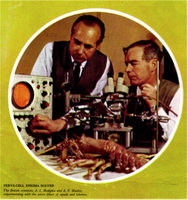
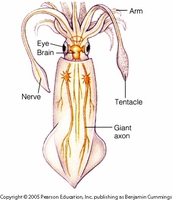
Researchers use glass microelectrodes to measure membrane potentials. The giant axon of the squid was instrumental in early studies due to its large size, allowing for easier manipulation and measurement.
Action Potentials
Phases of the Action Potential
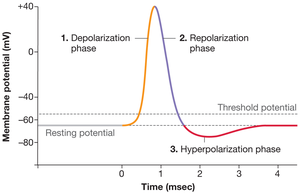
An action potential is a rapid, temporary change in membrane potential with three phases:
Depolarization: Membrane potential becomes less negative (toward +40 mV).
Repolarization: Membrane potential returns toward resting value.
Hyperpolarization: Membrane potential becomes more negative than resting potential.
All-or-None Principle
Action potentials are all-or-none events: they either occur fully or not at all. Their magnitude and duration are consistent for a given neuron.
Ion Currents During Action Potential
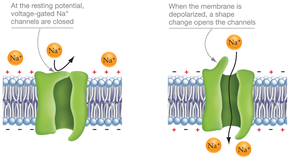
Depolarization: Caused by rapid influx of Na+ through voltage-gated channels.
Repolarization: Caused by efflux of K+ as K+ channels open.
Voltage-Gated Ion Channels
Voltage-gated channels open or close in response to changes in membrane potential. Na+ channels open quickly during depolarization, while K+ channels open with a delay.
Patch Clamping
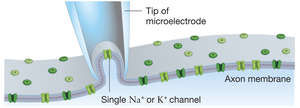
Patch clamping is a technique that allows the study of single ion channels. It confirmed that voltage-gated channels are either open or closed, and their behavior is critical for action potential generation.
Propagation of Action Potentials
Action potentials propagate along the axon as a wave of depolarization. The influx of Na+ at one segment depolarizes adjacent segments, triggering new action potentials downstream. The refractory period ensures unidirectional propagation.
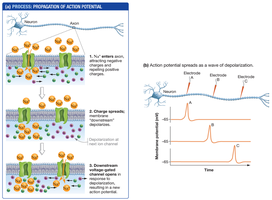
Myelination and Signal Speed
Myelinated axons conduct action potentials much faster due to saltatory conduction, where the action potential jumps between nodes of Ranvier. Large-diameter axons also increase conduction speed.
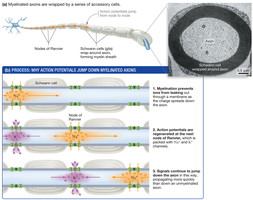
Synaptic Transmission
Structure of the Synapse
Neurons communicate at synapses, where the presynaptic neuron releases neurotransmitters into the synaptic cleft. These chemicals bind to receptors on the postsynaptic cell, altering its membrane potential.
Presynaptic neuron: Contains synaptic vesicles with neurotransmitters.
Postsynaptic cell: Receives the signal via neurotransmitter receptors.
Neurotransmitter Release
When an action potential reaches the axon terminal, voltage-gated Ca2+ channels open, causing synaptic vesicles to fuse with the membrane and release neurotransmitters by exocytosis.
Postsynaptic Potentials
Excitatory Postsynaptic Potentials (EPSPs): Depolarize the postsynaptic membrane, increasing the likelihood of an action potential.
Inhibitory Postsynaptic Potentials (IPSPs): Hyperpolarize the membrane, decreasing the likelihood of an action potential.
EPSPs and IPSPs are graded and can summate spatially and temporally. If the sum at the axon hillock reaches threshold, an action potential is triggered.
Termination of Signal
Neurotransmitter action ends when they unbind from receptors and are degraded, diffuse away, or are taken back up by the presynaptic cell.
Summary Table: Key Ion Channels and Their Roles
Channel Type | Stimulus for Opening | Main Ion(s) Conducted | Role in Neuronal Signaling |
|---|---|---|---|
Na+/K+ ATPase | ATP hydrolysis | Na+ (out), K+ (in) | Maintains resting potential |
K+ Leak Channel | Concentration gradient | K+ | Sets resting potential |
Voltage-Gated Na+ Channel | Depolarization | Na+ | Initiates action potential |
Voltage-Gated K+ Channel | Depolarization (delayed) | K+ | Repolarizes membrane |
Ligand-Gated Ion Channel | Neurotransmitter binding | Na+, K+, Cl- | Postsynaptic potentials |
Key Equations
Nernst Equation (for equilibrium potential of an ion):
Resting Membrane Potential (Goldman-Hodgkin-Katz equation):
Additional info: This guide covers the core concepts of neuronal signaling, including the structure and function of neurons, the mechanisms underlying membrane potentials and action potentials, and the process of synaptic transmission. These topics are foundational for understanding animal nervous systems and are directly relevant to General Biology at the college level.
